Nvidia Stock Forecast: Morningstar Analysts Call NVDA Highly Undervalued at $200
Key Takeaways
- •Morningstar maintains a $280 fair value estimate for Nvidia, well above the current trading price near $200, citing GPU market dominance and the CUDA software platform as key competitive advantages.
- •Analyst price targets vary widely from $270 to $425, reflecting ongoing debate about how long Nvidia's growth rates can be sustained before competitive pressures intensify.
- •Nvidia's forward PEG ratio of 0.050 and first-quarter revenue growth exceeding 80% with approximately 60% profit margins suggest the stock may be undervalued relative to its earnings trajectory.
- •Wall Street consensus projects full-year revenue of $393 billion, an 82% increase, with revenue potentially climbing to $560 billion the following year driven by next-generation data center platforms.
- •Nvidia faces competitive headwinds from custom AI chip development by Microsoft, Google, and OpenAI, as well as US export controls that restrict advanced semiconductor sales to China.
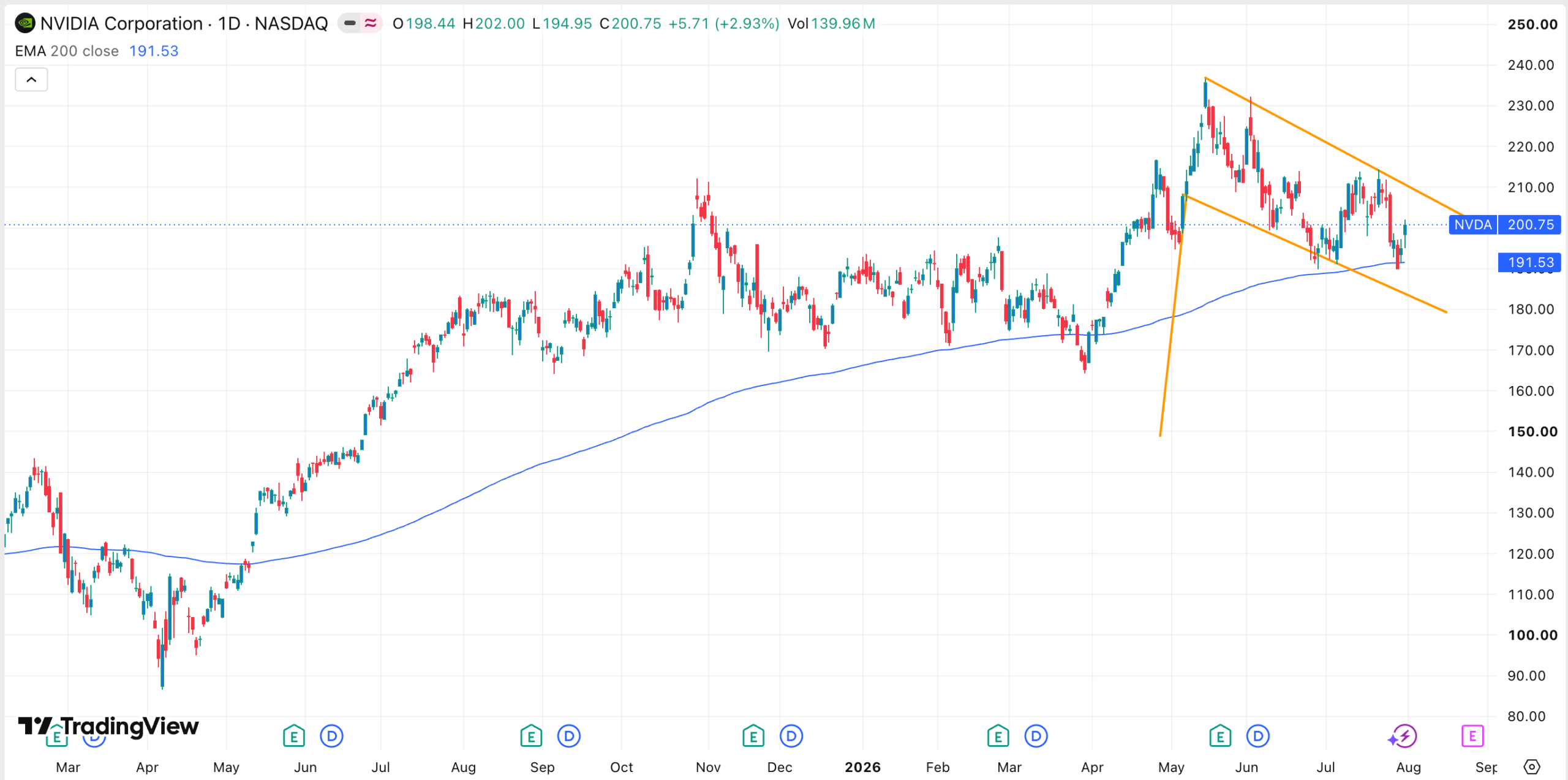
Nvidia (NVDA) shares closed out the month near the psychologically significant $200 level, having recovered more than 5% from their July low. The stock remains 15.2% below its year-to-date high, but a growing chorus of analysts argues that the current price significantly understates the company's fundamental value.
Morningstar Maintains Bullish Stance
In a recent research note, analysts at Morningstar reaffirmed their position that Nvidia is a highly undervalued stock with substantial upside remaining. Morningstar's fair value estimate for the company stands at $280, well above the current trading price near $200.
The analysts cited Nvidia's dominant market share in the GPU industry and the strategic importance of its CUDA software platform as key justifications for their assessment. CUDA enables companies to adapt standard GPUs for data center applications, creating a competitive moat that Morningstar believes is underappreciated by the market. The platform's ecosystem of developer tools and libraries has become a foundational layer for AI workloads, making it difficult for customers to migrate to alternative hardware even when competing chips offer comparable raw performance.
The analysts also pointed to sustained capital expenditure from hyperscalers as a supportive factor. Google has announced plans to spend over $205 billion on capital expenditure, while Microsoft, Meta Platforms (META), and Amazon (AMZN) have each committed to billions in additional spending on AI infrastructure. This spending cycle is widely viewed as a multi-year buildout tied to the competitive race among large technology firms to deploy generative AI at scale, with GPU-accelerated computing serving as the backbone for both model training and inference.
Diverging Analyst Targets
Several other firms share Morningstar's optimistic outlook, though price targets vary considerably:
- KeyCorp: $330
- China Renaissance: $319
- Needham: $270
- DA Davidson: $330
- Tigress: $425
A discounted free cash flow (DCF) analysis conducted by Simply Wall St yields a fair value of $236, also above the current price. The spread between the most conservative ($270) and most aggressive ($425) targets reflects ongoing debate over how long Nvidia's growth rates can be sustained before competitors erode its market position.
Valuation Metrics Suggest Discount
Nvidia's valuation multiples indicate the stock may be trading at a relative bargain. Its forward price-to-earnings ratio on a non-GAAP basis stands at 22, slightly below the technology sector median of 23. On a GAAP basis, the forward PE is 21, while the forward PEG ratio is just 0.050.
These metrics appear modest given the company's recent financial performance. Nvidia's latest earnings report showed first-quarter revenue growth exceeding 80%, with profit margins of approximately 60%. A PEG ratio well below 1 typically signals that a stock's earnings growth is not fully reflected in its price, though the metric is sensitive to the accuracy of forward growth assumptions.
Growth Expectations Remain Elevated
Wall Street analysts project continued strong growth. The consensus estimate for second-quarter revenue is $91.8 billion, representing a 96.4% year-over-year increase. For the full year, analysts expect annual revenue to reach $393 billion, a rise of 82%. Revenue is then projected to climb to $560 billion the following year.
Nvidia has historically exceeded analyst expectations, suggesting the actual 2027 figure could surpass $600 billion. Investors are closely watching the ramp of Nvidia's next-generation data center platforms, which the company has positioned as a significant performance leap over its current lineup. Successful adoption of these new architectures is considered a key driver underpinning the revenue projections for the coming years.
Competitive and Regulatory Headwinds Persist
Despite the bullish outlook, Nvidia faces notable challenges. Competition in the GPU sector is intensifying as Microsoft (MSFT), Google (GOOGL), and OpenAI develop their own custom AI chips. These in-house efforts aim to reduce dependence on a single supplier and lower the cost of large-scale AI deployment, though Nvidia's software ecosystem remains a significant switching barrier. Additionally, concerns have emerged regarding Nvidia's involvement in circular finance arrangements, which some investors view as a potential risk.
US export controls on advanced semiconductors also remain a factor. Restrictions on selling high-performance chips to China have constrained Nvidia's access to a major market, and any further tightening of these rules could affect revenue from the region. Nvidia has developed modified chip variants to comply with existing regulations, but the regulatory landscape continues to evolve.
Technical Analysis Points to Potential Breakout
On the daily chart, NVDA has formed a descending channel over the past several months. This pattern is consistent with a bullish flag formation, typically viewed as a continuation signal. The stock has also settled at the 200-day Exponential Moving Average (EMA), suggesting the long-term uptrend remains intact.
A bullish breakout could potentially push shares toward the year-to-date high of $236. This scenario would be confirmed if the stock moves above the upper boundary of the descending channel. Conversely, a drop below the lower boundary would invalidate the bullish technical outlook.
Source: The Market Periodical

