Nvidia Stock Falls to Multi-Week Lows as Intel, Alphabet, and Amazon Slide After Earnings
Key Takeaways
- •Nvidia shares have fallen to their lowest level since August 3, leaving them 14.4% below their monthly high after a decline that started on October 6.
- •Intel's revenue grew 21% to $16.5 billion, but a 5% drop in client computing revenue to $8.1 billion and ongoing supply-chain issues sent its stock down 50% from this year's peak to $70.
- •Alphabet plunged more than 10% and Amazon fell 7.30% after both reported slowing core businesses while continuing to expand capital expenditure, with Alphabet spending $205 billion on capex this year.
- •Nvidia's market capitalization has lost roughly $750 billion, eroding the value of its own $19.7 billion shareholding as well as stakes held by BlackRock, Vanguard, and State Street.
- •Technically, NVDA has dropped below the 38.2% Fibonacci retracement, its 50-day EMA, and the Supertrend indicator, with sellers targeting $200 support while a break above $220 would invalidate the bearish outlook.
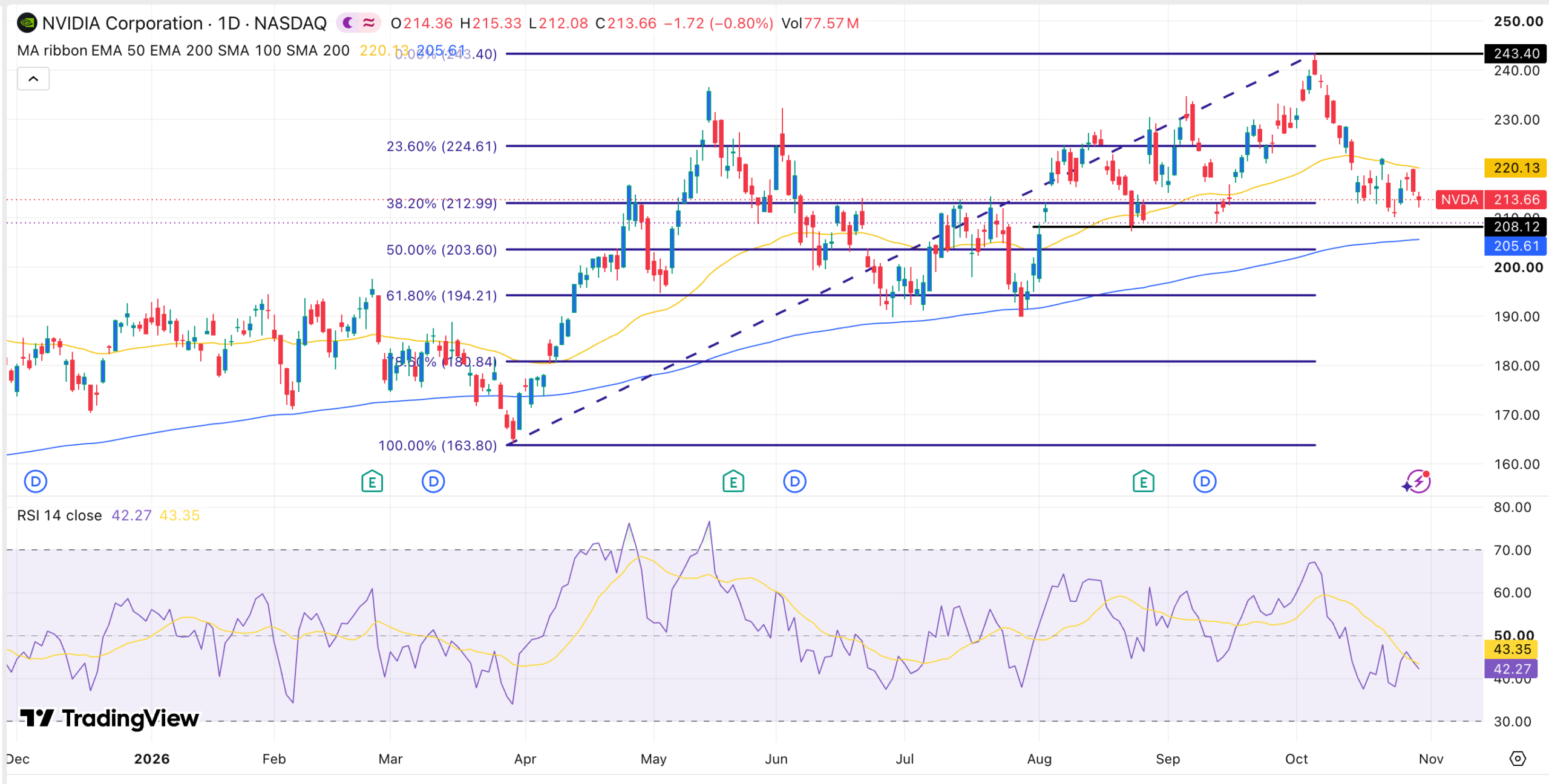
Nvidia (NVDA) shares have extended their decline, slumping to their lowest level since August 3 and standing 14.4% below their highest point this month. The sell-off, which has been underway since October 6, accelerated as concerns about artificial intelligence (AI) intensified, with several companies tied to the AI buildout — including Intel, Alphabet's Google, and Amazon — falling after their latest earnings reports. The reaction reflects Nvidia's central role in the AI economy: as the leading supplier of the accelerators used to train and deploy AI models, the company's fortunes are closely tied to the spending plans of cloud providers and semiconductor peers across the industry.
Intel Shares Continue to Slide After Earnings
Nvidia stock came under additional pressure after Intel published its quarterly earnings report, which showed that revenue continued to grow. Intel's revenue rose 21% to $16.5 billion, while earnings per share climbed to 52 cents.
The challenge, however, was that the company's PC business remained weak during the quarter. Client computing and physical AI revenue dropped 5% to $8.1 billion, and the company also pointed to ongoing supply chain issues.
Following the report, Intel's stock plunged to $70, its lowest level since April 23. The shares are down 50% from their highest level this year, a retreat that has shaved billions of dollars off the company's valuation.
Intel's earnings and the subsequent slide in its stock are significant for Nvidia for two main reasons. First, Nvidia is usually one of the last major technology companies to report each earnings season, so peers' results serve as barometers — including for the kind of supply chain issues Nvidia may face, a theme that has recurred across the semiconductor industry during the AI buildout. Second, Nvidia is the largest holder of its own shares, with a stake worth $19.7 billion. Other major holders include BlackRock, Vanguard, and State Street, which own the stock through their ETFs and mutual funds. As a result, the roughly 20% plunge in Nvidia's shares has continued to erode the value of those holdings.
Alphabet and Amazon Results Deepen the Pressure
Nvidia shares also fell after results from some of its biggest customers, contributing to a $750 billion wipeout in its market capitalization. Alphabet's shares plunged more than 10% on Thursday, their worst day in years, after results showed the core business slowing while capital expenditure continued to grow. Alphabet is spending $205 billion on capex this year, and management expects the figure to keep rising next year.
Amazon, meanwhile, dropped 7.30% in extended trading after publishing its financial results. Those results likewise showed the core business slowing down, even as management continues to spend on capital expenditure and research and development.
These results matter to Nvidia because Alphabet and Amazon are among its largest customers. Capital expenditure at hyperscalers flows directly into purchases of AI chips and data-center equipment, making these budgets a key gauge of demand for Nvidia's products. If their shares keep falling, there is a risk that the companies could begin paring back some of their investments in the AI industry.
The next important catalyst for Nvidia shares will be earnings from leading neocloud companies such as CoreWeave, Nebius, and IREN. Neoclouds are specialist providers that rent out GPU capacity for AI workloads, and they have become a notable part of the computing infrastructure built around Nvidia's hardware. Nvidia holds stakes in these businesses, and their results will help determine whether demand for its products remains intact. Nvidia's own quarterly report, which typically arrives at the end of the earnings season for major technology companies, will then offer the most direct read on that demand.
Nvidia Stock Price Technical Analysis
The daily chart shows the NVDA share price has slumped in recent weeks, moving from a high of $243 on October 5 to a low of $208. The stock has dropped below the 38.2% Fibonacci Retracement level and sits under the 50-day Exponential Moving Average (EMA), a trend gauge many traders use to filter short-term noise. It has also fallen below the Supertrend indicator, a sign that bears are in control.
Based on this setup, sellers are targeting the key support level at $200, while a move above the key resistance level at $220 would invalidate the bearish outlook and point to more gains in the near term.
Disclaimer: This article is for informational purposes only and does not constitute financial advice. Equity investments carry market volatility and the potential for capital losses. Investors should conduct independent research before making decisions.
This article is based on reporting originally published by The Market Periodical.

