Nvidia Stock Slides After Hours as Unverified Allegations Involving Jensen Huang Circulate
Key Takeaways
- •Nvidia stock fell about 2% in after-hours trading on Nov. 11 to roughly $170.48 after closing the regular session up 2.92% at $173.73 on volume of about 266.6 million shares.
- •Unverified claims involving CEO Jensen Huang and healthcare vice president Kimberly Powell spread on social media, but the underlying New York Times article could not be independently confirmed.
- •Nvidia's board launched an independent investigation on Nov. 8 into reports of a foreign intelligence effort targeting Huang, stating it had no reason to believe national security or company secrets were compromised.
- •Jensen Huang acknowledged marital infidelity in a separate statement and pledged to cooperate with the board's review, but he did not address the allegations involving Powell.
- •Baird downgraded Nvidia and Morgan Stanley removed the stock from its preferred list citing management uncertainty, ahead of fiscal third-quarter results scheduled for Nov. 17 with guidance of roughly $108 billion in revenue.
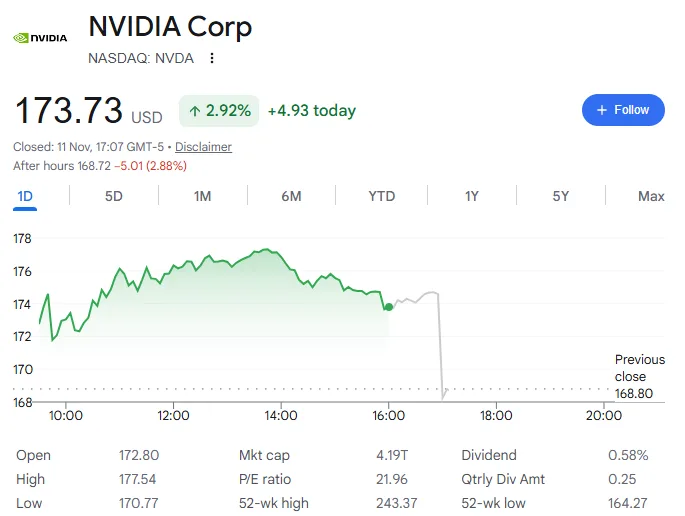
Nvidia shares retreated in extended trading on Nov. 11 after unverified allegations involving chief executive Jensen Huang and healthcare executive Kimberly Powell spread across social media, adding a new layer of leadership uncertainty for a company already contending with a board-level national-security review.
The semiconductor maker's stock had recovered during the regular Nasdaq session before sliding in after-hours action as the claims circulated online. The underlying New York Times article cited by social media accounts could not be independently verified.
After-Hours Slide Follows Regular-Session Rebound
Yahoo Finance recorded a regular-session close of $173.73, up 2.92% from the previous close. Trading volume reached roughly 266.6 million shares, and the intraday range spanned $170.77 to $177.54.
Public's extended-hours data subsequently showed trades between $167.05 and $170.54, with a displayed after-hours quote of $170.48, roughly 2% below the regular-session close, though different market feeds captured different prices throughout the session. The figures confirmed an after-hours retreat but did not independently establish its cause; extended-hours sessions typically carry thinner volume, and quotes from individual venues can diverge until regular trading resumes. Investors had already endured several days of sharp price swings before the new posts appeared.
Allegations Remain Unverified
Kalshi and market commentators on X attributed the allegations involving Huang and Powell to The New York Times. The posts claimed that five former employees described an alleged relationship between the two executives. The original article supporting those specific claims was not independently accessible during verification, and neither the posts nor the share-price movement established the alleged relationship as fact.
Nvidia's official website identifies Powell as vice president of healthcare, with responsibilities spanning artificial intelligence computing platforms, medical imaging, life sciences, and healthcare analytics. The company has said Powell joined Nvidia in 2008 and previously oversaw research and education initiatives. Her corporate position is independently documented; the personal allegations against her remain unconfirmed.
Separate Board Investigation Continues
Nvidia's directors announced an independent investigation on Nov. 8 following reports of a foreign intelligence effort targeting Huang. The board assigned independent directors and outside counsel to examine the available information. In its official statement, the board said directors had no reason to believe national security or company secrets were compromised, expressed confidence in Huang, and noted that he supported the review.
That inquiry followed earlier reporting about Huang's relationship with Alice Huang, formerly an executive at Singapore-based Megaspeed. The Associated Press reported that U.S. intelligence suspected Alice Huang of supplying information to Beijing. China's Foreign Ministry rejected the espionage allegations. The reported intelligence concerns remain allegations, and Nvidia's inquiry has produced no public findings establishing compromised information.
In a separate company statement, Jensen Huang acknowledged marital infidelity and apologized to his family and employees. He also pledged to cooperate with the board's review. His statement did not identify Kimberly Powell or confirm the allegations circulating on Wednesday, a distinction that matters because the acknowledged misconduct and the newer claims rest on different evidentiary records.
Wall Street had already reacted to the leadership question. Reuters reported that Baird downgraded Nvidia and that Morgan Stanley removed the stock from its preferred list, with both firms citing management uncertainty and questions about future data-center demand. Those analyst actions preceded the latest social-media allegations and cannot verify them, but they documented investor concern over leadership continuity and business expectations.
The board has not announced a completion deadline for its review, and Nvidia has offered no public finding linking Powell to the existing national-security inquiry. Investors therefore face unresolved questions rather than established findings regarding the latest claims.
Attention Shifts to Nov. 17 Earnings
Nvidia's second-quarter fiscal 2027 earnings release reported revenue of $96.2 billion, up 106% annually, with data-center revenue reaching $89 billion on demand for artificial intelligence computing equipment. Data-center sales made up more than nine-tenths of that total, which is why the future data-center demand questions cited by Baird and Morgan Stanley bear on the bulk of Nvidia's revenue base. The company projected approximately $108 billion in third-quarter revenue, subject to a 2% range, equivalent to roughly $105.8 billion to $110.2 billion. That forecast excluded China-related data-center computing sales and provides a measurable benchmark for the forthcoming results.
Revenue performance and governance oversight present different risks for shareholders. Strong product demand cannot resolve questions about internal controls, while allegations alone cannot establish declining customer orders. Recent trading data offers reference levels rather than predictions: Yahoo Finance showed a Nov. 10 low of $165.89 and a Nov. 11 high above $177.
Nvidia scheduled its fiscal third-quarter earnings release for Nov. 17, with management's call following that afternoon — the company's next scheduled public update while the board inquiry continues. Investors can weigh the company's updated financial outlook while awaiting any independently verifiable findings from the board.
This article provides market information, not investment advice. Unverified personal allegations should not guide investment decisions.

