Nvidia Stock Eyes Drop to $100 as Anthropic IPO Disappoints and AI Bubble Fears Rise
Key Takeaways
- •Nvidia stock has declined for seven consecutive weeks, reaching its lowest level since May 12 and trading roughly 50% below this year's high.
- •Technical indicators suggest a possible drop to the $100 support level, while a move above $150 resistance would invalidate the bearish outlook.
- •AI bubble fears have triggered declines at AMD, Lumentum, Western Digital, and Marvell as most analysts expect the Federal Reserve to raise rates by 0.25% at its December meeting.
- •Anthropic's sharp fall after its IPO has raised concerns that OpenAI, another Nvidia-backed company, could delay its own listing amid slowing revenue growth.
- •US authorities are investigating whether Nvidia used backdoors to sell chips to China, issues that intensified after Jensen Huang resigned over his relationship with Alice Huang.
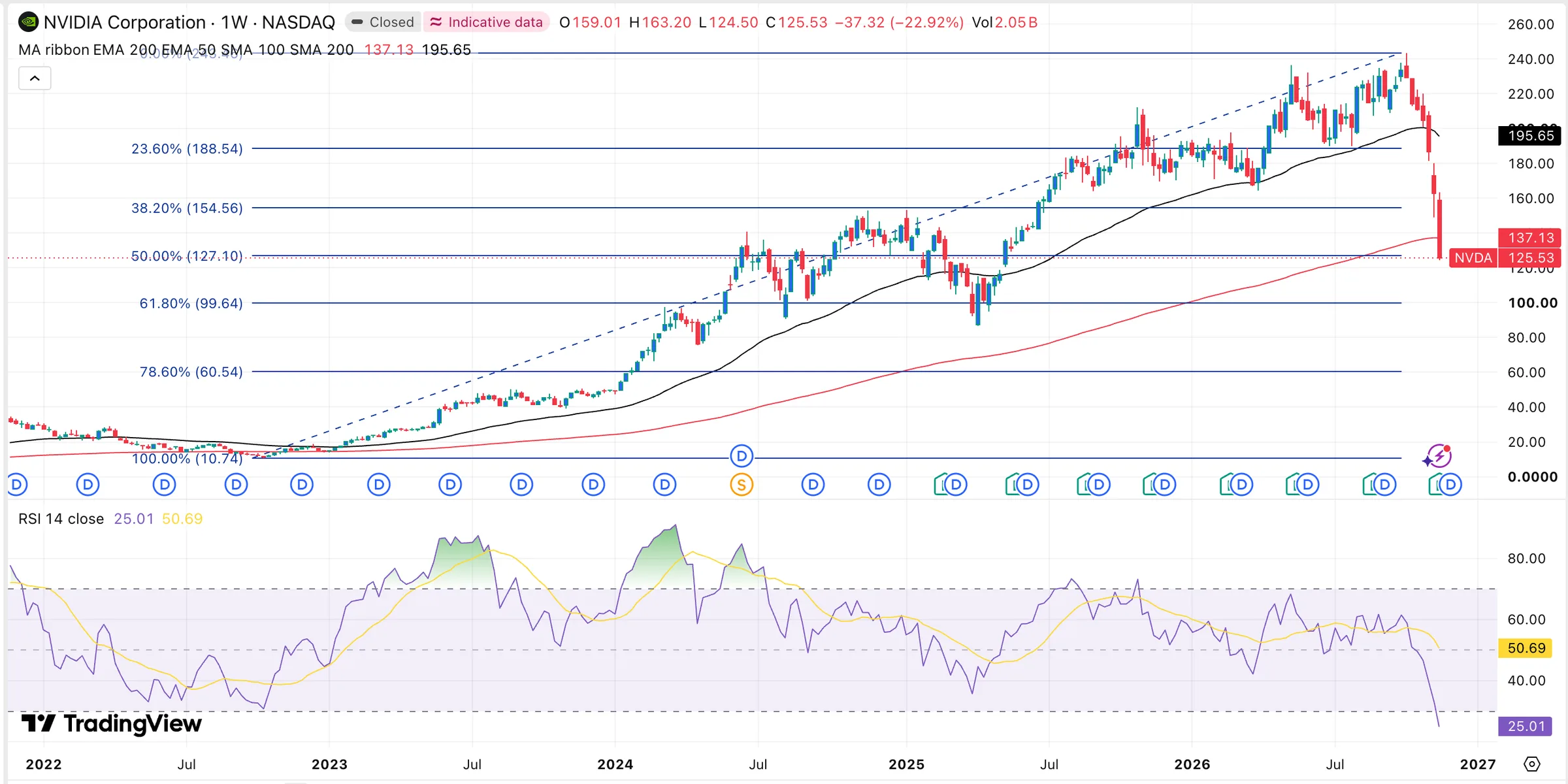
Nvidia stock extended a strong sell-off as investors dumped artificial intelligence (AI) companies in the wake of Anthropic's closely watched initial public offering (IPO). The shares have now declined for seven consecutive weeks, reaching their lowest point since May 12, and sit nearly 50% below this year's high. Technical signals have raised the probability that the stock tumbles to $100, according to a report by The Market Periodical.
Technicals Suggest a Drop to $100
On the weekly chart, NVDA has been in a steep sell-off over the past few weeks. The stock has fallen from $243 to the current $125, a level that coincides with the 50% Fibonacci Retracement level.
Nvidia has also dropped below both the 50-week and 200-week Exponential Moving Averages (EMAs), a sign that bears have prevailed. Meanwhile, the Relative Strength Index (RSI), a momentum gauge in which readings below 30 are traditionally considered oversold, has slid to an extreme reading of 25, while the Average Directional Index (ADX), which measures trend strength, has continued rising.
Taken together, these technicals suggest the stock has more downside in the coming days. Such a drop would take it to the key support level of $100, which coincides with the 61.8% Fibonacci Retracement level. A fall below that price would point to further downside over time. On the flip side, a move above the resistance level of $150 would invalidate the bearish outlook. For readers tracking the setup, the reaction at $100 and any attempt to reclaim $150 are the levels to watch.
AI Bubble Fears Rise Across the Sector
Nvidia's crash has coincided with retreats at other companies, including AMD, Lumentum, Western Digital, and Marvell Technologies, as investors remain concerned about the artificial intelligence industry.
Substantial risks have emerged that the AI bubble is bursting as interest rates rise. Most analysts believe the Federal Reserve will hike rates by 0.25% at its December meeting, and the odds of such a hike have jumped after recent macroeconomic numbers showed that the labor market strengthened while inflation continued falling. Rate expectations matter for AI-linked stocks because much of their value rests on profits projected years into the future, which become harder to justify as borrowing costs climb.
Top analysts have warned about the bursting of the AI bubble, with Ken Griffin and Michael Burry among the loudest voices.
Nvidia would be the most affected company if the AI bubble bursts. It is the biggest provider of the chips that power the industry and, most importantly, the biggest investor in the sector, with stakes in companies such as Anthropic, OpenAI, Marvell, and Nebius. That dual role as both supplier and shareholder is why its share price has become a widely followed gauge of sentiment on AI spending overall.
Anthropic IPO Flops After Debut
Meanwhile, Nvidia stock dropped after Anthropic's recent IPO, in which the company raised billions of dollars. Anthropic's stock initially jumped as investors bought a stake in the biggest AI company, but it then fell sharply as concerns about the AI industry persisted.
Nvidia is a big investor in Anthropic. As a result, there is fear that OpenAI, another company Nvidia has backed, will delay its own IPO. OpenAI's business is also facing major headwinds, with its revenue growth slowing. Because Nvidia holds equity in these companies, their listings and valuations feed directly into the value of its investment portfolio.
Regulatory Scrutiny Over China Ties
All of this is happening as Nvidia faces investigations by US authorities over its Chinese connections. While the company has insisted that it does not sell chips to Chinese clients, American authorities are assessing whether it used backdoors to do so. These issues grew louder after Jensen Huang resigned over his relationship with Alice Huang.
There is fear that the company will be investigated further while authorities seal the loopholes that have allowed it to sell chips to China. The scope of any follow-up probes, and any resulting changes to chip export rules, now sit alongside the Fed's December decision as developments likely to shape the stock's next move.
Fundamentals Remain a Bright Spot
On the positive side, Nvidia reported strong financial results, with revenue jumping to more than $115 billion in the third quarter. Management expects revenue growth to accelerate in the coming months, projecting that revenue will jump to over $725 billion next year, a big increase from the expected $423 billion this year — an implied jump of roughly 70% if achieved. Whether that operating momentum is enough to offset the technical, macro, and regulatory pressures described above is the question investors will be weighing in the weeks ahead.
This article provides general financial information, not investment advice. Stock prices fluctuate, and technical forecasts cannot guarantee future returns. Investors should conduct independent research before making financial decisions.

