Nvidia Stock Falls 9% as Anthropic, OpenAI Revenue Growth Slows
Key Takeaways
- •Nvidia stock fell to $220, roughly 9% below its all-time high of $243, after breaking below a crucial support level amid continued selling of AI shares.
- •OpenAI's annualized revenue has reportedly dropped below $50 billion, a notable decline from the $70 billion figure the company had indicated earlier in the year.
- •Anthropic's revenue grew nearly 50% last quarter to $16.8 billion and is profitable on an adjusted basis, but fell short of the $74 billion annualized figure analysts had projected through September.
- •Nvidia faces exposure through its major investment in Anthropic, which targets a $2 trillion valuation at its IPO, and through Anthropic's status as one of its largest chip customers.
- •Gartner warns that over $3.5 trillion of AI infrastructure spending, including by companies such as Nebius, CoreWeave, and IREN, could be exposed to impairment charges by the end of 2030.
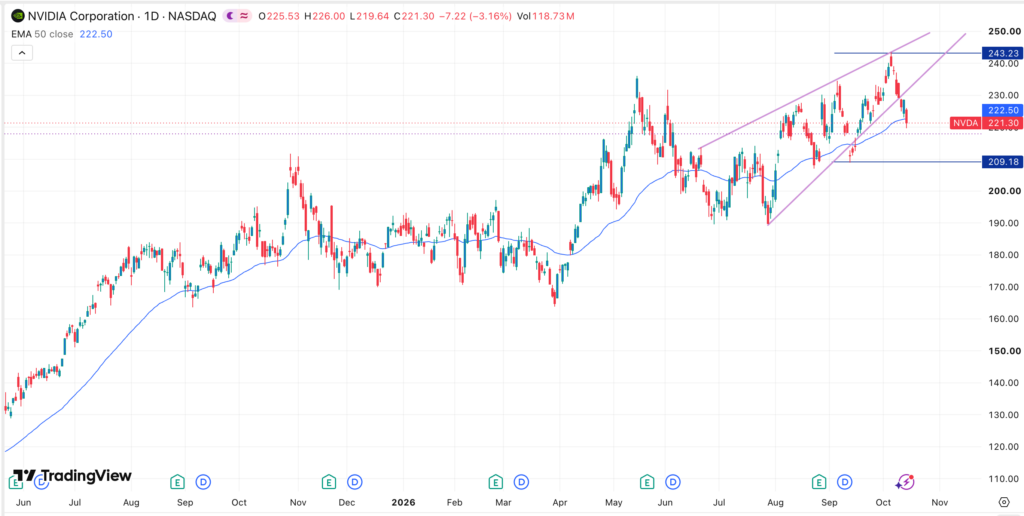
Nvidia stock dropped below a crucial support level this week, sliding to $220 as investors continued selling artificial intelligence shares. NVDA has dived over the past few weeks, moving from an all-time high of $243, and the decline leaves the chipmaker roughly 9% below that peak. Adding to the pressure are signs that revenue growth at leading AI developers Anthropic and OpenAI is slowing.
The reaction reflects Nvidia's position at the center of the AI buildout: it is the leading supplier of the processors used to train and run large AI models, which is why demand signals from the biggest model developers tend to feed directly into expectations for its data-center business.
The retreat may have further to run: the shares have formed a rising wedge pattern on the daily chart, a setup that often precedes continued downside.
Anthropic and OpenAI Revenue Growth Has Slowed
There are growing signs that the artificial intelligence (AI) industry is slowing this year. A recent report showed that OpenAI's annualized revenue — a measure of run-rate sales over a full year — was below $50 billion, a notable step down from earlier in the year, when the company had leaked to the media that its revenue had reached $70 billion.
Anthropic has told its investors that revenue rose by nearly 50% in the last quarter, jumping to $16.8 billion, according to a report by the Financial Times, and the company has already turned a profit on an adjusted basis. The growth is substantial, but it came in much lower than analysts expected and slower than the blistering pace Anthropic set earlier in the year. Analysts had projected that its annualized revenue through September would soar to $74 billion.
Signs that its revenue is slowing would send shockwaves through the AI industry, where competition is soaring. Much of that competition is coming from open-weight companies such as Alibaba, DeepSeek, and Moonshot.
Nvidia is exposed to the slowdown for two main reasons. First, it is a big investor in Anthropic, meaning weaker growth could hinder the company's goal of hitting a $2 trillion valuation when it launches its IPO. Second, Anthropic is one of the top spenders on Nvidia's chips.
Gartner Warning on AI Sector
Nvidia's slump comes amid ongoing concerns that the artificial intelligence bubble is about to burst. Ray Dalio has warned that rising interest rates may become the catalyst that causes the bubble to burst, and some top are now paying substantial sums to repay their debts. CoreWeave's bonds, for example, are now commanding a 15% annual return, while Oracle's yields have continued rising as the company faces challenges in its Project Jupiter project. Yields at those levels translate directly into higher borrowing costs for companies financing data-center expansion with debt. A bursting of the AI bubble would have a major impact on Nvidia's business.
Meanwhile, Gartner is warning that some of Nvidia's portfolio companies will need to announce large impairments — accounting charges that write down the value of assets when their expected returns fall short — by the end of 2030, and the research firm has said over $3.5 trillion of AI infrastructure spending could be exposed to impairment by that deadline. The list includes Nebius, CoreWeave, and IREN, which are spending billions of dollars. That deadline gives the impairment debate a concrete timeline, with future disclosures from the named companies serving as the checkpoints to watch.
Nvidia is also facing major competition from some of the biggest companies in the United States. Microsoft has launched the Azure Maia 300, which it believes is performing better than other chips. Google is boosting its TPU output, while Amazon's Trainium is doing relatively well. These in-house chips will not have a big impact on Nvidia's business for now, but they may do so in the future.
Nvidia Stock Technical Analysis
The daily chart helps explain why NVDA has plunged in recent days. The retreat followed the formation of a rising wedge pattern, which is made up of two ascending and converging trendlines; a bearish breakout from such a formation typically occurs as the two lines near convergence.
The stock has now moved below the lower side of the wedge. At the same time, the Relative Strength Index (RSI) and the Moving Average Convergence Divergence (MACD) — two widely followed momentum indicators — have both pointed downwards, a combination that suggests sellers are targeting the key support level of $200, a price zone where traders look for buying interest to slow a decline.
This article is for informational purposes only and does not constitute financial or investment advice.
This article originally appeared on The Market Periodical.

