Nvidia Stock Slips Toward $224 as Microsoft's Maia 300 Chip Puts $212 Level in Focus
Key Takeaways
- •Nvidia shares traded near $224.45 in premarket activity on Tuesday, Oct. 13, extending a retreat from a recent high of $243.37 amid growing caution in the semiconductor sector.
- •Microsoft's Maia 300 chip, which claims about 40% more tokens per megawatt than other GPUs, is not slated for deployment until 2027, while earlier Maia generations enter multigigawatt deployments starting next year.
- •Microsoft is estimated to represent roughly 20% of Nvidia's total sales, and other major clients including OpenAI and Google are also pursuing their own AI chips to reduce reliance on Nvidia.
- •Nvidia's most recent revenue reached $104 billion, with the company projecting about 70% annual revenue growth next year, supported by financing partnerships exceeding $500 billion with firms including Goldman Sachs, Brookfield, and Apollo Global.
- •Technical analysis based on a rising wedge pattern and Murrey Math Levels points to a potential decline toward $212, while any move above the $240 resistance level would invalidate the bearish outlook.
Nvidia (NVDA) shares extended their recent retreat on Tuesday, Oct. 13, with the stock trading near $224.45 in premarket activity, according to Barron's. The cautious shift followed Monday's close at $226.32, which came after the stock had touched a recent high of $243.37.
The premarket weakness reflected growing caution across the semiconductor sector, with sentiment additionally pressured by Microsoft's announcement of its new Maia 300 chip, which targets 40% higher inference efficiency than leading GPU-based systems, and by public comments from Broadcom's chief executive questioning speculative AI investments. Microsoft's move raised questions about future demand for Nvidia's graphics processing units, although the company does not plan to deploy the Maia 300 until 2027, rather than immediately replacing its existing hardware. Against that backdrop, technical scenarios now frame a conditional downside level of $212 for the shares.
Microsoft Milestone Puts Key Client Relationship in Focus
Microsoft has long been one of Nvidia's biggest customers. While exact figures are not publicly known, some estimates suggest the software giant accounts for roughly 20% of Nvidia's total sales — the kind of concentration that helps explain why a single customer announcement was enough to pressure sentiment across the chip sector. Nvidia has benefited from the relationship as Microsoft has continued intensifying its data center rollout, with Microsoft's capital expenditures predicted to exceed $200 billion this year.
There are now signs, however, that Microsoft is seeking to reduce its dependence on Nvidia. The company launched Azure Maia 300, a new chip it hopes will help cut its reliance on Nvidia and AMD. The new chip joins the Maia 100 and Maia 200, which will be part of multigigawatt deployments starting next year.
In a statement, Microsoft said the chips will serve as the primary AI inference system for its products and services. Most notably, the company noted that the chip provides about 40% more tokens per megawatt than other GPUs — a clear swipe at Nvidia, and a metric whose significance grows at the multigigawatt scale Microsoft has outlined for its AI buildout.
If Microsoft scales back its use of Nvidia's chips, Nvidia's revenue growth and margins are likely to slow. The development carries additional weight because other large Nvidia clients are pursuing similar paths. OpenAI has launched its Jalapeno chip, developed in collaboration with Broadcom, and has said that chip is also more powerful than Nvidia's offerings. Google, another major Nvidia customer, has continued to push its TPU and recently partnered with companies including Marvell Technologies and Broadcom to boost production. The pattern is notable because these are the same companies whose spending underpins Nvidia's own growth forecast.
Nvidia Still Thriving Despite Rising Competition
Nvidia's most recent results showed the business thriving despite intensifying competition across the industry. Revenue soared to $104 billion, extending a growth trajectory that began with the AI boom. The company estimates its annual revenue will jump by 70% next year, driven by continued spending from customers such as OpenAI, Microsoft, and Google, albeit at a slower pace.
The company has also crafted a strategy to sustain growth. It has partnered with banks and private equity firms including Goldman Sachs, Brookfield, and Apollo Global to provide financing worth more than $500 billion, extending purchasing power to a broader set of AI buyers at a time when some of its largest cloud clients are developing chips of their own. Just recently, SpaceX announced that it will raise $40 billion to buy these chips.
Nvidia is also entering new markets. It recently launched new chips, which Microsoft says outperform those from Intel and AMD — a business that may do well over time as AI agents grow. The company additionally expects to grow in China, where firms such as ByteDance and Tencent are boosting their performance.
Technical Picture: Rising Wedge and Murrey Math Levels
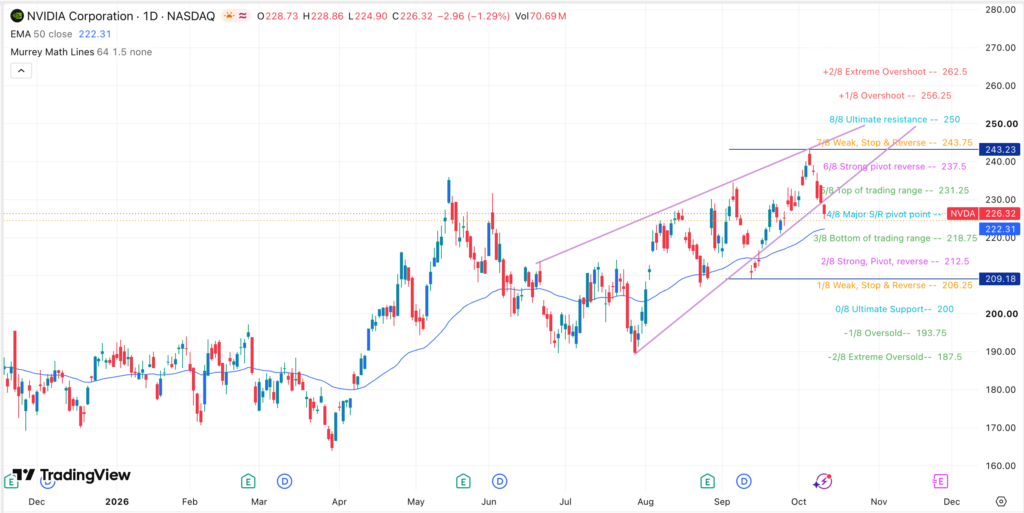
The daily chart shows NVDA in a steep sell-off over the past few days, with the stock moving from a high of $243 down to $223. The retreat came after shares formed a rising wedge pattern, a formation composed of two ascending and converging trendlines. The stock has also dropped below the Major S/R pivot point of the Murrey Math Lines tool.
Based on these signals, the analysis indicates the stock will likely continue falling, potentially reaching the Strong, Pivot, Reverse level of the Murrey Math Lines at $212. Any move above the $240 resistance level would invalidate the bearish outlook. Those two levels now serve as the near-term markers for the setup. On the fundamental side, the timeline is defined: Microsoft's earlier Maia generations enter multigigawatt deployments starting next year, the Maia 300 follows in 2027, and Nvidia has projected 70% revenue growth for the year ahead — leaving the company's upcoming results to show whether the in-house silicon push actually dents demand.
This article is for informational purposes only and does not constitute financial or investment advice.

