Nvidia Stock Stays Below Record High as Director Mark Stevens Sells Nearly 2.9M Shares
Key Takeaways
- •Nvidia director Mark Stevens sold nearly 2.9 million shares in late August and early September, generating roughly $648 million, after selling more than $295 million worth of stock in June.
- •Several senior Nvidia executives, including director Neal Stephen and CFO Kress Colette, reduced their holdings in recent months with no open-market purchases, while CEO Jensen Huang maintains a large position estimated at about $190 billion in net worth.
- •The upcoming Trump-Xi meeting in Washington is seen as the next catalyst for NVDA, as CEO Jensen Huang lobbies the Trump administration to broaden chip shipments to China, where US export controls currently restrict its most advanced chips.
- •Nvidia management forecasts 77% revenue growth next year on a baseline that assumes no revenue from China, meaning any regained market access would add to that outlook.
- •Nvidia holds large stakes in companies preparing to go public, including Anthropic at a sought $2 trillion valuation, OpenAI at a $1.2 trillion valuation, and British firm Nscale at a $33 billion valuation.
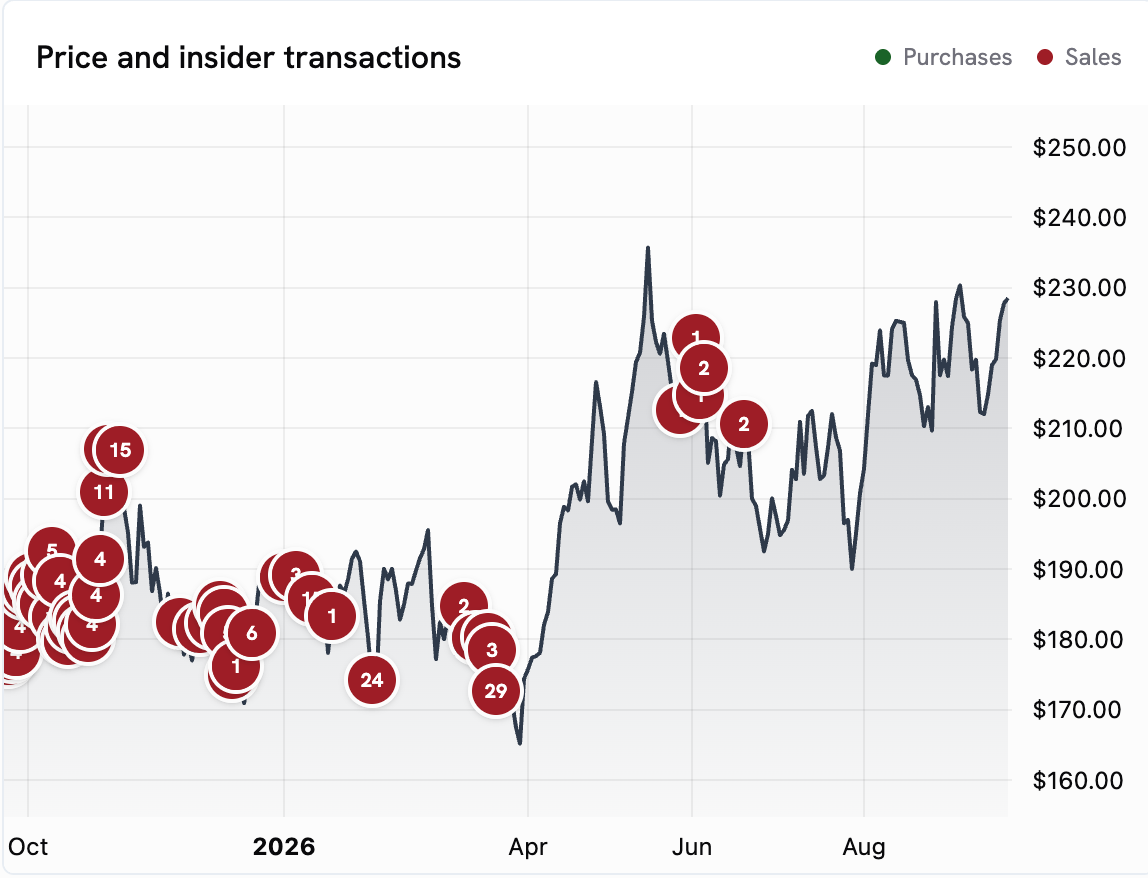
Nvidia (NVDA) shares remained below their record high on Sept. 23 as investors assessed heavy insider selling, the company's exposure to China, and its longer-term artificial intelligence growth outlook. The stock closed Wednesday's session at $225.36, down 1.5% on the day, leaving it roughly 4.7% below its all-time intraday high of $236.54, reached on May 14.
The muted performance comes as regulatory filings reveal that a member of Nvidia's board has continued to sell substantial amounts of stock. Trades by directors and officers are disclosed publicly through those filings, which is precisely what makes them a widely followed data point: they give outside investors a direct look at how the people closest to the company are managing their own holdings.
Director Mark Stevens Sells Nearly 2.9 Million Shares
SEC filings show that Mark Stevens, a director at Nvidia, sold nearly 2.9 million shares during late August and early September. Based on the reported transaction prices, those sales generated roughly $648 million.
The recent disclosures fit an established pattern. Data shows that Stevens recently sold shares worth more than $300 million, after selling more than $295 million worth of stock in June.
Stevens is not alone. Several other senior executives have also reduced their holdings over the past few months, and none of them has bought shares. Neal Stephen, another director, sold shares worth more than $3.3 million in June, while Chief Financial Officer Kress Colette sold stock worth millions of dollars earlier this year. That one-sided activity is the detail many observers focus on, since open-market purchases by insiders are comparatively rare and are often read as a vote of confidence in a company's direction.
Insiders typically sell shares for a range of reasons, including funding major purchases or as part of routine portfolio management. In more concerning cases, they may unload stock when they anticipate a rough patch for the company.
In Nvidia's situation, however, some of its most senior figures continue to hold on to their shares. Chief Executive Jensen Huang maintains a large position in the company and has an estimated net worth of about $190 billion. Shareholders are estimated to hold more than 862 million shares in the company, and most of them are institutional investors, including BlackRock, Vanguard, FMR, State Street, and Geode Capital Management.
Trump-Xi Meeting Emerges as Next Catalyst
Looking ahead, the next important catalyst for NVDA stock is the upcoming meeting between President Donald Trump and Xi Jinping in Washington. The meeting carries particular weight because the two leaders head the world's largest economies, with annual output exceeding $53.2 trillion.
Nvidia is likely to feature in the discussions. Huang has been pushing the Trump administration to allow chip shipments to China, and the company has already begun shipping some of its least advanced chips to Chinese companies, though it wants broader access. The lobbying reflects the constraints Nvidia now operates under in China, where US export controls have kept its most advanced chips out of the market and narrowed what it is permitted to ship.
China, however, has grown skeptical about allowing Nvidia to expand shipments into the country, preferring to boost its local production. Top Chinese companies including Huawei, Cambricon, Kunluxin, Moore Threads, and MetaX have already developed highly advanced chips — a domestic field Nvidia would have to contend with even if it regains broader access.
The report notes that Nvidia has ways to benefit regardless of the outcome of the Trump-Xi summit. Management believes revenue will grow by 77% next year, a growth figure that assumes no revenue from China. That baseline makes export policy a clear variable to watch: any access regained at the summit would add to the stated forecast rather than being required to reach it.
The company is also positioned to benefit from several upcoming IPOs. Anthropic is seeking a $2 trillion valuation, while OpenAI is in the process of raising cash at a $1.2 trillion valuation, and Nvidia holds large stakes in both companies. Nvidia also has a large stake in Nscale, a British company set go public at a $33 billion valuation. Taken together, the positions give Nvidia a financial stake in how several companies it has backed fare as they move from private valuations into public markets.
Mixed Technical Signals Below May Record High
Technical indicators are sending mixed signals about NVDA stock on the daily chart. On the negative side, there are signs that the stock is forming a diamond reversal pattern, a formation that often precedes a strong bearish reversal over time and that classically takes shape after an extended rally.
On the positive side, the stock remains above its 50-day and 100-day Exponential Moving Averages (EMAs), a sign that bulls remain in control for now. Moving averages of this kind are widely used as a quick check on whether a trend remains intact.
At this stage, the analysis indicates the stock may move in either direction. A clear breakout above the upper boundary of the diamond pattern would signal further gains, potentially toward $250. Conversely, a drop below the $220 support level would invalidate the bullish outlook. With those two levels bracketing the current price, the coming sessions offer clearly defined markers for either outcome.
This article is for informational purposes only and does not constitute financial or investment advice. Insider sales and technical patterns do not, by themselves, predict future stock performance.
Source: The Market Periodical — Is Nvidia Stock a Buy as Senior Director Continues His Selling Spree?

