Nvidia Stock Nears Record High as Rosenblatt Raises Target to $390 After $150 Billion Buyback
Key Takeaways
- •Rosenblatt analyst Kevin Cassidy upgraded Nvidia to buy and raised his price target to $390, implying about 70% upside and a potential market capitalization above $9.48 trillion.
- •Nvidia announced a $150 billion buyback program that brings its remaining repurchase authorization to roughly $235 billion, the largest in history, and has helped cut shares outstanding from 25 billion in 2022 to 24.15 billion.
- •Nvidia trades at a forward price-to-earnings ratio of 24, well below its five-year average of 42 and lower than peers including AMD at 80, Marvell at 62, and Lumentum at 44.
- •Nvidia expects its 2027 revenue to grow by more than 70%, and analysts at Piper Sandler, Needham, and Citi have set price targets between $300 and $315.
- •Key risks include custom AI chips from DeepSeek, Huawei, major US technology firms, and Chinese companies, along with AI bubble concerns tied to circular investments and ongoing losses at OpenAI and Anthropic.
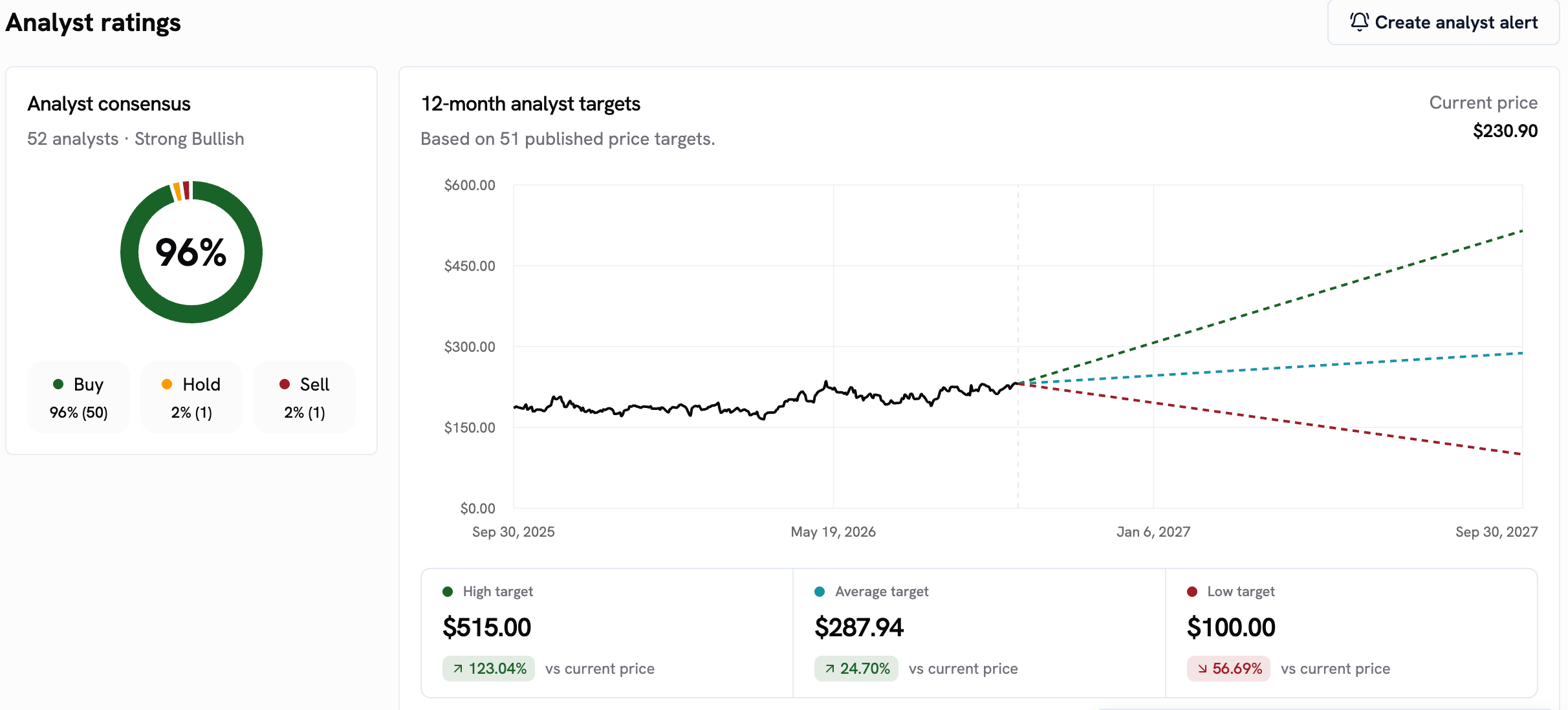
Nvidia stock has continued to climb and is now approaching a pivotal technical level, supported by a string of catalysts including a massive share repurchase program and sustained momentum in the artificial intelligence (AI) boom. NVDA rose to $231, within a few points of its all-time high of $236, with analysts predicting more gains ahead.
Rosenblatt Sees Further Upside
NVDA has jumped 22% from its lowest level in July, and analysts believe the stock has more upside to go. In a report on Tuesday, Rosenblatt analyst Kevin Cassidy upgraded the company's rating to buy and raised his price target to $390. Hitting that target would represent a 70% surge from the current level, a move that would lift Nvidia's market capitalization above $9.48 trillion. With Nvidia already among the most valuable companies in the world, sustained swings in its shares flow directly into the performance of the index funds and portfolios that hold it.
The upgrade came after the company announced a $150 billion buyback program, which brings the remaining repurchase authorization to about $235 billion — the largest buyback program in history. Such authorizations act as a ceiling on repurchase spending and are typically executed over multiple quarters. Nvidia's share repurchases have helped cut the outstanding share count to 24.15 billion from the 2022 high of 25 billion.
Buybacks boost a company's earnings per share by reducing the number of shares in circulation. In Nvidia's case, earnings per share have climbed to $2.4675 from $0.1199 in 2022.
Management likely decided to launch the large repurchase because of the company's cheap valuation. Data shows the stock is a bargain across metrics: its forward price-to-earnings ratio has moved to 24, far below its five-year average of 42.
Nvidia's forward multiple is also lower than those of its peers. AMD, a top competitor, trades at a forward multiple of 80, while Marvell Technology sits at 62 and Lumentum at 44. Other leading companies in the Magnificent 7 carry higher numbers as well.
Growth Expected to Continue Despite Risks
Beyond Rosenatt, other Wall Street analysts have remained highly bullish on the company. Piper Sandler's David O'Connor initiated coverage with a target of $300, Needham's Quinn Bolton has a similar target, and Citi's Atif Malik has set a target of $315.
These analysts have pointed to the company's strong revenue growth, which they expect to accelerate in the near term. In its recent earnings report, the company estimated that its 2027 revenue will jump by more than 70%, exceeding analysts' expectations. Because Nvidia's processors power much of the data center capacity used to train and run AI models, its forecasts are widely read as a gauge of AI demand across the technology industry.
Nvidia still faces major risks, however. DeepSeek has unveiled a chip developed in collaboration with Huawei. Other leading technology companies are also launching their own ASIC chips — application-specific integrated circuits designed for particular workloads rather than general-purpose computing — including Amazon, Google, Microsoft, and Meta Platforms, while Chinese firms such as MetaX, Cambricon, Moore Threads, and Baidu have built their own chips.
Another risk is concern that the artificial intelligence industry is in a bubble. Among the top reasons cited are circular investment arrangements, in which AI companies invest in one another and in their own customers, and the ongoing losses at companies such as OpenAI and Anthropic.
Nvidia Stock Technical Analysis
The weekly chart shows that NVDA stock has been in a bull run for years, though the rally has not moved in a straight line. Instead, the stock has formed several pullbacks, including one between May and July.
The shares have remained above an ascending trendline connecting the lowest swings since April last year and have consistently failed to move below it. The stock has also held above its 50-week moving average, which is providing strong dynamic support.
According to the analysis, a move above the $236 resistance level would signal that bulls have prevailed, leading to further gains, with the stock possibly jumping to $250 and above. Beyond the chart, the pace at which Nvidia puts its record authorization to work — and whether the competitive and sentiment risks above begin to surface in its results — will be key markers to watch in the coming quarters.
This article is based on a report by The Market Periodical (https://themarketperiodical.com/2026/10/01/nvidia-stock-nears-key-level-as-rosenblatt-lifts-target-following-150-billion-buyback/).

