Nvidia Stock Rebounds as Wall Street Analysts Stay Bullish Amid Rising Headwinds
Key Takeaways
- •Nvidia stock rebounded toward $220 after hitting a weekly low of $208.93, closing Sept. 17 at $219.34, up 2.54%.
- •Analyst price targets span from $300 at Piper Sandler and Needham to $515 at Raymond James, reflecting widely differing assessments of sector risks.
- •Fiscal Q2 revenue doubled to $96.2 billion, with Data Center sales up 117% to $89 billion, and the average fiscal 2027 revenue estimate stands near $411.5 billion.
- •Nvidia faces intensifying competition from AMD and Intel, startups such as SambaNova and Etched, and cloud giants Microsoft, Amazon, and Google, which are also among its biggest customers.
- •Technically, NVDA trades above its 50-day EMA, but bearish signals from a rising wedge pattern and the PPO suggest near-term pressure between support at $210 and resistance at $230.
Key Points
- Nvidia stock is rising despite ongoing fears surrounding artificial intelligence.
- Top analysts believe the shares have more upside this year.
- The company is confronting several major risks, including intensifying competition.
Nvidia stock recovered toward $220 on Sept. 18 after falling as low as $208.93 earlier in the week, as Wall Street analysts maintained bullish ratings despite renewed concerns about AI safety, infrastructure spending, and competition. NVDA closed Sept. 17 at $219.34, up 2.54%, and traded near $219-$220 on Friday as investors reassessed the selloff that followed calls from AI industry leaders to slow development.
The rebound matters because Nvidia remains at the center of the global AI infrastructure buildout. Fiscal Q2 revenue doubled to $96.2 billion, and Data Center sales rose 117% to $89 billion. Analysts still expect roughly $411.5 billion in fiscal 2027 revenue, while recent price targets stretch from $300 at Piper Sandler and Needham to $515 at Raymond James.
Analysts Keep Bullish Ratings
Top Wall Street analysts remain highly bullish on NVDA. In a recent note, James Schneider, a top analyst at Goldman Sachs, reiterated his bullish outlook on the company.
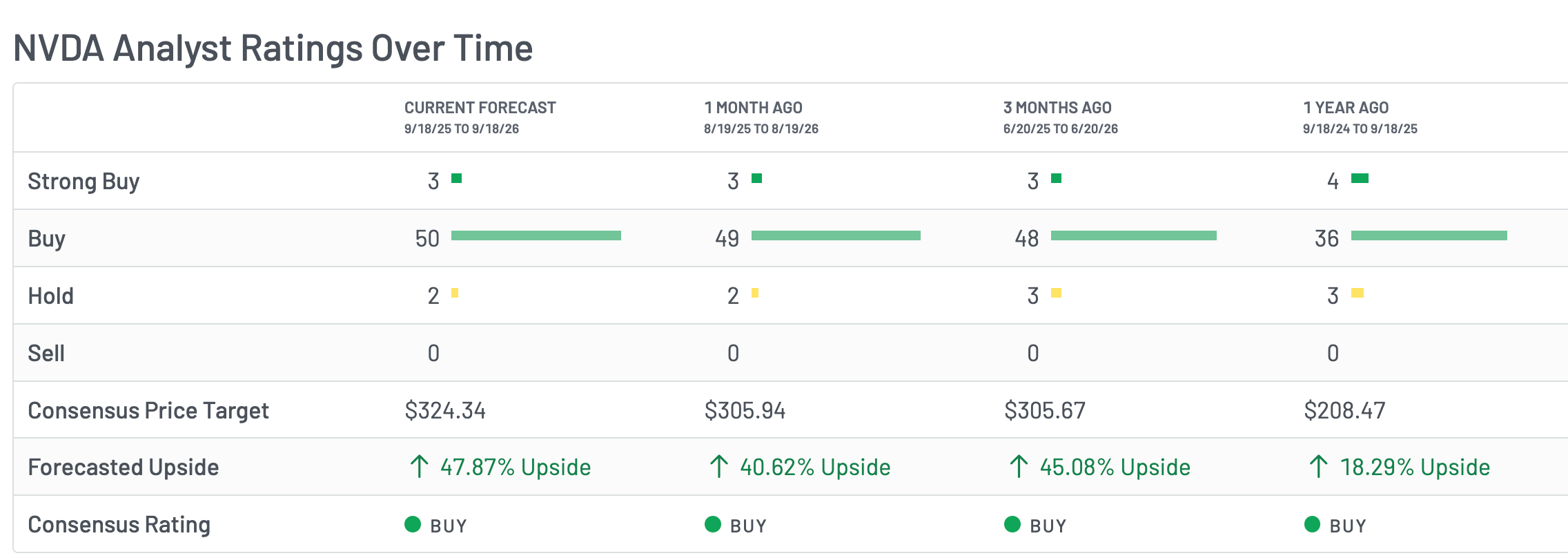
Piper Sandler moved its rating from neutral to overweight and set a $300 price target, about 37% above the current level. Needham holds a buy rating with a $300 target, while Rosenblatt Securities sees the stock rising to $390. Bullish coverage also comes from analysts at Deutsche Bank, China Renaissance, Philip Securities, and Evercore. The most aggressive target belongs to Simon Leopold of Raymond James Financial, who sees the stock at $515 — more than double the current share price. The spread between the lowest and highest targets underscores how differently analysts are weighing the risks now surrounding the sector.
These analysts have maintained their favorable outlook despite mounting headwinds. The most notable is the escalation of AI safety fears this year. Executives and policymakers have voiced concerns about the industry, including the chief executives of SpaceX, Anthropic, and OpenAI, who have warned that the industry needs to slow down to prevent major.
A slowdown could affect Nvidia, given its reach across the AI landscape: the company holds stakes in chipmakers such as Intel, neocloud companies such as Nebius and CoreWeave — providers that rent out AI computing capacity — and optical companies such as Coherent and Lumentum. That footprint means Nvidia's results are tied not only to its own chip sales but to the health of the broader AI ecosystem.
There are also signs of community resistance to data centers. A study released this week found that many Americans are concerned about the industry, and numerous data center projects have been cancelled this year as a result.
Competition Coming From All Areas
Nvidia is rising even as competition intensifies from traditional chipmakers, its own largest clients, and startups.
Established chipmakers AMD and Intel are gaining market share in the GPU industry. Google recently announced that it will use some of Intel's GPUs in its data centers.
Startups challenging Nvidia have raised substantial sums from corporations and venture capitalists. Samsung led an investment round for Euclyd, a Dutch semiconductor company. SambaNova raised $350 million in February at an $11 billion valuation, placing it among the biggest companies in the industry, while Etched raised $300 million at a valuation of more than $10.3 billion.
Nvidia also faces mounting competition from Microsoft, Amazon, and Google — companies that are simultaneously among its biggest customers. That overlap means Nvidia's revenue base and its competitive threats increasingly come from the same small group of cloud giants.
Despite these ongoing challenges, top analysts remain highly bullish. The average revenue estimate stands at $411 billion for this year, and Nvidia has historically beaten estimates, suggesting the actual figure could exceed $425 billion.
Technical Analysis
The daily chart shows NVDA has climbed in recent days even as concerns about the AI industry persist. The stock has moved above its 50-day Exponential Moving Average (EMA), a trend indicator that weights recent prices more heavily.
It has also jumped above the lower boundary of a rising wedge pattern — one of the most bearish formations in technical analysis — and the two lines of the Percentage Price Oscillator (PPO), a momentum indicator, have formed a bearish reversal signal. According to the analysis, the stock could remain under pressure in the near term before an eventual rebound to a record high. The key levels to watch are support at $210 — just below this week's low of $208.93 — and resistance at $230. Those levels frame the range investors will be watching as they weigh the bearish chart signals against this week's recovery.
This article is for informational purposes only and does not constitute financial or investment advice. Analyst price targets, technical indicators, and revenue forecasts do not guarantee future stock performance.

