Nvidia Stock Under Pressure as Polymarket Tool Points to Lower GPU Rental Prices
Key Takeaways
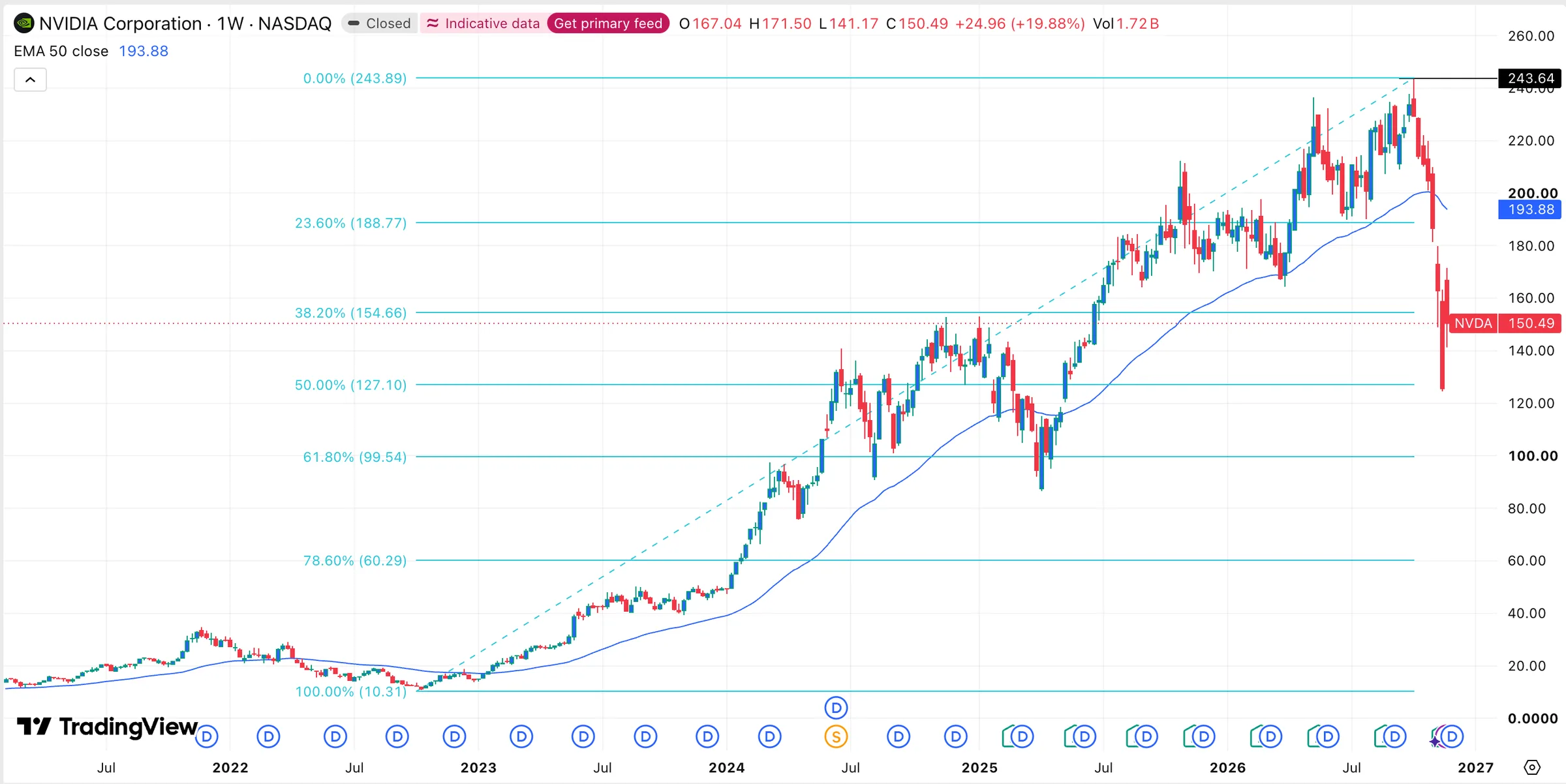
- •Nvidia stock closed at $150.49 on Nov. 27, down from a recent high of $243, and trades below the 50-week exponential moving average with an initial bearish target near the $127 retracement level.
- •Polymarket's compute markets project Nvidia GPU rental rates will keep falling, with the H100 expected to drop from $2.98 to $2.10 per hour and B200 rates to fall from $9.57 to $5.51.
- •US authorities are considering additional export restrictions on Nvidia chip sales to China, a market estimated to represent roughly 20% of the company's revenue and restricted since 2022.
- •Bloomberg reported that Blackwell chips were found in a Beijing data center with ties to Alice Huang, suggesting China's access to Nvidia's most advanced chips has been higher than expected.
- •CEO Jensen Huang will testify before Congress next week, and analysts' fourth-quarter revenue estimate of $130.8 billion, implying $423 billion for the full year, is likely to be revised lower.
Nvidia stock has dropped substantially over the past few weeks, and it surrendered part of its weekly gains as concerns surrounding chip exports persisted. Meanwhile, compute markets on Polymarket pointed toward lower graphics processing unit (GPU) rental prices through 2028.
Stock Analysis data showed that Nvidia (NVDA) closed at $150.49 on Friday, Nov. 27, at 1 p.m. EST. The shares gained 0.80% during the session but remained below Monday's closing price of $165.05.
Polymarket Tool Projects Further Drop in GPU Rental Rates
Polymarket, the popular prediction platform, has launched a new tool designed to map the future prices of Nvidia GPUs. The tool could become an important part of the AI industry, as companies are expected to use it in contract negotiations. Because the figures come from a prediction market, they reflect where traders are positioning rather than an official company or analyst forecast.
Data published on the website shows that GPU rental rates for Nvidia's AI chips will continue falling in the coming years as capacity increases. The price per hour of the basic H100 chip is expected to drop from the current $2.98 to $2.10 over the next two years. Most AI developers rent access to GPUs by the hour instead of buying the hardware outright, which makes these rates a direct input into the cost of training and running AI models.
The same trend is playing out on Nvidia's most advanced chips, including Blackwell and Rubin. B200 chips are going for $9.57 per hour, a rate that is projected to fall to $5.51, while B300 chips are going for $10.85, a figure that is expected to drop to $8.73, according to Polymarket's compute markets.
A drop in GPU rental prices is a sign that market participants expect supply to continue rising while demand stabilizes.
US Weighs Stricter Rules on Nvidia's Sales to China
A potential cause of these supply and demand dynamics is that US authorities are considering imposing more rules to prevent chip sales in China. While the numbers are not yet clear, chip sales to China are estimated to account for roughly 20% of Nvidia's massive revenue. Washington has restricted exports of Nvidia's most advanced chips to China since 2022 and has repeatedly tightened the rules as workarounds emerged.
There are signs that China's access to Nvidia's most advanced chips has been higher than expected. In a report published on Friday, Bloomberg said that Blackwell chips were found in a data center in Beijing with ties to Alice Huang.
Nvidia has also taken remedial measures to prevent its chips from reaching Southeast Asia. In the past, Chinese AI companies such as Alibaba, ByteDance, and Tencent accessed these chips by using data centers in countries like Malaysia and Singapore.
The implication of these developments is that Nvidia will likely lower its revenue estimates for the fourth quarter and for next year. Yahoo Finance data shows that analysts predict fourth-quarter revenue of $130.8 billion, up 92% from a year earlier. Such a number would bring full-year revenue to $423 billion. Nvidia has guided that its 2027 revenue will be 70% above its 2026 figure, and there is a likelihood that this estimate will be revised lower.
Looking ahead, next week will be important for Nvidia stock because CEO Jensen Huang will testify before Congress. He will likely answer questions on whether he knew that Alice Huang was a spy and whether he knew of the shipments to China. Any formal announcement of new export rules would also be closely followed, since it would clarify how much of the company's revenue tied to China could be affected.
Nvidia Stock Price Forecast: Technical Analysis
The weekly chart shows that NVDA stock has been in a strong sell-off over the past few months. It has fallen from a high of $243 to around $150, and a closer look shows that it is trading slightly below the 38.2% Fibonacci retracement level. Retracement levels and long-term moving averages are among the tools traders use to gauge potential support and resistance zones.
Nvidia stock has also plunged below the 50-week exponential moving average (EMA) and has continued forming a series of lower lows. As a result, the path of least resistance for the stock is bearish, with the initial downside target at the 50% retracement level near $127.
This article provides market analysis for informational purposes only and does not constitute financial advice.
This article was originally published on The Market Periodical on Nov. 28, 2026.

