Nvidia Stock Forecast: Shares Hit Lowest Level Since April as AI-Fueled Tech Sell-Off Intensifies
Key Takeaways
- •Nvidia's stock dropped to its lowest point since April 9, leaving it more than 25% below this year's high and firmly in bear market territory.
- •The sell-off coincided with a sweeping Democratic victory in the US midterm elections and growing public opposition to data centers over their impact on electricity bills.
- •In Ohio, 14 municipalities approved bans or restrictions on data center development, including one affecting a $2 billion Amazon project.
- •Nvidia has announced a large share buyback at depressed valuations and projects 70% revenue growth, with third-quarter revenue forecast at $108.9 billion, up 91% from a year earlier.
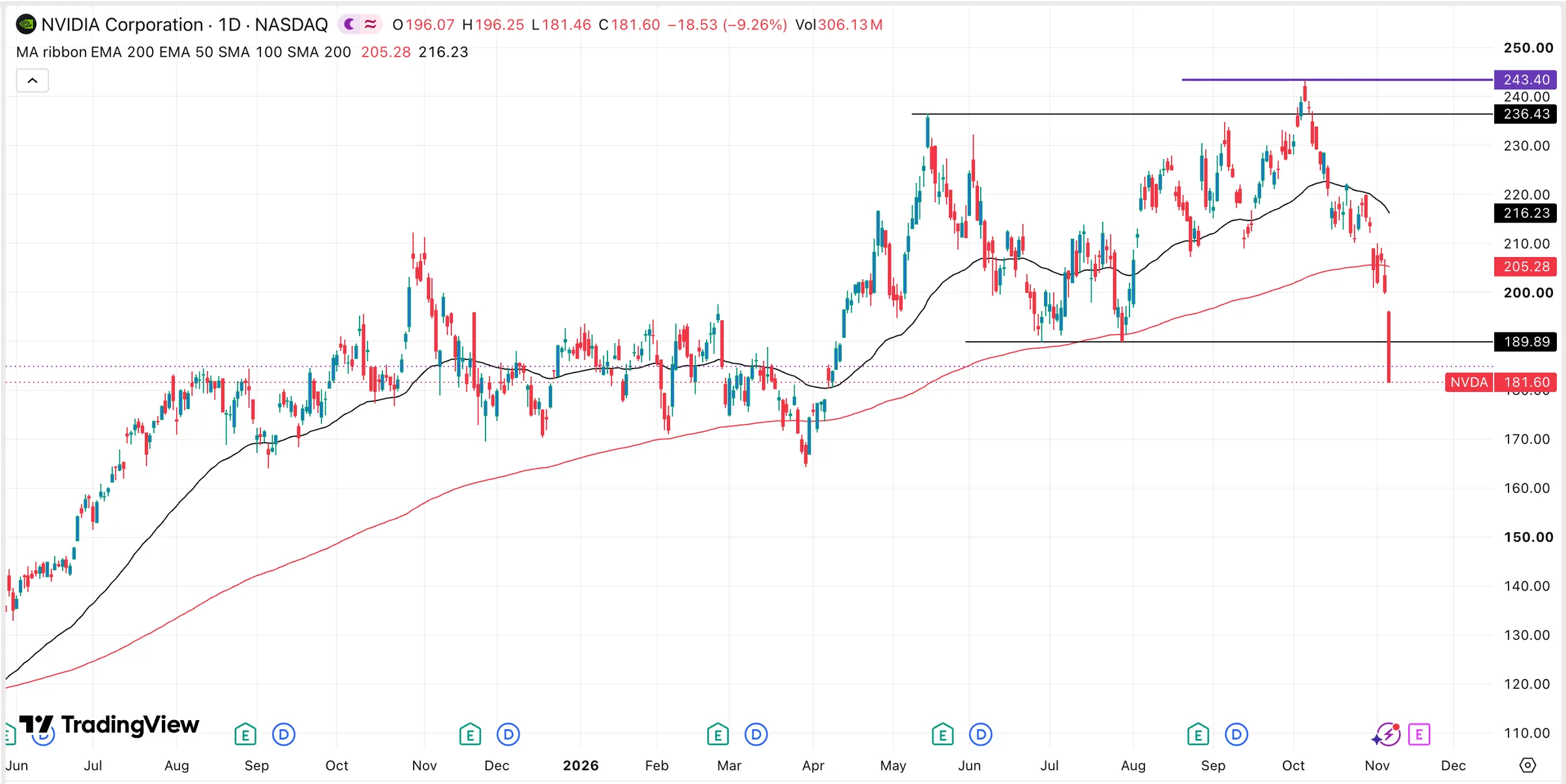
- •Technically, the stock broke below the $189.90 support level and both the 50-day and 200-day EMAs, with a potential near-term decline to $150 before an anticipated rebound as investors buy the dip.
Nvidia Shares Slide to Lowest Level Since April
Nvidia extended its sharp sell-off on Thursday, with the stock touching its lowest level since April 9 of this year. The decline, now exceeding 25% from the stock's highest point this year, has pushed the chipmaker deeper into bear market territory — a label conventionally applied when a stock falls 20% or more from a recent peak — and left investors weighing whether the rout will gain momentum or whether the pullback has created a buying opportunity.
The artificial intelligence industry has contributed to stock market gains over the past few years and helped drive Nvidia shares to a record high. In recent weeks, however, the tide has turned, with most AI-related companies moving into the red. Nvidia, the biggest name in the sector, has become the top laggard, falling by more than 25% from its highest point this year. Because it is the sector's most closely watched company, its chart is often read as a gauge of sentiment toward the AI trade more broadly.
Midterm Election Outcome and Data Center Backlash Weigh on the Stock
The decline coincided with the United States midterm elections, in which Democrats won by a large margin. The party is now on track to win 56 seats in the Senate and has crossed the 250-seat milestone in the House of Representatives.
Their victory has also coincided with the ongoing repudiation of data centers by the American public. Recent polls show that many Americans dislike data centers, largely because of their impact on power consumption, which drives up electricity bills. Many Americans voted for data center moratoriums. In Ohio, 14 municipalities passed bans or restrictions on data center development, including one that will affect a $2 billion development by Amazon.
Americans, especially younger ones, are also concerned that AI will take their jobs. Indeed, some large companies have announced large job cuts as they focus on AI optimizations.
At the same time, Democrats campaigned on making AI safety a priority when they retake Congress. That would mean passing stricter regulations that companies such as OpenAI and Anthropic would need to follow, especially as security incidents become more serious. Whether those campaign pledges turn into concrete legislation is now one of the policy threads to follow in the new Congress.
Nvidia is exposed to all of these developments because it is the biggest player in the industry, selling the chips used in data centers. The company has also invested in tens of companies across the sector, including chipmakers and neoclouds. That means its exposure runs through both its chip sales and its investment portfolio, since the value of those stakes moves with the fortunes of the same industry under pressure.
Potential Catalysts for NVDA Stock Remain
Several potential catalysts for Nvidia shares remain. One is that Nvidia recently announced a large share buyback as it takes advantage of its lower valuation. The company will likely use the reduced stock price to accelerate its share purchases.
The other catalyst is that the company's business continues to grow this year, and management expects the trend to continue next year. Nvidia expects the company's revenue growth to reach 70%, much higher than what analysts were expecting.
The upcoming earnings report is expected to show that revenue grew in the third quarter. Revenue is projected to come in at $108.9 billion, up 91% from a year earlier. In most cases, the company tends to do better than expected, meaning that the actual figure could be higher. That report will serve as the next scheduled checkpoint, offering a fresh read on whether data center demand is holding up despite the political and regulatory friction described above.
NVDA Share Price Technical Analysis
The daily chart shows the stock in a strong sell-off over the past few weeks. It dropped from a high of $243 in October to the current $181. The shares have plunged below both the 50-day and 200-day Exponential Moving Averages (EMA) — trend-following indicators that weight recent prices more heavily — a sign that bears remain in control.
Nvidia has dropped below the important support level of $189.90, its lowest level in June and July this year. The stock has also slumped below the Ichimoku cloud indicator, a charting tool that maps support, resistance, and trend momentum in a single view.
According to the analysis, the stock may continue falling in the near term, with a potential decline to $150. Further out, however, it is expected to rebound as investors start buying the dip.
This article is for informational purposes only and does not constitute financial advice. Stock investments carry risks, and technical price projections do not guarantee future returns.
This article originally appeared on The Market Periodical.

