Nvidia Stock in Focus as $14 Billion Hugging Face Acquisition Nears
Key Takeaways
- •Nvidia plans to spend $14 billion to acquire Hugging Face, potentially alongside a separate $1 billion package for its employees, according to Bloomberg.
- •The acquisition would be far above Hugging Face's last funding valuation of $4.5 billion from three years ago and could face regulatory scrutiny similar to Microsoft's Inflection AI and Meta's Scale AI deals.
- •Nvidia has built a broad AI investment portfolio including a $3.5 billion stake in MediaTek, the largest shareholder position in CoreWeave, and stakes in OpenAI, Anthropic, Intel, and others, raising concerns about circular investing.
- •A PwC report projects AI data center spending will exceed $31.6 trillion by 2050, with most of the outlay flowing to hardware companies like Nvidia and AMD, while a backlash halting 75 projects worth $130 billion is not expected to have a major impact.
- •Technical indicators including a rising wedge pattern and bearish divergence suggest Nvidia stock could pull back toward $200 or below.
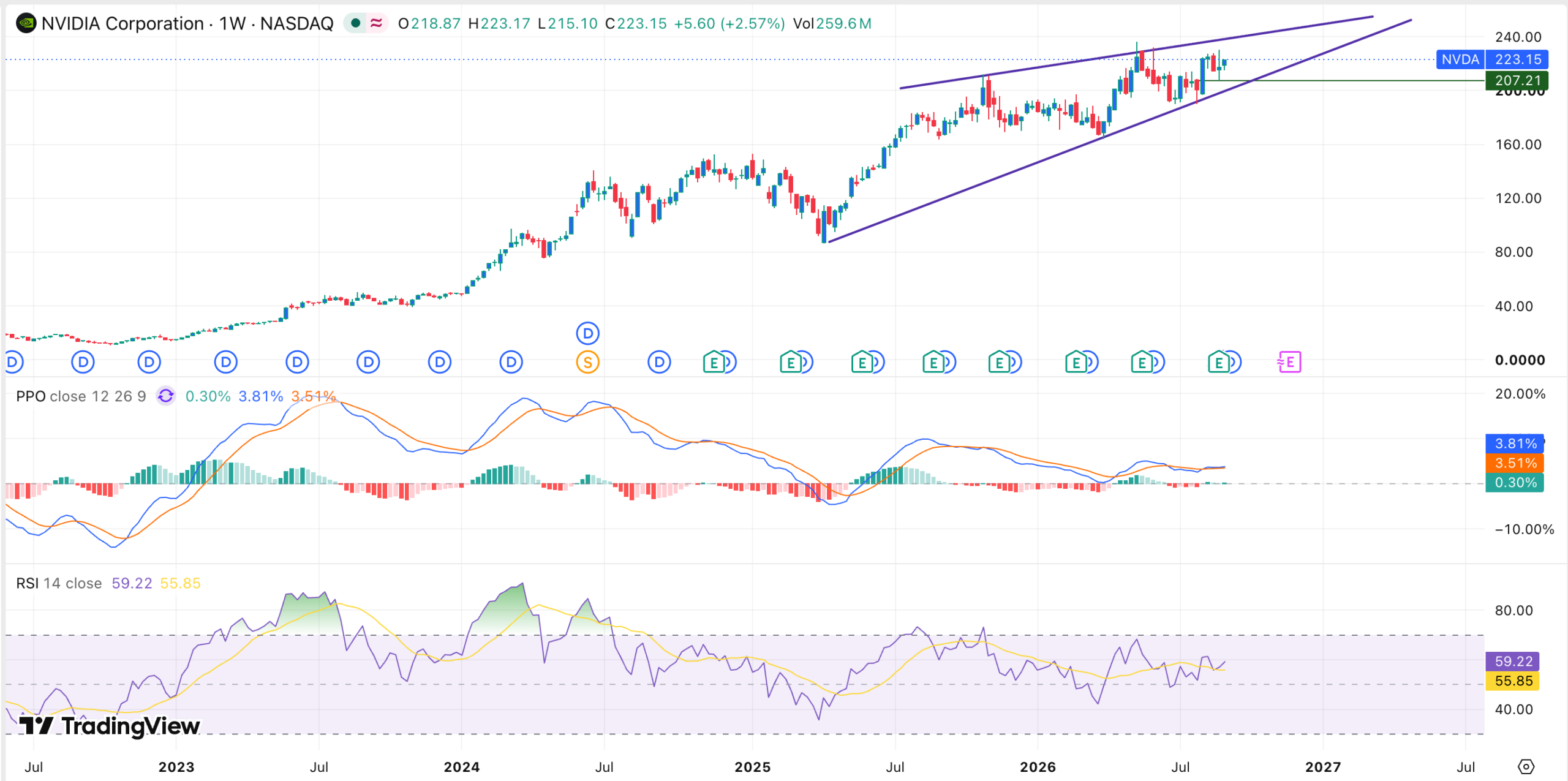
Nvidia stock held steady on Wednesday, touching a high of $219, as investors weighed a potential acquisition of Hugging Face alongside growing optimism that data center spending will accelerate in the years ahead. NVDA traded at $219, down nearly 5% from its highest point last week.
Nvidia Moves to Buy Hugging Face
NVDA shares are in focus as Nvidia nears a deal to acquire Hugging Face, a prominent company in the AI space. Hugging Face, founded in 2016 and originally known for its chatbot app, has grown into the de facto hub for open source machine learning: its platform hosts hundreds of thousands of publicly shared models, datasets, and tools such as the Transformers library, which developers widely use to build and fine-tune AI applications. According to Bloomberg, the company plans to spend $14 billion on the deal, which would rank among its largest acquisitions ever. In addition, Nvidia may announce a separate $1 billion package for Hugging Face employees.
Jensen Huang, Nvidia's CEO, intends to use the buyout to expand the company's market share in the artificial intelligence industry. As part of the effort, he plans to foster open source models, which have become highly popular this year. For Nvidia, whose GPUs dominate AI training and inference, owning the primary distribution platform for open models could tighten the link between the open source developer ecosystem and Nvidia's hardware and software stack, which includes its CUDA platform.
A $14 billion acquisition would mark a substantial jump from Hugging Face's last funding round, which valued the company at $4.5 billion three years ago. Other investors in Hugging Face include Google, Amazon, Intel, and Salesforce. If completed, the deal would also extend a broader wave of consolidation in AI, in which the largest technology and chip companies have increasingly acquired or taken major stakes in promising AI startups. Notably, the reported deal follows Microsoft's roughly $650 million licensing-and-hiring arrangement with Inflection AI in 2024 and Meta's reported $14.3 billion investment in Scale AI in 2025, both of which drew regulatory scrutiny over whether they amounted to de facto mergers — a consideration Nvidia's acquisition could also face.
A Broad AI Investment Portfolio
Nvidia has deployed its large balance sheet to invest substantial sums across the AI industry. This week, it invested $3.5 billion in MediaTek, a leading company making products for smartphones, smart home, data center, and automotive markets.
Nvidia has also become the biggest shareholder in CoreWeave, a former Bitcoin mining company that has grown into the largest neocloud operator, with a revenue backlog of $104 billion. It is also the ninth-biggest holder of SpaceX shares.
The company has further invested significant amounts in Nebius, Lumentum, Intel, Coherent, OpenAI, and Anthropic. These investments have fueled concerns about circular investing — a pattern in which Nvidia backs companies that then buy Nvidia's own chips and services, a dynamic that has drawn questions from analysts and regulators about how much of reported AI demand is independent of Nvidia's own capital.
AI Data Center Growth Expected to Continue
Nvidia stock is also reacting to ongoing optimism about artificial intelligence spending. A report released by PwC showed that AI data center spending will exceed $31.6 trillion by 2050 — an outlay that would dwarf historical projects such as railways, the internet, and electrification. Notably, the report said the bulk of this spending will flow to hardware companies such as Nvidia and AMD.
The report also noted that the ongoing backlash that has halted 75 data center projects worth $130 billion will not have a major impact on the business. That backlash reflects growing community and utility concerns over the enormous electricity and water demands of AI data centers, which have slowed or blocked projects in several markets.
Last week's results underscored how quickly the company is growing. Revenue jumped by more than 100% in the second quarter, and management predicts revenue will grow 77% next year.
The challenge, however, is that the GPU industry is becoming more competitive — with competition coming from Nvidia's own customers. One example is OpenAI, which has unveiled Jalapeno, a chip it says beats Nvidia's on some key metrics. Google, Microsoft, and Amazon are all developing their own ASIC chips. This shift toward custom silicon reflects hyperscalers' efforts to reduce dependence on a single supplier and lower their per-unit compute costs, and a Hugging Face acquisition could be read against that backdrop as Nvidia deepening its reach into the broader developer ecosystem rather than relying on hardware sales alone.
Nvidia Stock Price Forecast: Technical Analysis
Technical indicators suggest NVDA stock may be at risk of a significant pullback. One key risk is a rising wedge pattern, formed by two converging trendlines that are nearing their point of convergence.
Another risk is a bearish divergence, a common bearish reversal signal in technical analysis. This pattern occurs when key oscillators such as the Relative Strength Index (RSI) and the Percentage Price Oscillator (PPO) continue to decline. On that basis, the stock could break down, potentially toward $200 or below.
This article is for informational purposes only and does not constitute financial advice. Equity markets can experience sharp price movements.
