Nvidia Stock Hits Record as SpaceX Seeks $40 Billion for AI Chips
Key Takeaways
- •Nvidia shares touched an all-time intraday high of $243.37 on Oct. 6 and closed at $239.24, keeping the company's market capitalization near $6 trillion.
- •SpaceX is seeking roughly $40 billion in financing, arranged mostly by Apollo Global Management with $10 billion in bank loans and $30 billion in investment-grade debt, to fund purchases of Nvidia AI chips.
- •Nvidia's most recent earnings showed revenue above $104 billion, and management expects revenue to rise 70% next year.
- •Ray Dalio warned that the AI bubble may burst soon, citing rising global interest rates, substantial industry debt levels, and bond yields at their highest in decades.
- •NVDA has formed a rising wedge pattern that suggests possible upside toward $250 before a potential pullback as earnings season continues.
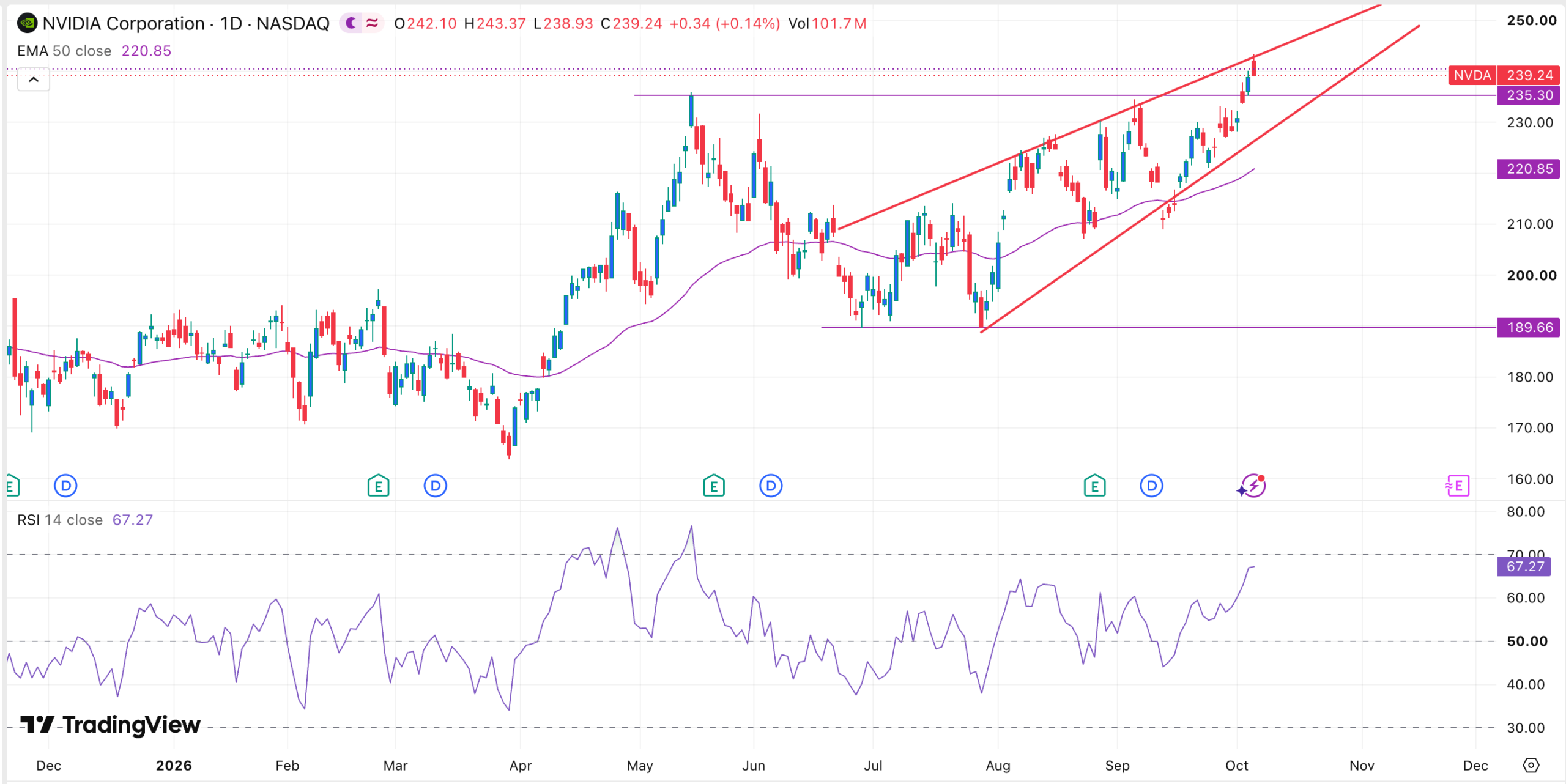
Nvidia shares stayed near record territory on Oct. 6 after touching an all-time intraday high of $243.37 and closing the session at $239.24. The move extended a rally that has pushed Nvidia's (NVDA) market capitalization toward $6 trillion.
The latest demand catalyst came from SpaceX, which is seeking roughly $40 billion in financing to fund purchases of Nvidia AI chips. Nvidia has been one of the biggest beneficiaries of the industry-wide buildout of AI data centers. The planned spending would add another major buyer to an already expanding pool of hyperscalers and AI infrastructure companies competing for Nvidia hardware.
SpaceX Lines Up $40 Billion to Buy Nvidia Chips
SpaceX has gradually become one of Nvidia's biggest clients as it continues to bet heavily on the artificial intelligence industry. The company now aims to deepen that relationship by borrowing $40 billion to buy Nvidia chips. Its processors have become the industry standard for AI training and inference workloads.
According to the Financial Times, most of the financing will be arranged by Apollo Global Management, one of the largest firms in private credit and equity. Of the total, $10 billion will take the form of bank loans, while the remaining $30 billion will be structured as investment-grade debt. The arrangement also underscores how heavily borrowed money now figures in the industry's expansion plans, a dynamic that has moved to the center of the debate over whether the AI boom can last.
The two companies have a long relationship. Nvidia is now one of SpaceX's biggest shareholders, with a stake worth more than $21 billion.
SpaceX has been betting aggressively on AI. It has continued to roll out updates to its Grok bot as it seeks to bridge the gap with leading companies such as OpenAI and Anthropic. At the same time, SpaceX is working to become a major player in the GPU rental industry, where it has already received large orders from companies including Google, Anthropic and Reflection AI. Its eventual goal is to operate orbital data centers, which would likely run on Nvidia GPUs.
Nvidia stands to benefit directly from the deal, since most of the borrowed money would flow into its business. That would come on top of the spending already underway across the data center industry, where firms such as Microsoft, Google, Meta Platforms and Amazon continue to accelerate their AI investments.
That spending helps explain why Nvidia's business keeps growing. Its most recent earnings report showed revenue jumping to more than $104 billion, while profit and free cash flow continued to surge. Management revenue to rise by 70% next year.
Ray Dalio Warns That the AI Bubble May Burst
Meanwhile, Ray Dalio, who founded Bridgewater Associates in 1975 — a hedge fund with more than $100 billion in assets — warned that the AI bubble may burst soon. He cited rising interest rates around the world and debt levels across the industry that have reached substantial levels. Recent data show that ten- and thirty-year bond yields have climbed to their highest levels in decades.
Dalio also believes the bubble will burst because of the need to convert wealth into cash.
Dalio joins other prominent voices who have warned that the AI boom could reverse. Michael Burry, the investor known for his wager against the U.S. housing market before the 2008 financial crisis, has argued that the bubble will pop when neocloud companies begin to factor in the depreciation of the chips they are buying from Nvidia. On the other side of the debate, some analysts see no AI bubble at all, pointing to the relatively cheap valuations of the industry's biggest companies, such as Nvidia and Micron. The outcome of that argument carries particular weight for Nvidia, since the company is one of the biggest beneficiaries of the spending that bulls point to and the maker of the chips that bears say could expose losses once depreciation is counted.
NVDA Stock Is Bullish but Forming a Risky Pattern
The daily chart shows NVDA shares in a strong rally this year. The stock recently jumped above the crucial resistance level of $236 — its previous all-time high — and remains above all moving averages as the Relative Strength Index (RSI), a momentum indicator, continues to rise.
The risk, however, is that the shares have formed a rising wedge pattern, made up of two converging trendlines. The setup suggests the stock could have more upside, potentially toward $250, followed by a pullback, possibly as earnings season continues. Looking ahead, Nvidia's next earnings report is a natural checkpoint for whether growth tracks management's 70% revenue forecast, while the path of ten- and thirty-year yields — which Dalio cited — offers a gauge of the rate pressure behind the bubble debate.
This article is for informational purposes only and does not constitute financial or investment advice. Stock prices, analyst views and technical patterns may change as market conditions evolve.
This article was originally published by The Market Periodical.

