Nvidia Stock Slides to Lowest Level Since April as Board Probes Spying Allegations Involving Jensen Huang
Key Takeaways
- •Nvidia shares dropped to $175.87 in premarket trading, their lowest level since April 7 and about 27% below the year's high.
- •CEO Jensen Huang confirmed in a letter to employees that he had a relationship with a Chinese woman whom US intelligence services believe is a spy, prompting the board to open an investigation.
- •Analysts expect third-quarter revenue to rise 91% to $108 billion, with Nvidia's record of beating estimates suggesting a result above $110 billion.
- •The stock trades at a forward price-to-earnings ratio of 20, which coincided with the company launching a $150 billion share repurchase program.
- •Technically, the shares have fallen below the 38.2% Fibonacci retracement level and the 50-day EMA, though a rebound toward the $200 resistance level remains possible.
Nvidia (NVDA) shares extended their sharp decline in premarket trading as investors reacted to a report detailing Chief Executive Jensen Huang's alleged infidelity and the launch of a new internal investigation by the company's board. The stock fell to a low of $175.87, its weakest level since April 7 and roughly 27% below its high for the year. The drop marks the latest leg of a slump that has taken shape in recent weeks as AI-related companies across the sector have sold off. Jim Cramer, however, urged investors to look past the noise and buy the dip.
Shares Fall After Huang Confirms Relationship Tied to Spying Allegations
The decline deepened after Huang sent a letter to employees in which he confirmed that he had been in a relationship with a Chinese woman whom US intelligence services believe is a spy, according to a report by The New York Times. Nvidia's board has since announced an investigation into the matter, while officials in Washington have called for meetings and potential hearings.
The stock is under pressure as investors assess the impact of the situation. In most cases, however, sharp moves of this kind after a major event tend to be short-lived. Jim Cramer, the popular analyst, wrote that he would buy more Nvidia shares after the drop. He argued that Nvidia still offers the most cutting-edge technology and that this advantage is not away. He also noted that demand for the company's GPUs has kept rising this year, and he dismissed the ongoing panic after the Democrats' election win as noise.
Strong Earnings Expected Next Week
These developments are unfolding as investors await the company's financial results, which are due next week and will show whether demand is still rising. Data compiled by Yahoo Finance shows that analysts expect the company's revenue growth to have been supercharged last quarter. The average estimate calls for revenue to have jumped by 91% in the third quarter to $108 billion. Nvidia tends to do better than estimates, meaning that its third-quarter revenue is likely to come in above $110 billion.
Recent earnings by technology companies have sent signals about what to expect. AMD, a top competitor, published strong results, with its data center business gaining momentum. Nvidia's top clients, including Microsoft, Google, and Amazon, also released strong numbers and maintained their capital expenditure plans.
These results come at a time when the company's valuation has slumped, with the forward price-to-earnings ratio standing at 20. That relatively cheap valuation helps explain why the company decided to start a $150 billion share repurchase program.
The upcoming report therefore provides a near-term point of reference for the demand picture described by Nvidia's customers and competitors, while the board investigation and potential Washington hearings remain separate issues for investors to monitor.
Portfolio Exposure Adds to the Risks
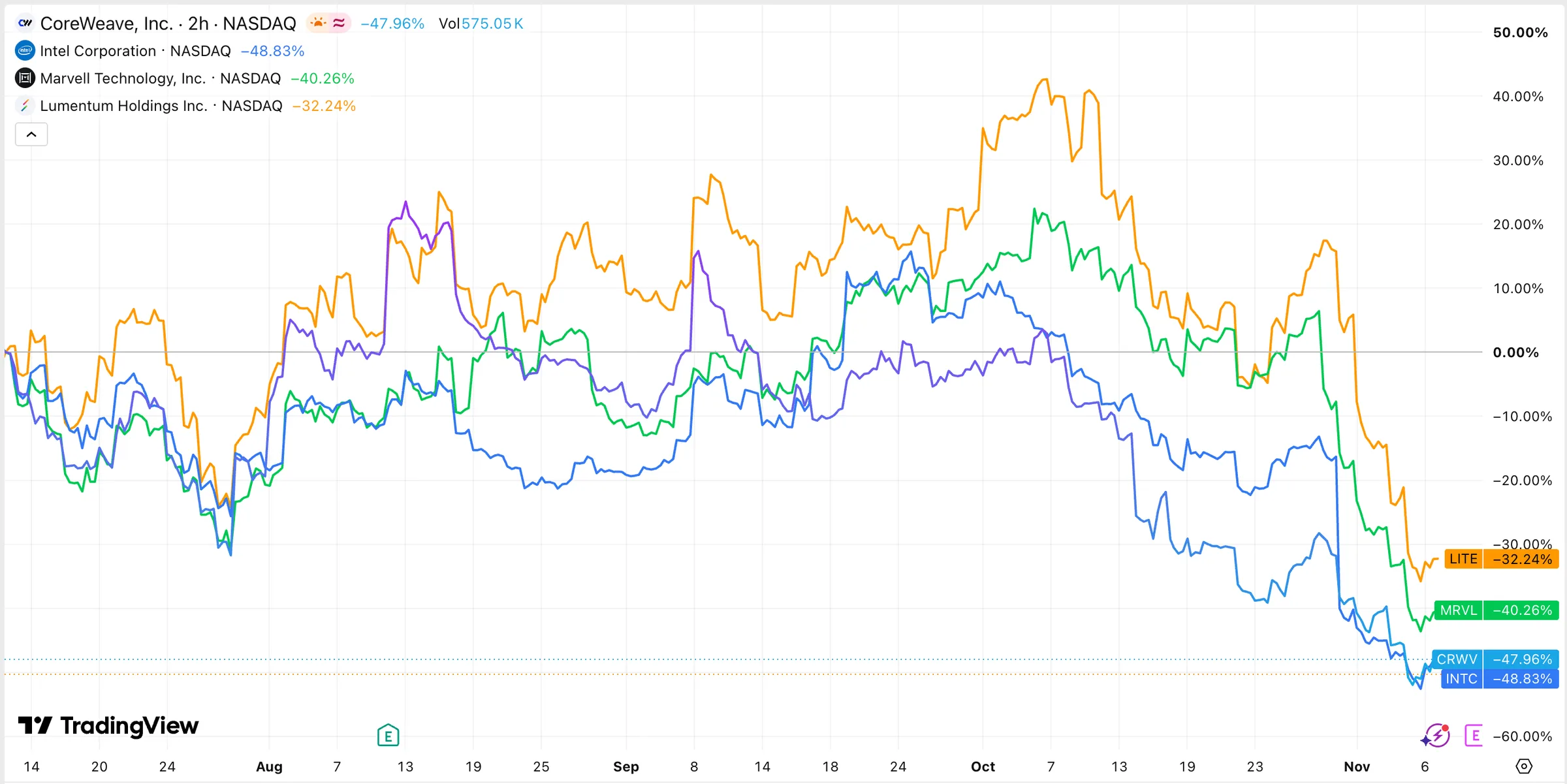
Still, Nvidia faces some potential risks ahead. The most notable are the ongoing data center delays and the potential moratoriums that could follow the Democrats' victory in the midterm elections. The company also faces a risk related to the fair value of its investments, since many companies it has backed have tumbled. Intel, for example, has slumped by 60% from its peak this year, while CoreWeave, Nebius, IREN, and Marvell Technology have all fallen by double digits from their all-time highs. Other companies it has invested in, including Lumentum, have plunged as well.
Nvidia Stock Price Technical Analysis
On the charts, Nvidia shares have been in a strong bearish breakout over the past 30 days. The stock has dropped below the 38.2% Fibonacci Retracement level, which is drawn by connecting the lowest level of 2025 with the all-time high. It has also moved to the lower side of the Bollinger Bands and slumped below the 50-day Exponential Moving Average (EMA).
As a result, there is a likelihood that the shares will remain under pressure in the near term. However, it is also possible that they will bounce back, potentially toward the key resistance level at $200.
This article provides market information, not financial advice. Stock prices can fluctuate sharply, and price forecasts do not guarantee returns. Readers should consult a qualified financial professional before making investment decisions.
This article was originally published by The Market Periodical.

