Nvidia Stock Falls Below Key Support as Big Tech Spending Rises
Key Takeaways
- •Nvidia stock has broken below its 200-day weighted moving average for the first time since July 7, declining from a June peak of $236 to approximately $190.
- •Meta, Microsoft, and Alphabet have collectively committed over $500 billion in capital spending for the year, with Nvidia serving as the dominant GPU supplier to all three companies.
- •The broad semiconductor selloff has affected multiple chip companies including Samsung, SK Hynix, Micron, and AMD, indicating sector-wide de-risking rather than company-specific deterioration.
- •Investors have raised concerns about circular investment patterns where Nvidia invests in companies like OpenAI and CoreWeave, which then purchase Nvidia products, though CEO Jensen Huang has dismissed these concerns.
- •Chinese AI competitors such as Moonshot's Kimi K3 are emerging with lower-cost alternatives, potentially threatening Nvidia's investments in AI companies and its market position among enterprise customers.
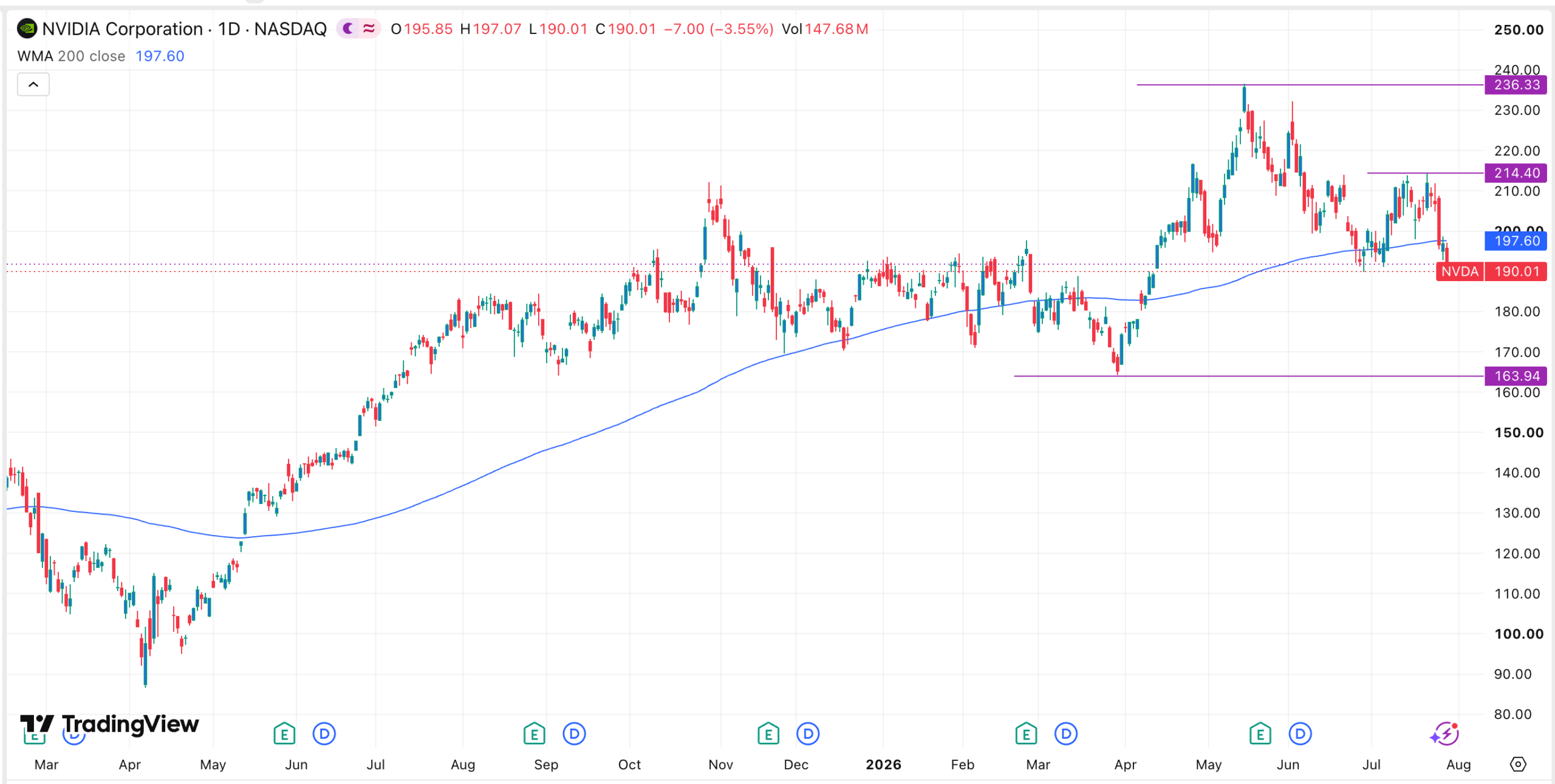
Nvidia stock price has fallen below its 200-day weighted moving average (WMA) as the broader semiconductor selloff accelerated. The 200-day WMA is one of the most widely tracked technical indicators among institutional investors, and a break below it often signals a broader shift in market sentiment rather than a short-term fluctuation.
After peaking at $236 in June, the stock has now dropped to $190. The move comes as investors weigh whether the decline is justified, even as major technology companies continue to increase capital spending.
Nvidia Stock Breaks Below Key Support
Technical analysis shows NVDA has moved below its important 200-day weighted moving average for the first time since July 7.
Historically, moves above or below this level have triggered significant price action. For example, the stock climbed to $236 after crossing above the average on April 9, when it was trading at $185.
A closer look also shows that the stock is approaching the key support level of $190, which was its lowest level earlier this month. A break below that level would invalidate the double-bottom pattern and point to additional downside.
If that happens, the next level to watch is $163, the stock's low from March 30. That bearish view is reinforced by a double-top pattern on the four-hour chart.
The negative outlook would be invalidated if Nvidia stock rises above key resistance at $214, which was the highest level reached on July 15. A move above that price would suggest further gains, potentially back to the year-to-date high of $236.
Big Tech Firms Plan Higher Capital Spending
Nvidia shares have fallen even as some of its largest customers plan to increase spending this year. In a statement on Wednesday, Meta Platforms said it expects to spend between $130 billion and $145 billion in capex this year.
In its last financial results, Meta said it would spend between $125 billion and $145 billion. That suggests the company may be prepared to spend an additional $5 billion.
Meta's spending plans matter because there have been concerns that the company has overinvested in the data center sector. A recent report said Meta was considering leasing its extra space to other companies.
Microsoft also plans to increase spending this year. It expects to spend $50 billion this quarter and $175 billion in the current calendar year. Last week, Alphabet raised its spending plans to $205 billion.
That spending should benefit Nvidia, which supplies these companies with GPUs and other products. The company is also expanding into the CPU market, which has become more attractive as demand for AI agents rises. The combined capex commitments from Meta, Microsoft, and Alphabet represent one of the largest infrastructure buildouts in technology history, and Nvidia is the dominant GPU supplier to all three companies.
Circular Investment Concerns and AI Weakness Weigh on Nvidia
The latest drop in Nvidia stock is taking place as investors rotate away from AI-related companies. Recently, stocks such as Samsung, SK Hynix, Micron, and AMD have all fallen by double digits despite strong revenue performance. The breadth of the selloff across multiple semiconductor names suggests a sector-wide de-risking rather than company-specific deterioration.
Another factor behind the selloff is concern about the circular nature of the AI industry. In this setup, Nvidia invests in customers, and those customers then use the same cash to buy Nvidia products, helping support Nvidia's revenue and stock price.
Nvidia has invested in several customers, including OpenAI, CoreWeave, IREN, and Nebius. Jensen Huang has strongly rejected those claims and said spending would remain strong even without those investments.
Nvidia is also facing pressure as investors evaluate competition from Chinese AI companies, which are offering products that are nearly identical to those from U.S. firms. Moonshot's Kimi K3 has become the largest open-weight model, and there are concerns that many enterprise customers may choose cheaper Chinese models over time. These competitive dynamics have intensified amid ongoing U.S.-China technology tensions and export restrictions on advanced semiconductors.
That possibility could hurt Nvidia, which has made major investments in companies including OpenAI and Anthropic. On the positive side, the recent decline has made the stock cheaper, with the forward price-to-earnings ratio falling to 21.

