Nvidia Stock Slides Below $200 After US Midterm Elections as AI Sector Sell-off Deepens
Key Takeaways
- •Nvidia fell 3.17% to close at $200.13 on Nov. 4, briefly dropping below the $200 mark even as the Dow Jones Industrial Average gained 3% after the midterm elections.
- •Nvidia's market capitalization has declined to about $4.83 trillion from a peak near $5.76 trillion, and companies across the AI sector have collectively lost more than $1 trillion in value in recent weeks.
- •Democratic control of both congressional chambers has raised concerns about potential slowdowns in the U.S. data center rollout and constraints on approvals of Nvidia H200 chip exports to China, which already include sales to ByteDance and Alibaba.
- •The report cites Nvidia's robust fundamentals, including more than $104 billion in latest quarterly revenue, a projected 70% revenue increase for 2027, and a forward price-to-earnings ratio of 22 far below its five-year average of 42, as potential catalysts for a recovery.
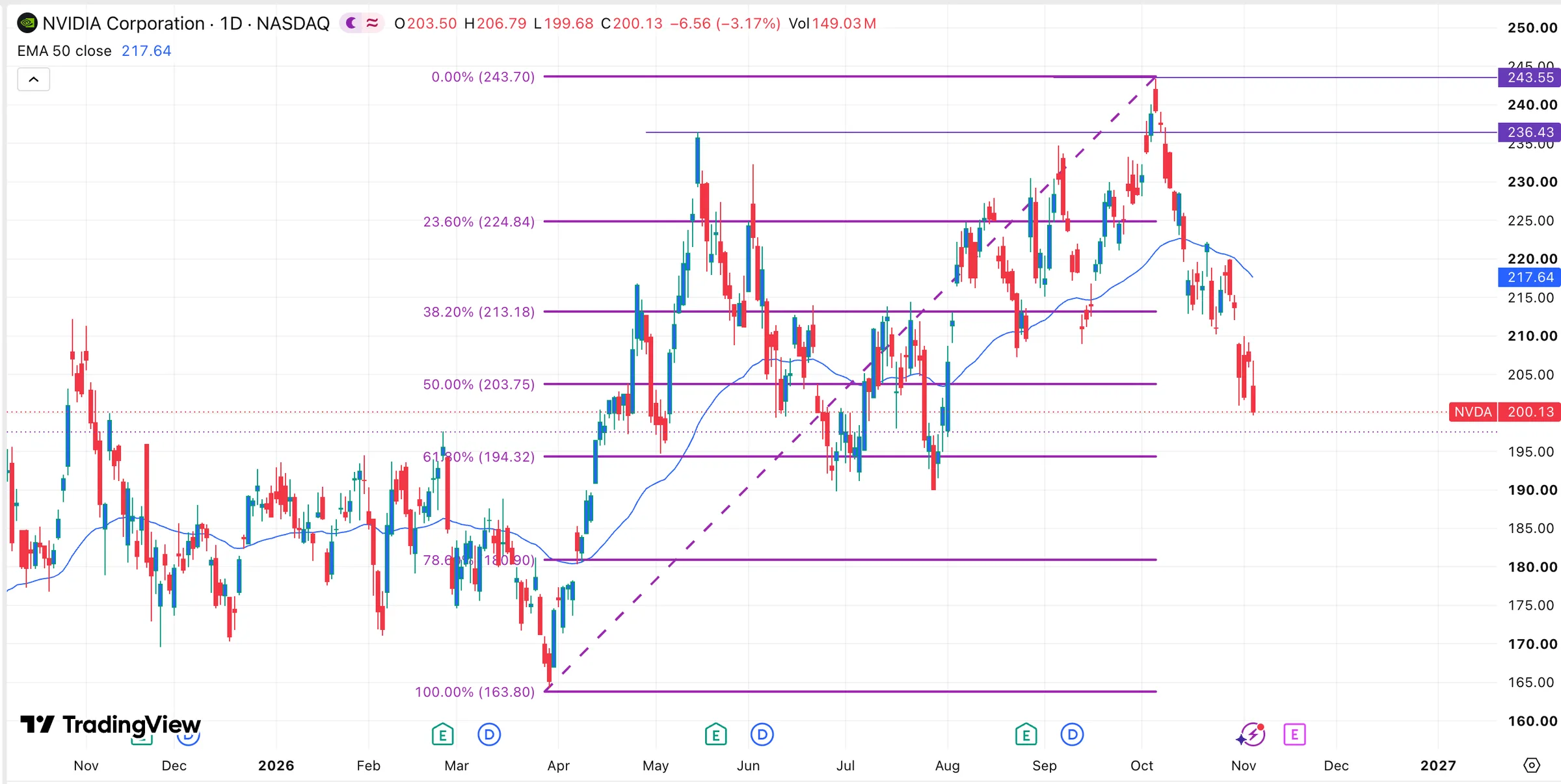
- •Technically, the stock has fallen from a high of $243 below its 200-day moving average and the 50% Fibonacci retracement level, with the analysis projecting a possible further decline to the 61.8% retracement level at $194 ahead of the upcoming earnings report.
Key Points
- Nvidia closed at $200.13 on Nov. 4, down 3.17%, after briefly falling below the key $200 support level.
- The decline came even as major U.S. indexes rallied following midterm elections won by Democrats.
- AI-linked companies have lost more than $1 trillion in market value in recent weeks.
- Cited reversal catalysts include Nvidia's growth trajectory, its valuation, and its upcoming earnings report.
Nvidia Extends Post-Election Decline
Nvidia stock extended its recent slide on Nov. 4, even as major U.S. indexes rallied in the wake of the midterm elections. Shares closed at $200.13, down 3.17%, after briefly dipping below the closely watched $200 support level — a round number that technical traders often treat as a psychological threshold.
The drop reduced Nvidia's market capitalization to approximately $4.83 trillion, down from an earlier peak near $5.76 trillion. By contrast, the Dow Jones Industrial Average jumped 3%, underscoring the divergence between semiconductor stocks and the broader market. A split like that typically signals sector-specific pressure rather than a market-wide retreat, and with a market cap of roughly $4.83 trillion, Nvidia is by far the largest listed company in the AI complex — which is why its swings are often read as a gauge of sentiment toward AI stocks more broadly. Nvidia's upcoming earnings report could deliver another test of investor confidence.
The sell-off in NVDA has coincided with declines across the AI sector, including several companies in which Nvidia has invested. Marvell Technology, for example, has slumped more than 50% from its year-to-date high, a slide that continued after it agreed to merge with Lumentum in a $115 billion deal. Neocloud providers backed by Nvidia, including CoreWeave, IREN, and Nebius — firms that rent out GPU-powered computing capacity for AI workloads — have also plunged. In total, companies in the AI space have lost more than $1 trillion in value over the past few weeks, with Nvidia and Micron leading the declines.
Policy Concerns After Democratic Wins
The sell-off followed midterm elections in which Democrats won control of the House of Representatives and the Senate, including victories in states such as Texas and Kansas that the party had not carried in decades. Control of both chambers gives a party leverage over the legislative agenda and oversight of the executive branch, which is why shifts in Washington's balance of power tend to ripple through policy-sensitive parts of the market.
According to the analysis, a key concern is that Democrats may put the brakes on the ongoing data center rollout across the country, as many of the party's voters oppose such large projects over rising utility costs. Trump, by contrast, has supported the data center industry, a stance credited with helping push the stock market to record highs.
A further worry is that a Democratic majority could constrain the Trump administration's approval of Nvidia chip exports to China. The administration has already agreed to sell H200 chips to several Chinese companies, including ByteDance and Alibaba.
Potential Catalysts for a Reversal
The report identifies several potential catalysts that could drive Nvidia shares higher. First, despite the political noise, Democrats are unlikely to succeed in halting data center development in the United States.
Second, Nvidia's underlying business remains strong. In its most recent earnings report, the company generated more than $104 billion in revenue, a substantial increase from a year earlier. Jensen Huang has estimated that 2027 annual revenue will rise about 70% from this year's total; he has historically been highly conservative in such projections, meaning the actual figure could be higher.
Third, and most importantly, the report points to signs that Nvidia is significantly undervalued. The stock trades at a forward price-to-earnings ratio of 22 — a valuation measure that divides the share price by projected future earnings — far below its five-year average of 42, a gap that could attract dip-buyers.
Nvidia also holds large stakes in companies such as Anthropic and OpenAI, both of which are expected to go public soon, giving the chipmaker a chance to monetize those holdings.
Technical Picture
On the charts, NVDA has tumbled from a high of $243 to below $200. It has already slipped beneath the 50% Fibonacci retracement level — horizontal lines derived from fractions of a prior price move that traders use to judge where pullbacks may stall — and is now targeting the decisive 61.8% retracement point. The stock has also fallen below its 200-day moving average, a long-term trend gauge whose loss is conventionally read as a shift into a downtrend, while oscillators such as the Relative Strength Index (RSI) and the MACD point downward.
The analysis concludes that the stock will likely continue to push lower in the coming days, potentially dropping to the 61.8% retracement level at $194 before resuming its downward trend.
The next scheduled catalyst is Nvidia's earnings report, cited earlier as a test of investor confidence; it now doubles as the event where the deteriorating technical setup and the strong fundamentals laid out above will be weighed against each other.
This article provides market analysis, not investment advice. Stock prices can fluctuate, and technical projections do not guarantee future returns.

