Nvidia Stock Pulls Back as Jensen Huang Projects $3 Trillion-to-$4 Trillion AI Market
Key Takeaways
- •Jensen Huang said the AI market could grow to between $3 trillion and $4 trillion, potentially increasing demand for GPUs, CPUs and other semiconductors.
- •Nvidia reported more than $96 billion in second-quarter revenue, alongside $59 billion in net income and a 75% gross margin.
- •Analysts forecast Nvidia’s annual revenue at $411 billion followed by $727 billion, without including potential China sales or CPU revenue.
- •Nvidia shares fell to $219 but remained above the 100-day EMA, while technical analysis identified a possible cup-and-handle formation.
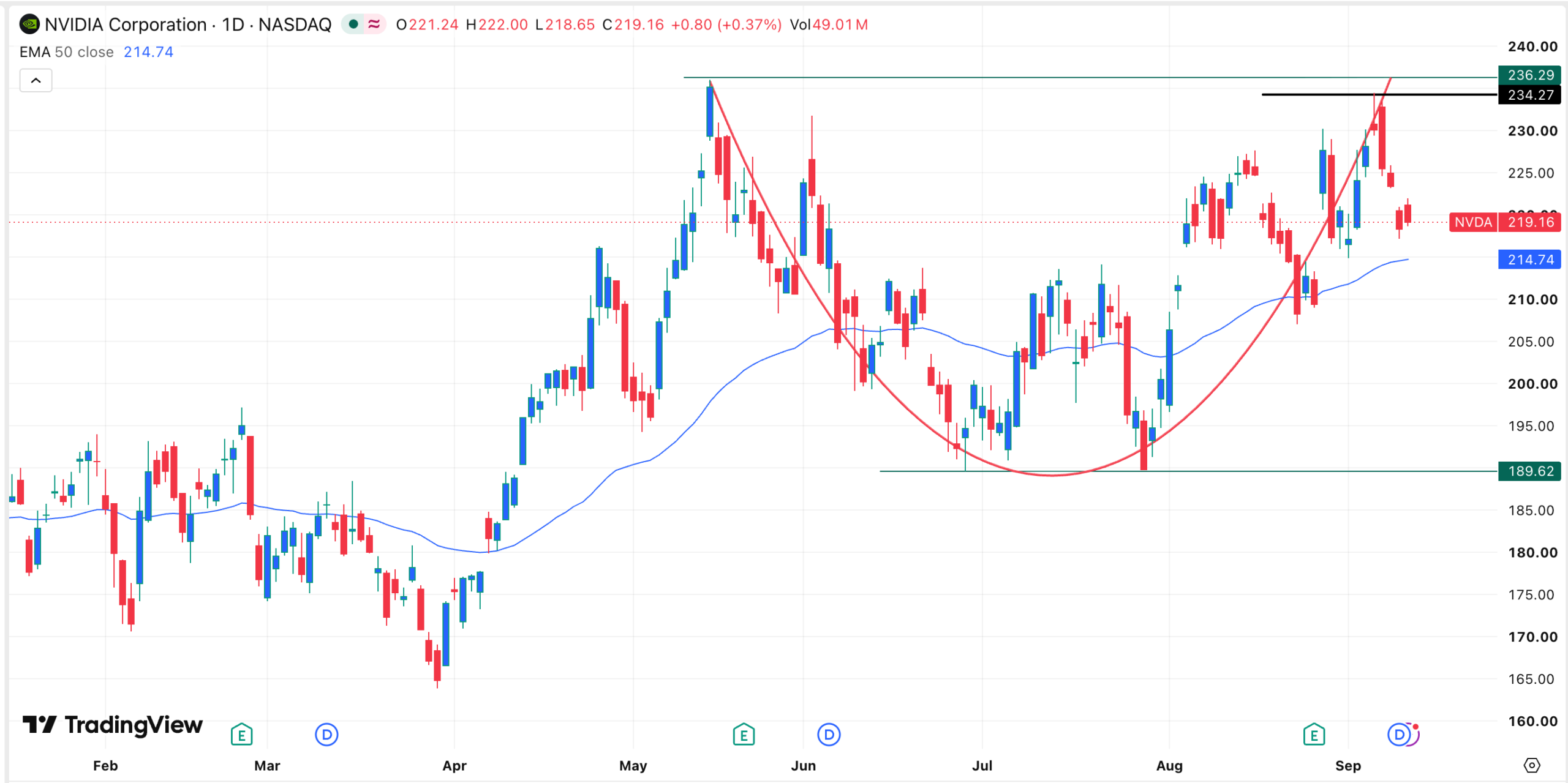
Nvidia shares fell during the week, reaching an intraday low of $220 before declining to $219 on September 11. The NVDA stock price was modestly below the monthly high of $234 and reached its lowest level since September 2.
The decline came even after Nvidia CEO Jensen Huang made a bullish projection for the artificial intelligence industry at a Goldman Sachs event. Huang said the AI market could grow to between $3 trillion and $4 trillion. The Market Periodical reports that Nvidia could benefit from this expansion because AI systems depend heavily on semiconductors.
Huang projects multitrillion-dollar AI market
Huang said AI models would continue to become more capable over time, increasing demand for graphics processing units (GPUs) and central processing units (CPUs). The comments came several weeks after PWC, described in the report as a leading accounting company, published a forecast that AI data-center spending would reach $32 trillion through 2050.
If those projections are realized, companies such as Nvidia and AMD could benefit from demand generated by the AI industry and related emerging industries. The report said there are already signs that AI models are advancing. Anthropic, for example, said it had identified actors using its models to develop biological weapons. Separately, an Anthropic employee resigned in a statement this week, saying that AI would cause humanity’s extinction in the near future.
Nvidia revenue and earnings continue to rise
Nvidia’s financial results show substantial business growth in recent years. The company’s annual revenue was more than $26 billion in 2021, rising to $215 billion last year.
In its most recent results, quarterly revenue was significantly higher than the level recorded in 2023. Revenue increased 18% from the first quarter and 106% from the same period a year earlier. Nvidia generated more than $96 billion in the second quarter, and company management and analysts expect the figure to continue increasing.
The company’s financial statement also showed net income of $59 billion, exceeding Nvidia’s revenue in the second quarter of the previous year. Gross margin increased from 72.4% in Q2’26 to 75% in Q2’27.
The average analyst estimate calls for Nvidia’s annual revenue to nearly double to $411 billion, followed by 77% growth to $727 billion the following year. The report described those estimates as potentially conservative because Nvidia has often exceeded analysts’ expectations.
The estimates also exclude potential sales in China. In addition, the company’s guidance does not include its CPUs, which are competing in a market historically dominated by AMD and Intel.
Technical analysis identifies cup-and-handle pattern
Technical analysis of Nvidia’s daily chart indicates that the stock could be approaching a bullish breakout, according to the report. Despite the recent pullback, NVDA has remained above its 100-day exponential moving average (EMA).
The stock has also formed what the report identifies as a cup-and-handle pattern, commonly viewed in technical analysis as a bullish continuation formation. The current pullback is described as part of the handle. Such a formation can precede a bullish reversal, although technical patterns do not guarantee future price movements.
The report said a rebound could take the stock toward the upper boundary of the cup at $236. A move above that level could open the way toward $300 by the end of the year, according to the article.
This article is for informational purposes only and should not be considered financial or investment advice. Equity and technology markets remain volatile. Readers should conduct independent research before making investment decisions.

