Nvidia Stock Falls 12% From October High as Gartner Flags $3.5 Trillion in AI Impairment Risk
Key Takeaways
- •Nvidia shares closed at $214.13 on Oct. 16, about 12% below their Oct. 6 high of $243.37, amid concerns over borrowing costs and the returns on AI infrastructure spending.
- •Gartner warned that more than $3.5 trillion in infrastructure investment could face impairment exposure by 2030, with neocloud providers such as CoreWeave, Nebius, and IREN expected to book billions in impairments.
- •The AI Bubble Index rose to 74, nearing its extreme threshold of 80, while Nvidia's forward price-to-earnings ratio of 24 remains well below its five-year average of 45.
- •Nvidia has invested billions across the AI ecosystem, holding stakes in OpenAI, Anthropic, optics firms Lumentum and Coherent, and chipmakers Intel and Marvell, leaving its portfolio exposed to any sector downturn.
- •Technically, a sustained break below $210 support could bring $200 into focus, while a recovery above $220 and $230 would weaken the bearish outlook, and the average analyst estimate values the shares at $250 or higher.
Nvidia shares extended their October correction this week, closing at $214.13 on Oct. 16 — roughly 12% below their Oct. 6 high of $243.37 — as investors reassessed the financial returns on artificial intelligence infrastructure spending. The pullback followed mounting concerns over borrowing costs, data center expenditure, and the pace of future AI revenue growth.
The sell-off gained traction after research firm Gartner warned that more than $3.5 trillion in AI infrastructure investment could face impairment exposure by 2030. An impairment is the accounting charge a company records when an asset's value falls short of what it originally paid, which makes the forecast a gauge of how much of the AI buildout could ultimately be written down. Nvidia's most recent financial results, however, continue to show substantial revenue expansion, leaving open the question of whether future customer spending can sustain that growth.
AI Bubble Concerns Mount
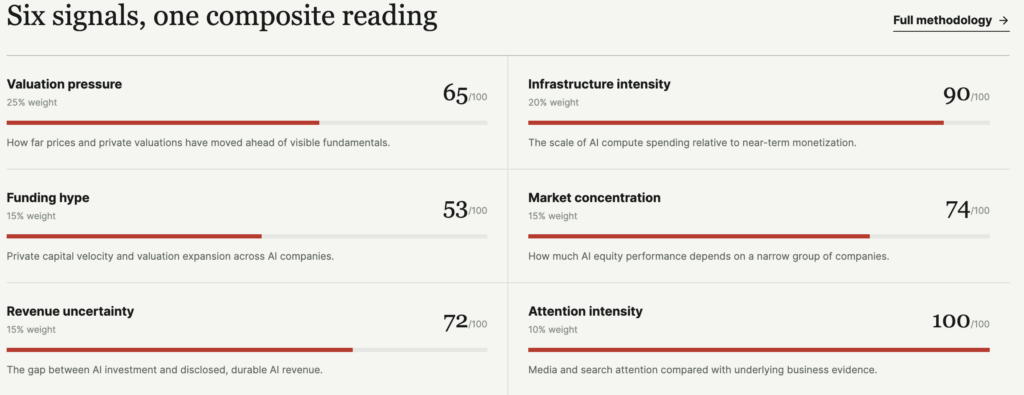
Signals that the AI sector may be overheating have accumulated. The closely watched AI Bubble Index jumped to 74, an elevated risk reading that is moving closer to the extreme threshold of 80. The index evaluates several key metrics across the AI industry: attention intensity, revenue uncertainty, funding hype, valuation pressure, infrastructure intensity, and market concentration.
Valuation pressure, which carries a 25% weighting and measures how far public and private valuations have moved ahead of fundamentals, remains one of the index's lowest components, since most AI companies are not dramatically overvalued. Nvidia itself trades at a forward price-to-earnings ratio of 24 — a valuation gauge reflecting the price investors pay per dollar of expected earnings — well below its five-year average of 45. Attention intensity, which tracks media and search interest, has hit a reading of 100 as discussion of AI spreads across platforms. Revenue uncertainty stands at 72 out of 100, while infrastructure intensity has climbed to 90.
With the index rising, warnings of a potential bubble have grown louder. Ray Dalio, the billionaire founder of Bridgewater Associates, has cautioned that the bubble may burst soon, pointing to rising interest rates and bond yields. The Federal Reserve has hiked rates to 4%, while the ten-year Treasury yield is hovering near its highest point in nearly two decades — conditions that raise the cost of financing the data center buildout underpinning the AI expansion. Other prominent investors, including Michael Burry, have warned that the AI bubble will burst, citing robust spending and questions over revenue visibility. OpenAI's annualized revenue came in $20 billion below expectations, and while Anthropic's revenue growth continued, its momentum was slower than expected.
Nvidia Would Be Highly Exposed if the Bubble Bursts
Nvidia, led by CEO Jensen Huang, would be among the companies most affected if the AI bubble were to burst. Its GPUs power the most advanced AI models in use today, meaning demand could fade quickly in a downturn.
The company's reach also extends far beyond sales. Nvidia has invested billions of dollars across the AI space, and is one of the top investors in both OpenAI and Anthropic. It has also backed neocloud providers such as CoreWeave, Nebius, and IREN — firms that rent out GPU computing capacity to AI developers. Gartner's recent report warned that these neocloud companies will need to book billions of dollars in impairments by the end of 2030.
Nvidia has additionally invested in optics companies such as Lumentum and Coherent, as well as chipmakers including Intel and Marvell. As a result, any change of fortune in the AI sector would reverberate through its portfolio.
On the positive side, many analysts believe Nvidia stock has further upside, with the average estimate putting the shares at $250 or higher.
Technical Picture: Could NVDA Test $200?
Nvidia stock remains under pressure after retreating from its October high. Several sessions of selling have brought the shares closer to the $210 region, which represents a nearby psychological support reference. A sustained break below $210 could bring the $200 area into focus.
The $200 level also appeared in earlier bearish technical analysis that identified a possible rising wedge formation. A rising wedge develops when ascending trendlines converge and upward price momentum begins to weaken. However, the formation requires a confirmed breakdown before it can support a bearish reversal interpretation.
The stock's recent correction is consistent with weaker short-term momentum, but it does not guarantee further losses. The Relative Strength Index and the MACD — two widely followed momentum indicators — can provide additional evidence of momentum changes, although neither indicator independently establishes the timing or extent of a possible decline.
On the upside, $220 represents a nearby recovery reference. A sustained move above that region could bring $230 back into focus, and further gains would be needed to challenge the October high near $243. The next trading sessions will help determine whether the decline continues or buyers establish support.
What Comes Next for Nvidia Stock
Nvidia faces two competing developments following its October correction. Gartner's report highlights the financial risks associated with rapid AI infrastructure expansion, while the company's latest quarterly results demonstrate continued demand and substantial profitability. The central issue is whether customers can generate sufficient returns to maintain their capital expenditure commitments.
Investors will monitor financing conditions, infrastructure utilization and spending guidance from major technology companies. Technically, continued weakness below $210 could bring $200 into focus, while a recovery above $220 and $230 would weaken the immediate bearish outlook.
For now, the correction reflects concerns about future AI investment returns rather than a confirmed contraction in Nvidia's latest reported business.
This article is for informational purposes only and does not constitute financial or investment advice. Stocks are volatile, and investors may lose capital. Readers should conduct independent research and consult a qualified financial adviser before making investment decisions.
This article originally appeared on The Market Periodical.

