Nvidia Stock Nears Record High as DBS Analyst Says AI Bubble Fears Are Overblown
Key Takeaways
- •DBS Chief Investment Officer Hou Wey Fook said there is no AI bubble, noting Nvidia's forward P/E of 24 and TTM multiple of 33 sit well below their five-year averages of 42 and 58.70.
- •Nvidia announced a $150 billion share repurchase program on top of its existing $80 billion buyback, aiming to lift earnings per share by reducing shares outstanding.
- •Micron trades at a forward P/E of 8, far below the S&P 500 average of 19, after last week reporting revenue growth exceeding 330%.
- •Earnings from Taiwan Semiconductor, Microsoft, Amazon, and Meta are due before Nvidia's Nov. 17 report, where analysts expect revenue of $109 billion, up 91% from a year earlier.
- •Nvidia trades above its 50-day and 100-day EMAs with rising MACD lines pointing toward $250, though a rising wedge pattern raises the possibility of a bearish breakout toward $200.
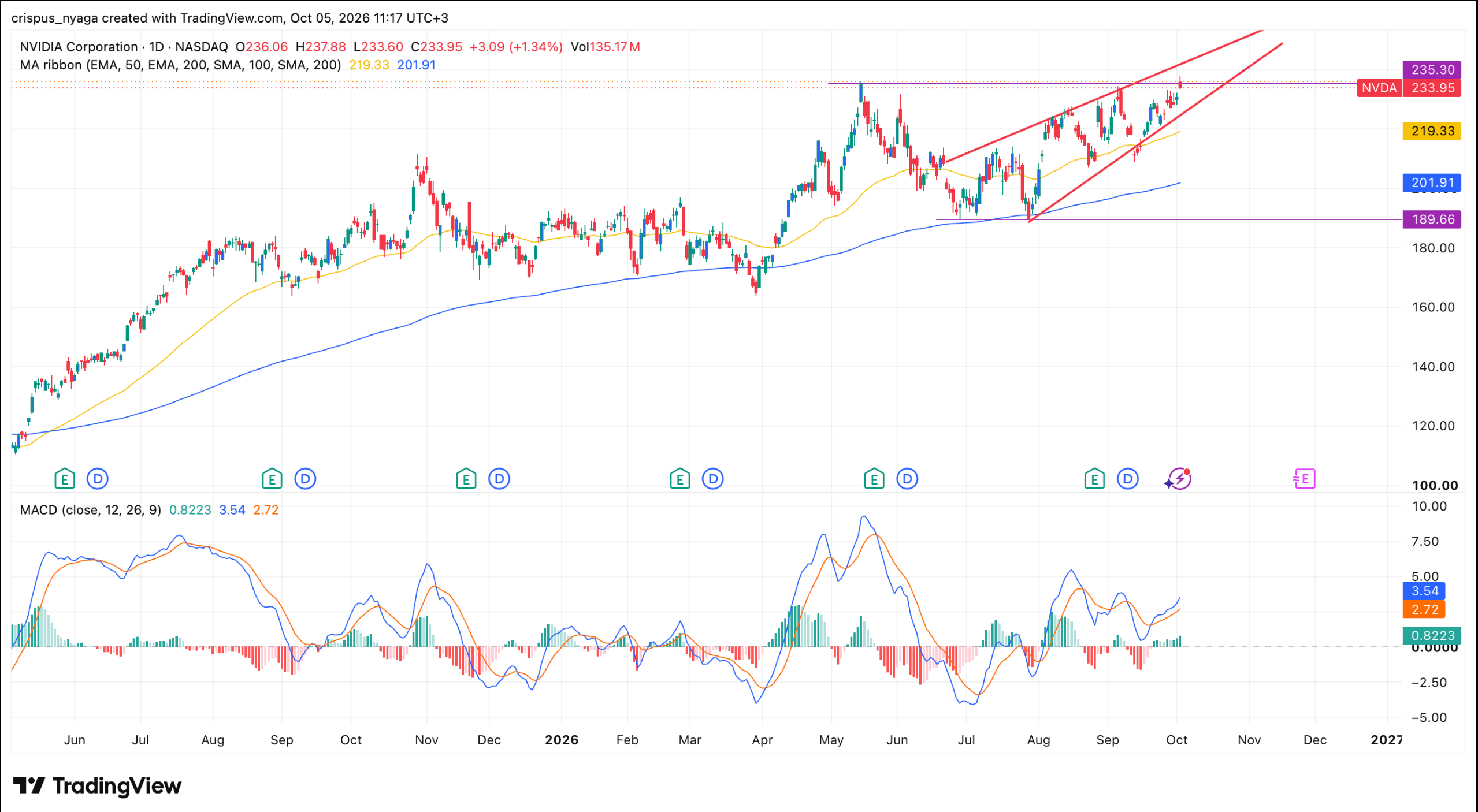
Nvidia shares finished last week within sight of their all-time high after extending a rally that began in late September. The stock touched $237.88 on Oct. 2 before closing at $233.95, as DBS Chief Investment Officer Hou Wey Fook challenged concerns of an artificial intelligence bubble, pointing to Nvidia's earnings growth and forward valuation as evidence supporting his view.
That face-off has made Nvidia one of the most closely watched stocks in the market, with its results and valuation serving as reference points for the broader AI trade. The advance has nonetheless left the shares sitting near a key resistance zone following the strong run, and a rising wedge on the daily chart introduces a possible downside scenario even as broader momentum holds.
DBS CIO Says There Is No AI Bubble
Hou Wey Fook, Chief Investment Officer at DBS Group, a bank with more than $728 billion in assets, argued in a Bloomberg interview that there is no AI bubble, basing his case on the valuations of many companies across the industry.
Nvidia, he noted, trades at a forward price-to-earnings ratio of 24, much lower than its five-year average of 42. Its trailing twelve-month (TTM) multiple of 33 also sits below the five-year average of 58.70. Measured on GAAP numbers, the forward P/E ratio has moved to 23.43, again lower than the five-year average of 51. In theory, a company experiencing strong revenue and profitability growth should trade at a bigger multiple.
That relatively cheap valuation helps explain why Nvidia announced a large share buyback program last week. The company will repurchase shares worth $150 billion, on top of the $80 billion it is currently buying back. The goal is to reduce the number of shares in circulation, a step that normally leads to higher earnings per share (EPS) because profits are spread across fewer shares.
Other companies in the AI space also carry relatively modest valuations. Micron is a good example, trading at a forward P/E ratio of 8 despite its strong financial results — a multiple far below the S&P 500 Index's average of 19. Its earnings report last week showed revenue jumping by more than 330%.
Still, some prominent analysts believe an AI bubble has formed and could burst in the near future. Among the most notable voices warning of one are Michael Burry, who rose to prominence betting against the U.S. housing market before the 2008 financial crisis, and Ray Dalio, the founder of Bridgewater Associates, one of the world's largest hedge funds. With views this divided, the coming round of corporate results will hand each side fresh data to weigh.
Big-Tech Earnings Loom as the Next Catalyst
The next major catalyst for NVDA stock will be the upcoming earnings from its top clients and suppliers. Those results will provide more hints on whether AI-related spending is continuing — and because they land before Nvidia's own report, they will set the tone for expectations heading into its print.
The first important report to watch will come from Taiwan Semiconductor, the world's largest contract chipmaker and Nvidia's biggest supplier. Other top companies scheduled to publish their numbers include its clients Microsoft, Amazon, and Meta Platforms.
Nvidia is usually one of the last companies to publish its financial results. This time, it will release its numbers on November 17, with analysts expecting revenue to come in at $109 billion, up 91% from a year earlier.
Nvidia Stock Price Technical Analysis
The daily chart shows NVDA stock in an upward trend over the past few weeks, having jumped from a low of $189.66 on July 29 to a record high of $237.6. The shares are now hovering around their previous all-time high.
Momentum indicators remain supportive. The stock has stayed above its 50-day 100-day Exponential Moving Averages (EMA), and the two MACD lines have continued to rise. Taken together, these technicals suggest the stock could keep rising, potentially toward the psychological level of $250.
On the other hand, the stock has formed a rising wedge pattern, a common reversal sign. The pattern takes shape as price advances within two ascending trendlines that converge toward one another, and it usually leads to a bearish breakout — in this case, potentially toward $200.
This article is for informational purposes only and does not constitute financial or investment advice. Valuation metrics, technical patterns, and analyst opinions do not guarantee future stock performance.
Source: The Market Periodical

