Nvidia Stock Enters Bear Market as OpenAI Losses Widen and Anthropic Cuts IPO Valuation Target
Key Takeaways
- •Nvidia's stock fell to $166, its weakest level since April 2, pushing it into bear-market territory with market capitalization down nearly $1 trillion and endangering its rank as the world's second most valuable company.
- •OpenAI's third-quarter revenue rose 50% sequentially to $10 billion, but the company still posted a quarterly loss exceeding $10.9 billion and raised only $11 billion against a $30 billion fundraising goal.
- •Anthropic lowered its IPO valuation target to $1.3 trillion from $2 trillion after its S-1 filing showed continued losses amid rising compute costs.
- •Because Nvidia is a major investor in both OpenAI and Anthropic, the marked-down valuations hurt its own worth, and a profitability-driven slowdown at these firms could weaken demand for its chips.
- •CEO Jensen Huang faces scrutiny after admitting an affair with a woman whom US officials believe was a Chinese spy allegedly linked to illicit Nvidia chip sales, raising questions about his leadership amid the lack of a clear succession plan.
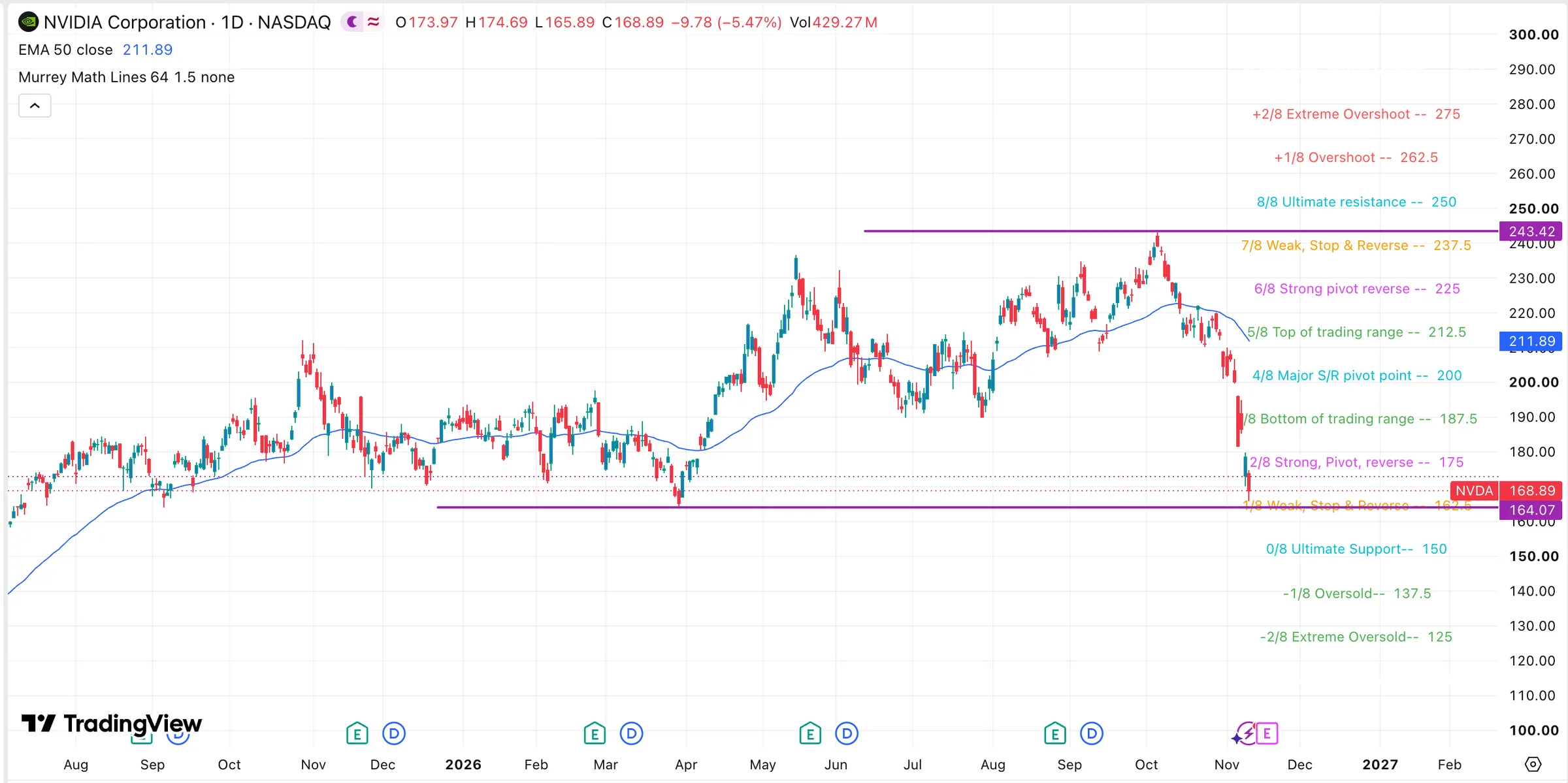
Nvidia shares extended their sell-off on Tuesday, deepening a slide that has pushed the stock into bear-market territory — generally defined as a decline of 20% or more from recent highs — and left it at risk of ceding its position as the world's second-largest company by market value to Alphabet. The decline took the stock to a low of $166, its weakest level since April 2, and the pressure could persist as OpenAI loses momentum and Anthropic's initial public offering (IPO) plans slip further.
OpenAI's Losses Continue to Mount
Nvidia's stock has come under pressure as OpenAI and Anthropic, two companies closely tied to its AI business, continue to confront major challenges.
Revenue at OpenAI jumped 50% in the third quarter from the second quarter to $10 billion, according to The Wall Street Journal. While the growth was encouraging, the company continues to post heavy losses. Its adjusted operating margin improved from minus 150% to minus 109% between the second and third quarters, but the loss for the quarter still stood at over $10.9 billion.
Those figures likely explain a significant setback in the company's fundraising. OpenAI had set out to raise $30 billion at a $1.4 billion valuation, but instead secured $11 billion at a $1.25 trillion valuation — falling short of its original fundraising goal even as revenue accelerated, a gap that underscores the shift toward profitability now reshaping how AI companies are valued.
Anthropic Lowers Its IPO Valuation Target
Anthropic is also facing challenges as it moves toward its IPO. According to the WSJ, the company is now aiming for a $1.3 trillion valuation, far below the $2 trillion it had been targeting. The more sobering outlook followed the release of the company's S-1 filing — the financial disclosure companies submit to US regulators before going public — which showed that it continued to suffer losses amid the rising cost of compute. The reduced target places Anthropic alongside OpenAI among AI companies whose valuations have been marked down, with direct consequences for Nvidia, a major investor in both.
Why the Metrics Matter for Nvidia
These metrics are important for Nvidia for two main reasons. First, the chipmaker is a major investor in both companies, meaning its own valuation has suffered as theirs have been marked down. Second, with investors turning their attention to profitability, the two companies may decide to slow their AI rollouts — a move that could weaken demand for Nvidia's chips. From Nvidia's perspective, the compute costs weighing on those companies are the same spending that drives demand for its chips.
Huang Controversy Adds Pressure
The stock has also dropped sharply amid ongoing turmoil involving CEO Jensen Huang, who admitted to having an affair with a Chinese woman known as Alice Huang. US officials believe Ms. Huang was a Chinese spy passing information to China. It is also believed that her company, Megaspeed, helped facilitate the illicit sale of Nvidia chips to China.
Attention has since turned to how the crisis will evolve and how it could affect the company over the long term. A key concern is whether Nvidia's board will decide to push Huang out at a time when the company has no clear succession plan. On the positive side, other large companies have survived scandals of similar magnitude in the past.
Earnings Report Due Next Week
Nvidia will next publish its financial results next week, which are expected to confirm that revenue growth has continued. Yahoo Finance data shows the company's revenue jumped 91% in the third quarter to $109 billion. In most cases, the actual result tends to come in higher than expected. The report doubles as the next checkpoint for the pressures described above: it will show whether Nvidia's revenue acceleration has held up even as its closest AI partners contend with heavy losses, fundraising shortfalls, and a scaled-back IPO valuation.
Technical Outlook
The daily chart shows that NVDA has dropped sharply in recent weeks, with its market capitalization down nearly $1 trillion. The stock has fallen to a crucial support level that coincides with its lowest swing in March, has slumped below the Strong Pivot Reverse level of $175 on the Murrey Math Lines tool — a framework traders use to map support and resistance — and remains below its 50-day moving average, a widely followed gauge of intermediate-term trend.
Based on those levels, there is a likelihood the stock will bounce back, potentially to the Major S/R pivot point of the Murrey Math Lines at $200. On the other hand, a drop below the key support level of $164 would point to more downside, potentially toward the support at $150.
This article first appeared on The Market Periodical.

