Nvidia Stock Risks $194 as AI Selloff Erases $836 Billion in Market Value
Key Takeaways
- •Nvidia's stock fell nearly 16% from its October peak of $243 to end the month at $204.64, wiping out roughly $836 billion in market value amid an AI-sector selloff.
- •Other major technology stocks declined sharply as well, with Alphabet down more than 30% from its year-to-date high, Amazon down over 16%, Meta down more than 21%, and Intel dropping over 20% in a single session.
- •OpenAI is raising funds at a $1.25 trillion valuation, $10 billion below its original target, a shortfall being closely watched because OpenAI is among the largest buyers of AI computing capacity.
- •Nvidia holds a dual role as the leading GPU supplier, with more than $104 billion in second-quarter revenue and analyst expectations of $411 billion in annual revenue this year, and as a major investor whose Intel stake has shrunk to about $15 billion.
- •Technical indicators show Nvidia trading below its 50-day and 200-day moving averages and the 38.2% Fibonacci level, suggesting bearish momentum with potential downside targets at $198 and $194.
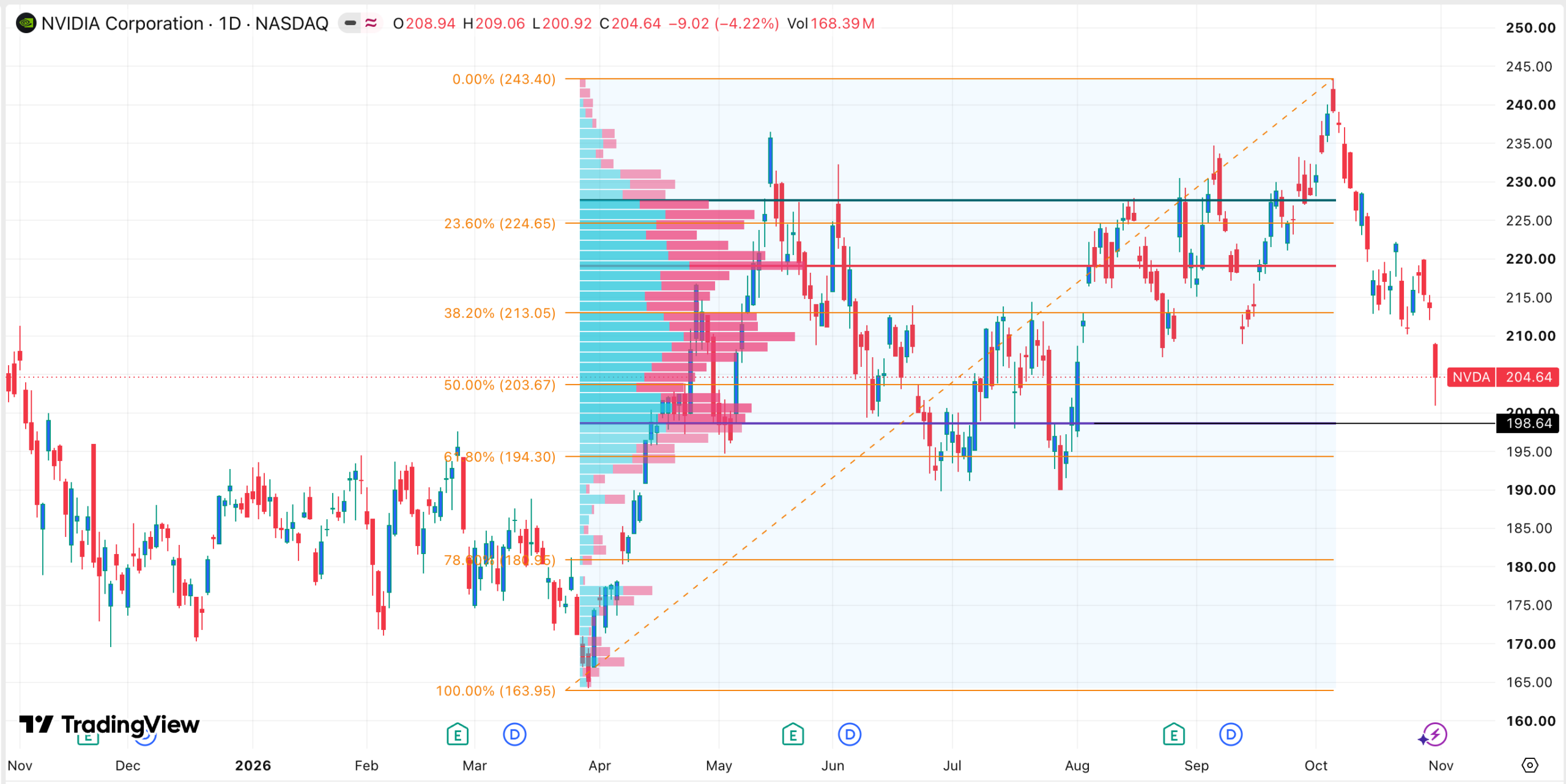
Nvidia stock ended October at $204.64, down nearly 16% from its recent peak of $243, as an intensifying selloff across the artificial intelligence sector wiped out roughly $836 billion of the chipmaker's market value and sharpened concerns that the AI bubble may be starting to burst.
The decline followed earnings-related drops across major technology stocks and fresh concerns about artificial intelligence spending. Investors also assessed weaker fundraising expectations for OpenAI and mounting financing risks among AI infrastructure operators. Even so, cloud providers continued to report rapid revenue growth, complicating claims that demand had collapsed. Nvidia's swing draws outsized attention because its data center chips anchor much of the industry's infrastructure buildout, making the stock a common proxy for confidence in the AI trade.
Nvidia Loses $836 Billion in Market Value
A rout is unfolding across the AI industry as questions over whether it is in a bubble persist. Those concerns accelerated this week, when several of the sector's biggest companies plunged after releasing their quarterly earnings.
Alphabet, the parent company of Google and YouTube, ended the week at $278, down more than 30% from its year-to-date high of $404. Amazon, another leading spender that is pouring more than $220 billion into capital expenditures this year, finished the week at $240, down over 16% from its all-time high. Meta Platforms has slumped by more than 21% from its year-to-date high, while Intel stock cratered by over 20% on Friday alone.
A series of negative headlines compounded the pressure. One was that OpenAI is raising funds at a $1.25 trillion valuation. While that is a large figure, it falls well short of the company's expectations, with the round coming in $10 billion below what it had originally sought to raise. The outcome is being tracked closely across the industry because OpenAI is among the largest buyers of AI computing capacity.
In another report, Blackstone, a leading firm in the private equity industry, said it may not secure an investment-grade rating after its initial public offering. That would be a significant event, since Anthropic is expected to list at a $2 trillion valuation, which would make it the biggest company in the industry.
Nvidia Is Exposed to an AI Slowdown
Nvidia is highly exposed to these developments. It is the biggest supplier of GPUs, generating more than $104 billion in the second quarter, and analysts expect its annual revenue to reach $411 billion this year, followed by $692 billion.
At the same time, Nvidia is a major investor in some of the biggest companies in the AI industry, including OpenAI and Anthropic. The company also suffered a sizable loss when Intel's stock plunged, as Nvidia is Intel's biggest investor and the value of that stake has now dropped to about $15 billion. That dual role, as both the leading vendor of AI hardware and a shareholder in many of the industry's biggest names, has become a focal point of the bubble debate.
Nvidia has also invested heavily in top neoclouds. Its positions include publicly traded companies such as CoreWeave, IREN, and Nebius, along with large stakes in private neocloud operators like Nscale, Lambda, and Firmus. These companies have come under pressure amid warnings that they may be forced to take large write-downs over time.
The neoclouds are also facing funding challenges. Just this week, Elon Musk warned that financing for unprofitable companies had essentially dried up. Indeed, the bond yields of some of the biggest operators, including CoreWeave, have jumped to junk levels, a sign that credit markets now treat these borrowers as carrying elevated default risk.
NVDA Stock Price Technical Analysis
The daily chart shows the NVDA share price has slumped over the past few months, dropping from a high of $243 in October to the current $204. The stock has moved below the Point of Control (PoC) of the fixed range volume profile.
It has also fallen beneath the 50-day and 200-day Exponential Moving Averages (EMA), a sign that bears have already prevailed, and slumped below the 38.2% Fibonacci Retracement level. For readers less familiar with these tools, the PoC marks the price where the most volume changed hands within the measured range, while Fibonacci retracement levels are widely used to flag potential support and resistance zones during pullbacks.
As a result, the path of least resistance for the stock is bearish, with the initial target at $198, the lower area value. A move below that level would point to further downside toward the 61.8% Fibonacci Retracement level at $194.
Beyond the chart, the next reads on the sector's health will come from Nvidia's upcoming quarterly earnings and guidance, hyperscalers' capital spending plans, and progress in OpenAI's funding round or a potential Anthropic listing. Financing conditions for neocloud operators, echoed in their bond yields, offer another signal worth monitoring.
This article is informational and does not constitute financial advice. Stock investments involve volatility and the possible loss of capital.
Source: The Market Periodical

