Nvidia Stock Pulls Back as Earnings Put $80 Billion Buyback in Focus
Key Takeaways
- •Nvidia will report fiscal second-quarter 2027 results on Aug. 26, with analysts expecting record revenue of about $92 billion.
- •The company has committed up to $105 billion in credit and compute for OpenAI’s planned Ohio data center, which will be built by SB Energy.
- •Nvidia also announced a $500 billion financing arrangement involving Brookfield, Goldman Sachs and BlackRock to support companies using its products and services.
- •Investors are watching for any update to Nvidia’s $80 billion share repurchase authorization announced in May.
- •Technically, Nvidia has slipped back toward the $216–$220 area, with $200 identified as the next major support level if nearby support breaks.
Nvidia (NVDA) shares have retreated from their August highs as investors reassess the company's deepening financial commitments to artificial intelligence infrastructure ahead of next week's fiscal second-quarter earnings report.
The stock recently traded around $220 after climbing above $227 earlier in August. The pullback came as investors scrutinized Nvidia's growing role in financing the AI buildout, including multibillion-dollar commitments to data center projects and customer financing programs.
Attention now turns to Aug. 26, when Nvidia is scheduled to report fiscal second-quarter 2027 results. Nvidia's fiscal year ends in late January, which is why a summer report falls under fiscal 2027. The report is expected to provide clearer evidence on revenue growth, margins and the company's capital-return plans — including the additional $80 billion share repurchase authorization announced in May, which has become a focal point for the stock.
AI Financing Commitments Weigh on the Stock
NVDA has slumped over the past several days as investors react to some of the company's recent actions. One of the most significant concerns was Nvidia's decision to back OpenAI's massive data center in Ohio. Nvidia will provide up to $105 billion in credit and compute for the facility, which will be built by SB Energy, a company backed by SoftBank.
As part of the deal, OpenAI will use Nvidia's chips — a provision that has intensified concerns about the chipmaker's circular financing model. Under that model, Nvidia invests in firms that then become clients using its data centers. The company has entered similar agreements with CoreWeave, Nebius and IREN. Vendor-backed financing has a cautionary precedent in prior infrastructure buildouts: telecom equipment suppliers extended large amounts of customer credit during the late-1990s fiber boom, and substantial portions of that credit were written down when the dot-com and telecom bubble burst. That history is one reason arrangements in which a supplier helps fund its own customers attract close scrutiny.
In a separate move, Nvidia reached a $500 billion deal with major financial institutions including Brookfield, Goldman Sachs and BlackRock. Under the arrangement, those institutions will provide financing to companies that use Nvidia's products and services.
The commitments have added to broader concerns about the ongoing AI boom, which some investors believe has become a bubble that may burst soon. If that were to happen, Nvidia would be among the most exposed companies, given its position as one of the boom's top beneficiaries. Nvidia's results are also treated as a read-through for the broader AI trade: data center products generate the bulk of the company's revenue, so its growth figures are widely watched as a proxy for AI infrastructure spending across the industry.
Earnings Report Takes Center Stage
The upcoming earnings report, due next week, is the next key catalyst for NVDA stock. Analysts expect the results to show that the company's growth accelerated in the last quarter. The average estimate calls for revenue of roughly $92 billion — a record high that would represent a near-doubling from the year-ago period. Nvidia's actual results also have a chance of coming in above the company's own guidance and forward estimates.
The share repurchase program may be the most important aspect of the report. In its last report, Nvidia said it would repurchase $80 billion in shares, further reducing the number of outstanding shares.
The company may now decide to boost its buybacks because of its comparatively cheap valuation. Data shows Nvidia has a forward price-to-earnings ratio of 24, well below its five-year average of 42. On that basis, an expanded repurchase program is a possibility.
Nvidia's outstanding shares have been in a steep downward trend, which has helped the company boost its earnings per share in recent years. Shares outstanding have dropped from more than 25 billion in 2022 to 24.2 billion today, and the company is expected to continue that retreat. The decline has coincided with ongoing dividend increases.
Therefore, while an earnings beat and raise may not be enough to lift Nvidia stock on their own, a bigger share repurchase program may do the trick.
Technicals Put $200 Support in Focus
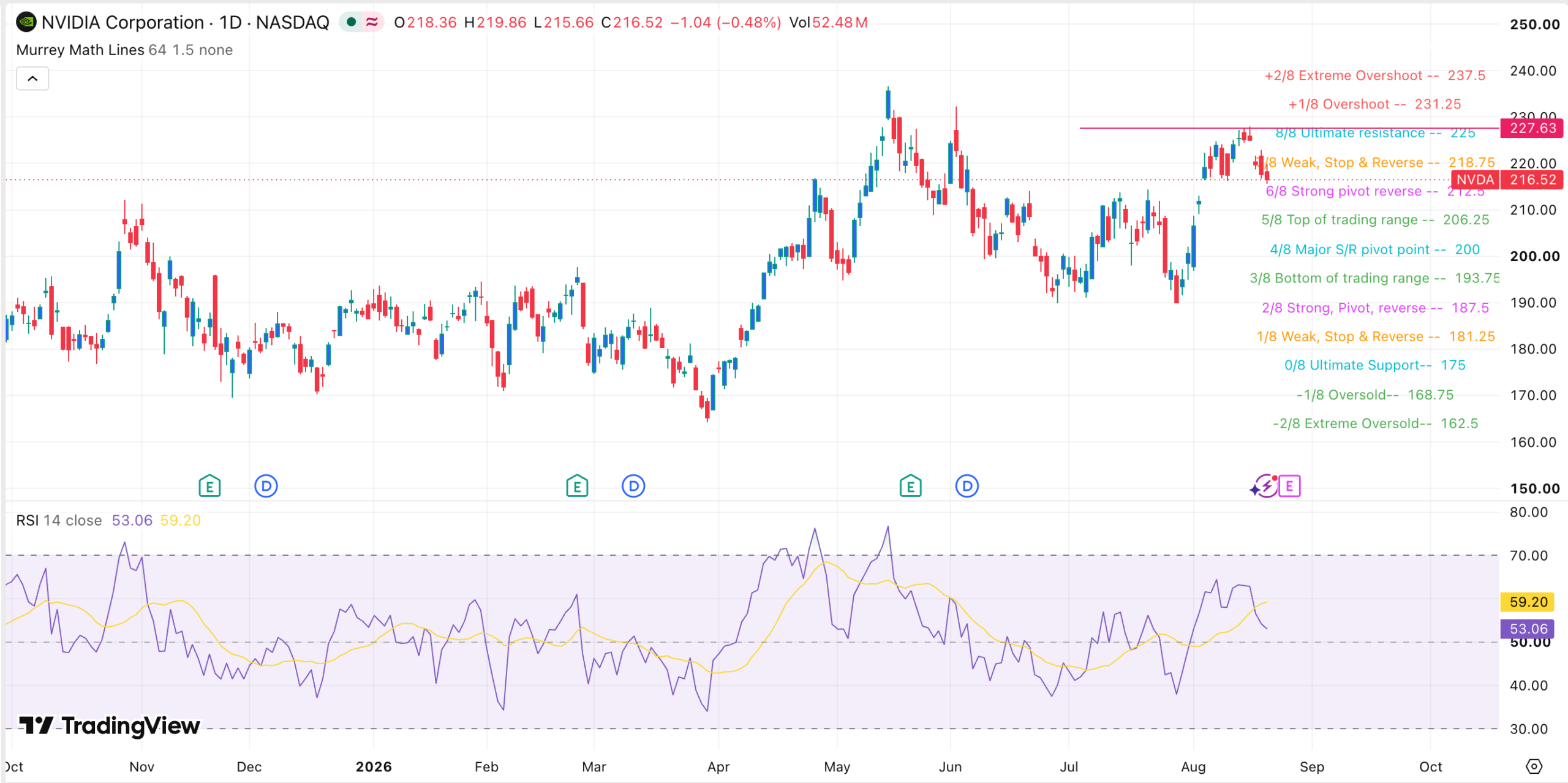
The TradingView daily chart shows Nvidia stock retreating from an August high near $227. NVDA has moved back toward the $216–$220 region after failing to sustain the recent advance.
Momentum has also weakened. The Relative Strength Index has moved toward its neutral 50 level, showing that recent buying strength has faded. The chart also shows price approaching an earlier fair value gap — a zone of price imbalance left by a sharp prior move that traders often watch for potential fills.
The $200 region remains the next larger support area in the supplied technical setup. A decline from $216 to $200 would represent roughly 7% downside. That target remains conditional, however: NVDA would first need to break nearby support before the $200 region becomes the main downside test.
The bullish scenario requires the opposite move. A recovery above the recent $227 high would weaken the pullback structure and return attention toward Nvidia's record high near $236.54.
For now, earnings remain the more important catalyst. Nvidia already has substantial buyback capacity, and the Aug. 26 report will show whether revenue growth, margins and cash generation remain strong enough to support the next move in Nvidia stock. Beyond the headline numbers, investors will also be watching for any update to the buyback authorization and for how management frames its customer financing commitments.
This article is for informational purposes only and does not constitute financial advice. Equity markets can experience sharp price movements.

