Nvidia Stock Breaks Above $210 Resistance as S&P 500 Reaches Record High Ahead of AMD Earnings
Key Takeaways
- •Nvidia's stock broke above the $210 resistance level and has recovered more than 10% from its lowest point last month amid a broad U.S. market rally.
- •AMD's upcoming earnings report is projected to show $11.3 billion in revenue, representing a 47% year-over-year increase, and is viewed as a key signal for overall AI infrastructure spending.
- •Analysts expect Nvidia's revenue to have surged 96% to $91 billion, driven by major technology firms collectively pledging over $750 billion in AI data center investments this year.
- •Technical patterns including a double-bottom at $189 and a breakout above a descending channel suggest potential further upside toward the all-time high of $236.
- •Chinese AI companies Moonshot and DeepSeek have released capable models at lower costs, posing a longer-term risk to AI compute demand dynamics that could affect Nvidia and its portfolio companies.
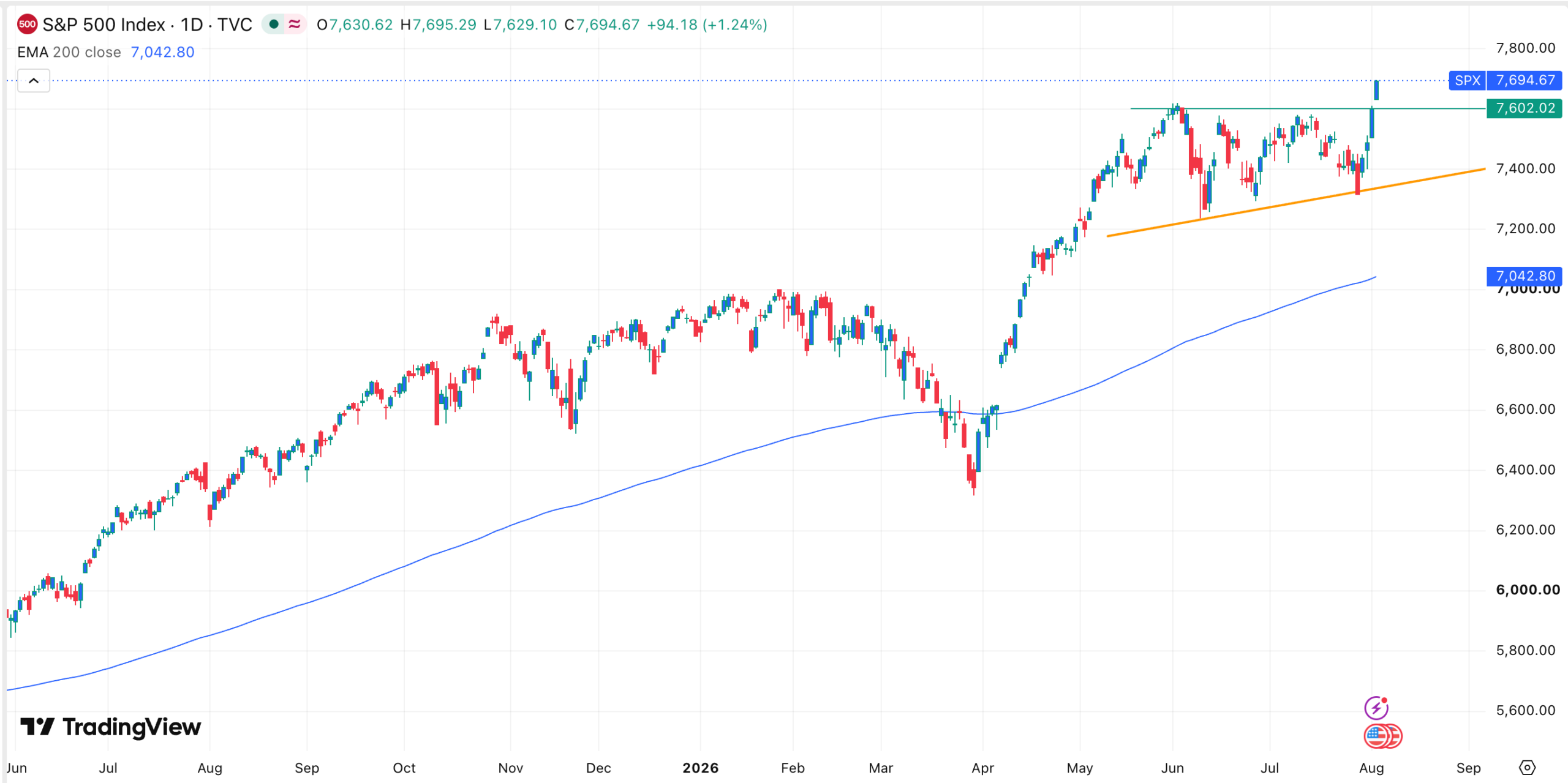
Nvidia (NVDA) shares climbed above the key resistance level of $210 as U.S. equities regained momentum, with the S&P 500 Index notching a record high. The stock has now rebounded more than 10% from its lowest point last month. Market attention is now turning to Advanced Micro Devices' (AMD) earnings report, scheduled for release after the market close.
Broad Market Rally Supports Nvidia's Advance
NVDA has been trending gradually upward amid a broader risk-on environment in U.S. markets. The S&P 500 and Nasdaq 100 have both reached all-time highs, with some analysts suggesting further upside remains possible.
Several factors are contributing to the equity market rally. Crude oil prices have continued to decline, with Brent falling to $80 and West Texas Intermediate (WTI) dropping to $76.70. This pullback followed remarks by Scott Bessent that the United States and Iran were engaged in discussions about reopening the Strait of Hormuz.
Additionally, U.S. corporate earnings have been strong. S&P 500 second-quarter earnings growth exceeded 45%, surpassing analyst expectations. U.S. bond yields have also been declining, with the 10-year yield moving to 4.64% and the 30-year to 5.20%. Equities typically perform well in an environment of falling bond yields, and growth-oriented semiconductor stocks such as Nvidia tend to be particularly sensitive to rate expectations given their elevated valuations and long-duration cash flow profiles.
However, uncertainties remain. There is a risk that hostilities between the U.S. and Iran could resume, which would likely push oil and helium prices higher over the longer term.
AMD Earnings in Focus
The next significant catalyst for NVDA is AMD's upcoming earnings report. AMD is Nvidia's largest competitor, and investors frequently use its results as an indicator of what to expect from Nvidia's own report later in the month. AMD's MI300 series accelerator has positioned the company as the leading alternative supplier of data center AI chips, making its forward guidance a closely watched signal for overall AI infrastructure spending.
Analysts anticipate AMD's revenue at $11.3 billion, representing a 47% year-over-year increase. Annual revenue is projected to grow 43% this year and 60% next year. Beyond top-line growth, traders will be watching whether AMD is gaining market share against Nvidia.
Nvidia is scheduled to report its own earnings later this month. Analysts expect robust results, with revenue estimated to have surged 96% to $91 billion. A key driver behind the company's continued strength is sustained capital expenditure from major technology firms, which have collectively pledged to invest over $750 billion this year — spending tied primarily to data center buildouts for AI training and inference workloads that rely heavily on Nvidia's GPU platforms.
Longer-term risks for Nvidia include the growing competitive presence of Chinese AI companies. Moonshot and DeepSeek have both recently released capable models that are undercutting their American counterparts on cost. If cheaper-to-run AI models gain traction, they could alter the economics of AI compute demand, potentially affecting companies such as OpenAI and Anthropic, in which Nvidia has invested.
Technical Analysis
On the charts, Nvidia broke above the significant resistance at $210 and moved beyond the upper boundary of a descending channel, a formation consistent with a bullish flag pattern that can precede further gains.
The stock has also established a double-bottom pattern at $189, a level that aligned with the 200-day Exponential Moving Average (EMA). Taken together, these technical patterns point to potential additional upside, with the all-time high of $236 representing an approximate 13% gain from current levels. A decisive move above that threshold could open the path toward the next major resistance at $250. Conversely, a decline below the $189 double-bottom would invalidate the bullish technical setup.

