NVIDIA Stock Surges as SpaceX Commits Exclusively to Its AI Chips
Key Takeaways
- •Elon Musk announced during SpaceX's first public earnings call that the company will exclusively use Nvidia products for its computing infrastructure, citing the upcoming Vera Rubin architecture as the best available platform.
- •SpaceX plans to install over two gigawatts of computing capacity by the end of 2026 and aims to reach approximately 10 gigawatts during 2027, a scale comparable to the electricity demand of major metropolitan areas.
- •SpaceX reported total quarterly capital expenditure of $18.4 billion with the majority directed toward AI infrastructure, while its artificial intelligence division generated approximately $2.6 billion in second-quarter revenue alongside heavy losses.
- •All analysts covering Nvidia maintain a bullish outlook with a consensus price target of $304, though the company faces intensifying competition from AMD's Instinct accelerators and in-house custom silicon programs at Amazon and Google.
- •Technical indicators point to a potential near-term rebound for Nvidia shares, with support at the 200-day Exponential Moving Average and a double-bottom breakout, while the next key resistance level sits at the all-time high of $236.
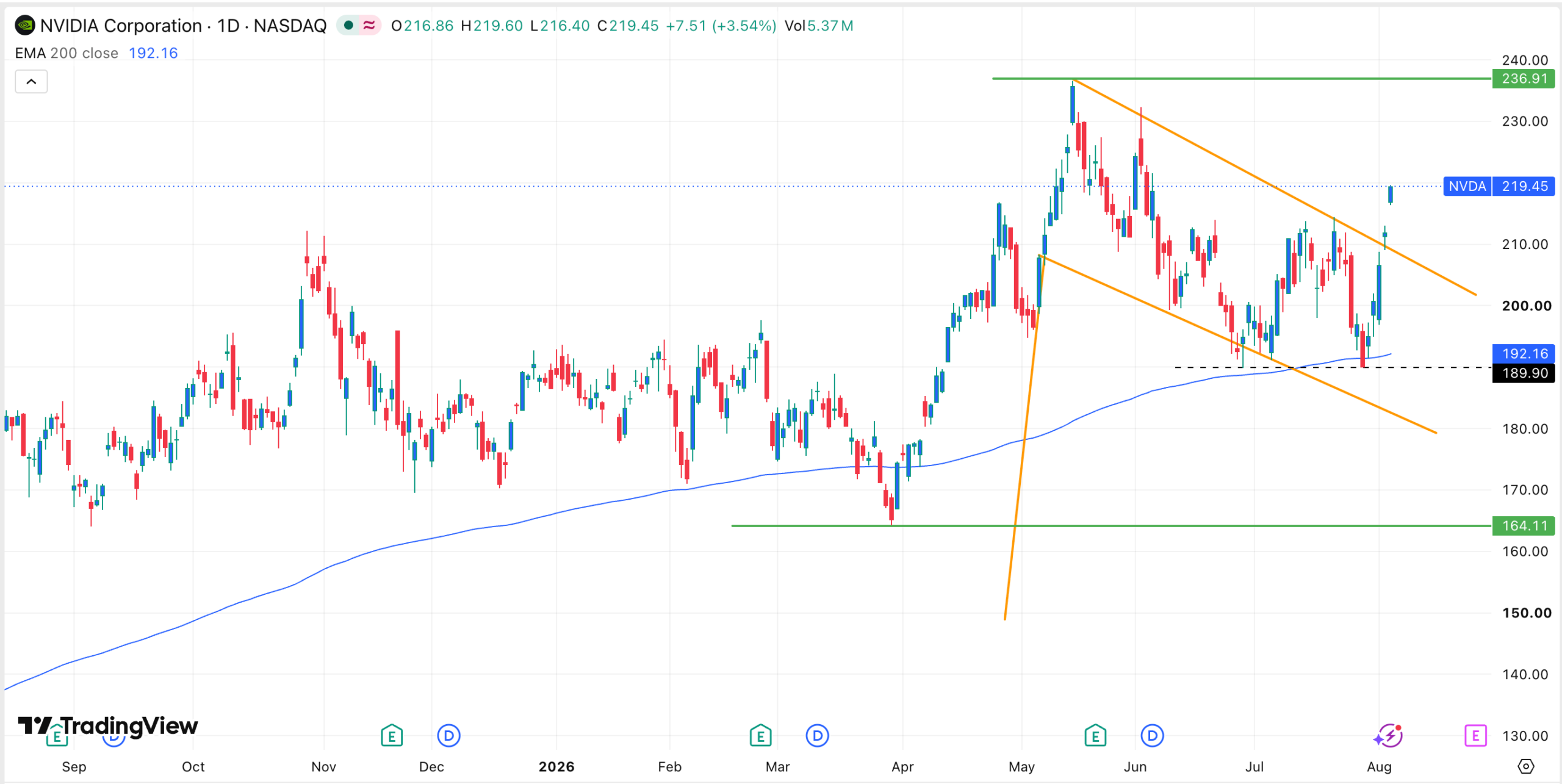
NVIDIA shares climbed approximately 4% on Wednesday, approaching $220, after Elon Musk announced that SpaceX would build its computing infrastructure exclusively around Nvidia products. The endorsement centered on Nvidia's upcoming Vera Rubin architecture, which Musk identified as the strongest option for SpaceX's planned computing expansion. Vera Rubin, named after the pioneering astronomer, is Nvidia's next-generation AI platform succeeding Blackwell, and the public commitment from SpaceX amounts to one of the most explicit high-profile endorsements of that roadmap to date.
"We've decided to build exclusively on Nvidia because we think the Vera Rubin architecture is the best architecture," Musk said during SpaceX's first public earnings call, according to a transcript.
The commitment effectively excludes rival accelerators from AMD and other chip designers from SpaceX's planned infrastructure and positions Nvidia as a primary supplier for a major expansion of artificial intelligence operations that SpaceX acquired through xAI. Nvidia already holds an estimated 80% or more of the AI accelerator market, and a closed-ecosystem decision by a large infrastructure builder like SpaceX reinforces the competitive moat that has made the company the default choice for frontier AI workloads.
SpaceX Outlines Massive Computing Buildout
SpaceX disclosed plans to install over two gigawatts of computing capacity by the end of 2026, with a longer-term goal of reaching approximately 10 gigawatts during 2027, according to reporting on the earnings call. To put that scale in perspective, the largest individual hyperscale data centers today typically operate in the range of tens to low hundreds of megawatts, meaning SpaceX's targets represent power consumption on par with the electricity demand of major metropolitan areas.
The company's artificial intelligence division generated about $2.6 billion in second-quarter revenue. The unit also recorded heavy losses as SpaceX ramped up infrastructure spending. Total capital expenditure for the quarter reached $18.4 billion, with the majority directed toward artificial intelligence infrastructure.
That level of spending could translate into substantial Nvidia orders, though SpaceX did not disclose a fixed dollar value for future GPU purchases. The announcement also arrives amid a broader industry buildout in which the largest technology companies — including Microsoft, Meta, Amazon, and Alphabet — have collectively committed hundreds of billions of dollars to AI data center capacity over the coming years.
Valuation Profile and Analyst Targets
Nvidia currently trades at a forward price-to-earnings ratio of 23, modestly above the S&P 500 Index average of 20. The company's forward PEG ratio stands at 0.53, below the sector median of 1.29 and its own five-year average of 1.44.
According to MarketBeat data, all analysts covering the company maintain a bullish outlook. The consensus price target is $304, representing a potential 43% increase from current levels. The most optimistic forecast comes from Tristan Gerra of Baird, who has set a target of $500.
Despite the bullish sentiment, the company faces headwinds. Competition in the AI chip industry continues to intensify, which could affect its market position going forward. AMD has been advancing its Instinct MI-series accelerators, and both Amazon and Google have been expanding their in-house custom silicon programs. Additionally, shares of several companies Nvidia has invested in — including Lumentum, CoreWeave, and Nebius — have pulled back sharply in recent sessions.
Technical Indicators Signal Potential Rebound
Technical analysis points to a potential near-term rebound. The stock found support at the 200-day Exponential Moving Average (EMA), a historically significant level. NVDA also formed a double-bottom pattern at $191 and subsequently broke above the pattern's upper boundary at $211. A bullish flag pattern has additionally formed, with the stock trading above its upper trendline.
The next key resistance level sits at the all-time high of $236. A move above that threshold could open the path toward the psychological level of $250, followed by $300. Before those targets become relevant, however, the stock must first clear its previous record near $236.

