Nasdaq Rallies 6.5% to Best Day Since April 2025, but Bitcoin's Nvidia-Driven Bounce Fades
Key Takeaways
- •Nvidia's board reinstated Jensen Huang as chief executive on Monday, 11 days after his November 12 resignation, and said an independent committee's investigation into a foreign intelligence effort targeting him will run to its conclusion.
- •The Nasdaq Composite closed at 24,090, up 6.5% from Friday, marking its strongest session since April 9, 2025, while Nvidia shares jumped 31.48%, their best day since May 2003.
- •Bitcoin's climb to about $64,600 on the reinstatement news fully reversed during U.S. trading hours, leaving it roughly $30 below its midnight UTC level after hitting a two-year low near $56,000 on Friday.
- •Monday's returning money flowed into AI stocks, with computing-power companies — several of them former Bitcoin miners — rising more than 20%, while Bitcoin has regained only about a quarter of its slide from $74,000.
- •Analysts flagged Monday's spot Bitcoin ETF flows, several weeks of net inflows plus growing stablecoin supply, near-certain December Fed rate hike expectations, and Wednesday's October PCE inflation report as key tests of whether crypto buyers return.
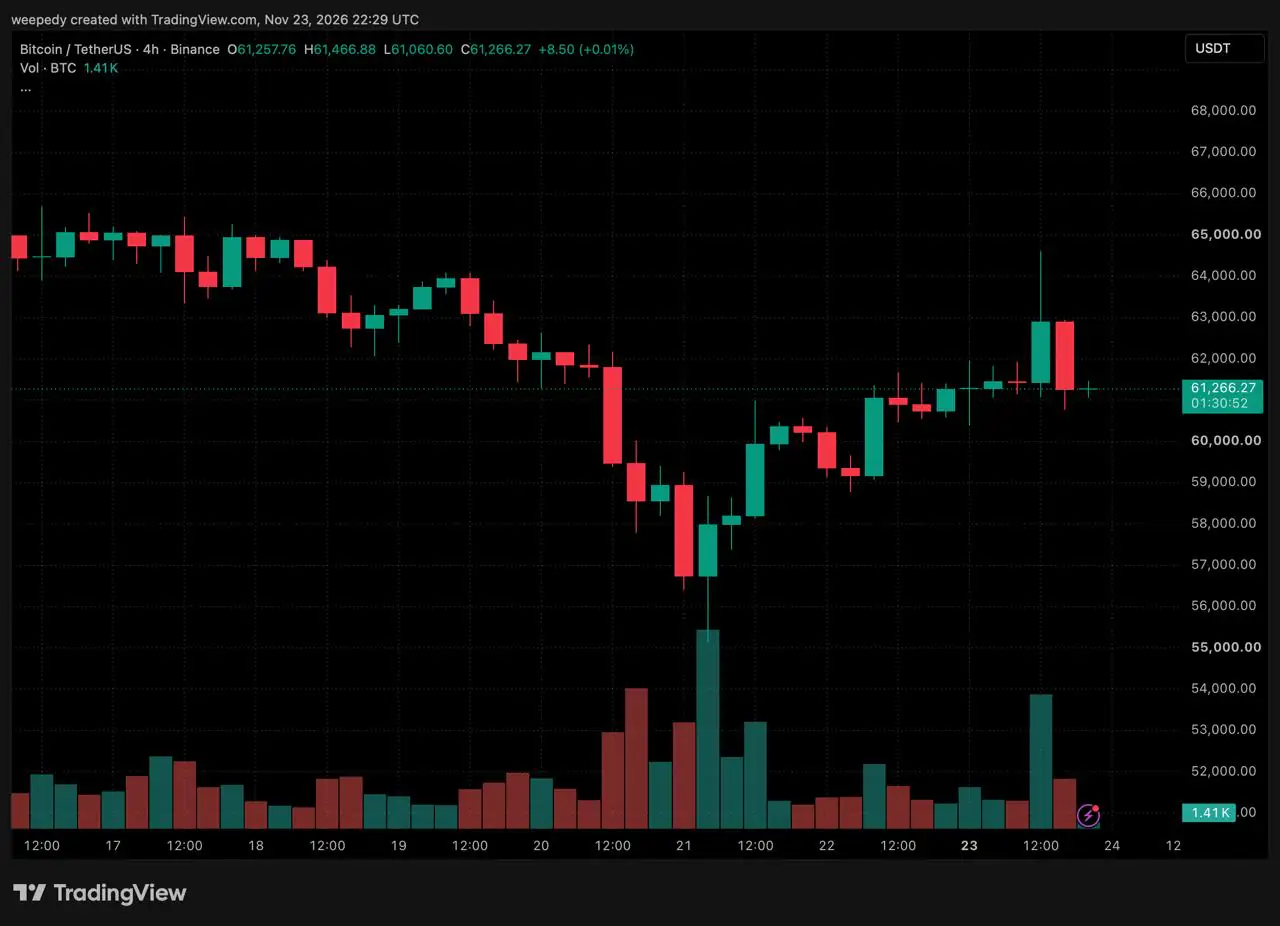
Nvidia's board reinstated Jensen Huang as chief executive on Monday, 11 days after he stepped down, and the news briefly sent Bitcoin back above $63,000 earlier in the day. By the time Wall Street closed, however, nearly all of the cryptocurrency's gains had vanished.
The Nasdaq's best day since April 2025
The Nasdaq Composite closed at 24,090, up 6.5% from Friday's 22,618, according to Nasdaq index data. That made it the index's strongest session since April 9, 2025, and it followed a week in which the Nasdaq lost 10%, CNBC reported.
Nvidia did most of the lifting. Its shares closed 31.48% higher — the stock's best day since May 2003 — after a week of heavy losses that followed Huang's November 12 resignation. In announcing his return, the board said an independent committee's investigation into a foreign intelligence effort targeting Huang would still run to its conclusion.
Nearly all of the index's gain was in place before regular trading began. The Nasdaq opened at 24,270, already 7.3% above Friday's close, touched 24,354, and then drifted lower to finish 0.74% below its opening level.
Bitcoin's rebound came early and faded during U.S. hours
Bitcoin's recovery was already underway when the Nvidia news landed. It fell below $56,000 on Friday, a two-year low, and was back near $61,270 by midnight UTC on Monday. Huang's return then carried it as high as about $64,600 — a 5.4% climb that fully reversed by the U.S. close.
The reversal played out while Wall Street was open. Bitcoin was back below $62,000 by 17:31 UTC, three hours into the U.S. session, and hourly data put it near $61,240 at 21:00 UTC, when stocks closed.
Because Bitcoin trades around the clock, its day runs from midnight UTC, while the Nasdaq's change is measured from Friday's close. Measured from Friday's lows, Bitcoin is also higher, but that gain came over the weekend. Monday's Nvidia news added nothing that lasted.
The contrast in how the two moves held up was stark:
- Nasdaq Composite: about 85% held. The index led Friday's close by as many as 1,736 points and finished 1,472 points higher.
- Bitcoin: none held. It peaked about $3,330 above its midnight UTC level and finished roughly $30 below it.
Why the Nvidia bounce didn't carry into crypto
The money that returned on Monday went to AI stocks. CoinDesk reported that companies renting out computing power — several of them former Bitcoin miners — jumped more than 20% at points during the day. Nvidia has now recovered more than four-fifths of its losses since Huang left, while Bitcoin has regained only about a quarter of its slide from $74,000.
Selling during U.S. trading hours has become a pattern. “Bitcoin has fallen in seven of the eight U.S. sessions since Huang went,” Adam Haeems of Tesseract told CoinDesk. The outlet also noted that Bitcoin's daily declines last week tracked outflows from spot Bitcoin ETFs — exchange-traded funds that hold Bitcoin directly and whose daily flows are widely watched as a gauge of investor demand.
Interest rates add to the pressure. Markets see a December Fed rate hike as close to certain, the two-year Treasury yield sits near 4.7%, and the dollar is at its strongest since March 2025 — conditions the outlet said weigh on Bitcoin. Borrowing demand in crypto lending markets also barely moved during the rally, which CoinDesk read as a sign that leveraged buyers have not returned.
The data that will test Monday's move
Haeems pointed to Monday's spot Bitcoin ETF flows as the first check on whether buyers are coming back. Jasper De Maere of Wintermute told CoinDesk that a few days of data cannot confirm a trend, and that he wants several weeks of net ETF inflows and growing stablecoin supply — often read as a gauge of fresh capital available to buy crypto — before calling a bottom. Wednesday's October PCE inflation report, the inflation gauge the Federal Reserve tracks most closely, and thin Thanksgiving-week trading in U.S. markets come next.

