Nvidia Reinstates Jensen Huang as CEO; Analyst Predicts a Second AI Boom
Key Takeaways
- •Nvidia's board brought Jensen Huang back as president, CEO and board director on November 23, less than two weeks after his resignation over a personal scandal.
- •The reinstatement announcement sent Nvidia shares up 31% by the close, and Anthony Pompliano argued the AI rally would gain renewed momentum because chip demand continues to exceed supply.
- •Nvidia had lost nearly a third of its value after Huang admitted to an extramarital affair, and the board initially stated on November 17 that it had no plans to bring him back.
- •President Trump publicly urged the board to reinstate Huang and later claimed credit for the reversal, while Pompliano said investors should now view Nvidia as indirectly run by the US government.
- •Risks persist from the unchanged board, reports linking the scandal to an alleged Chinese spy, and US export controls on advanced chip sales to China, as Nvidia fell about 7% on Tuesday and tokenized NVDA tested support at $148.
Nvidia's board has reinstated Jensen Huang as president, chief executive officer and board director, less than two weeks after he stepped down amid a personal scandal. The announcement, made on November 23, sent Nvidia shares to a 31% gain by the close that Monday.
Investor Anthony Pompliano quickly called the next leg of the AI rally, arguing that the sector is set for renewed momentum because demand for AI chips continues to outpace supply.
Pompliano: The AI Trade Is Set for a "Second Wind"
In a nine-point post on X, Pompliano argued that "the AI trade is about to catch a second wind." His reasoning centers on supply and demand: the recent sell-off gave the market a breather, yet orders for AI chips still run ahead of what suppliers can deliver. In his words, "demand is still outstripping supply, so we are going much higher."
Pompliano also placed Huang on what he described as the Mount Rushmore of technology founders, and noted that the US stock market added roughly $3 trillion in minutes as the news spread. Few executives can move the entire market with a single press release. Huang, who co-founded Nvidia in 1993, just did.
The bullish case rests on a straightforward idea. Large technology companies continue to spend heavily on data centers, and Nvidia sells the chips those facilities run on. With the leadership drama resolved, investors can return their focus to orders, margins and the next product cycle.
Why the Board Reversed Course
The timeline helps explain the scale of the market's reaction. Nvidia closed at $186.64 on November 6, before Huang admitted to an extramarital affair. From there, the stock lost close to a third of its value. On November 17, the board said it had no plans to bring him back. Six days later, it reversed course, with chair Harvey C. Jones calling Huang "the right person to lead NVIDIA."
Pompliano read the sequence as a lesson in shareholder power. In his view, the board tried to over-govern the situation and the market punished the decision, while the rebound of more than 30% on Huang's return showed exactly where investors stood.
Political pressure played a role as well. President Trump publicly urged the board to reinstate Huang and later claimed credit for the reversal. Pompliano went a step further, writing that investors should now view Nvidia as indirectly run by the US government.
Lingering Risks: Board Composition and China
The comeback does not erase every problem. The same directors who accepted Huang's resignation remain on the board, and Pompliano wrote that "Jensen needs to immediately remove the entire board of directors."
The scandal also carried a China angle. Reports tied one of the affairs to a woman described as an alleged Chinese spy, and the board was compelled to state that Huang's reinstatement poses no national security risk.
On trade policy, Pompliano has argued that the US and Nvidia should flood China with chips so that Chinese firms remain dependent on American supply rather than building better alternatives of their own. Such proposals sit against a long-running policy backdrop: US export controls have restricted sales of Nvidia's most advanced AI chips to China in recent years, making the Chinese market a recurring flashpoint in Washington's technology policy.
Can NVDA Extend Its Gains?
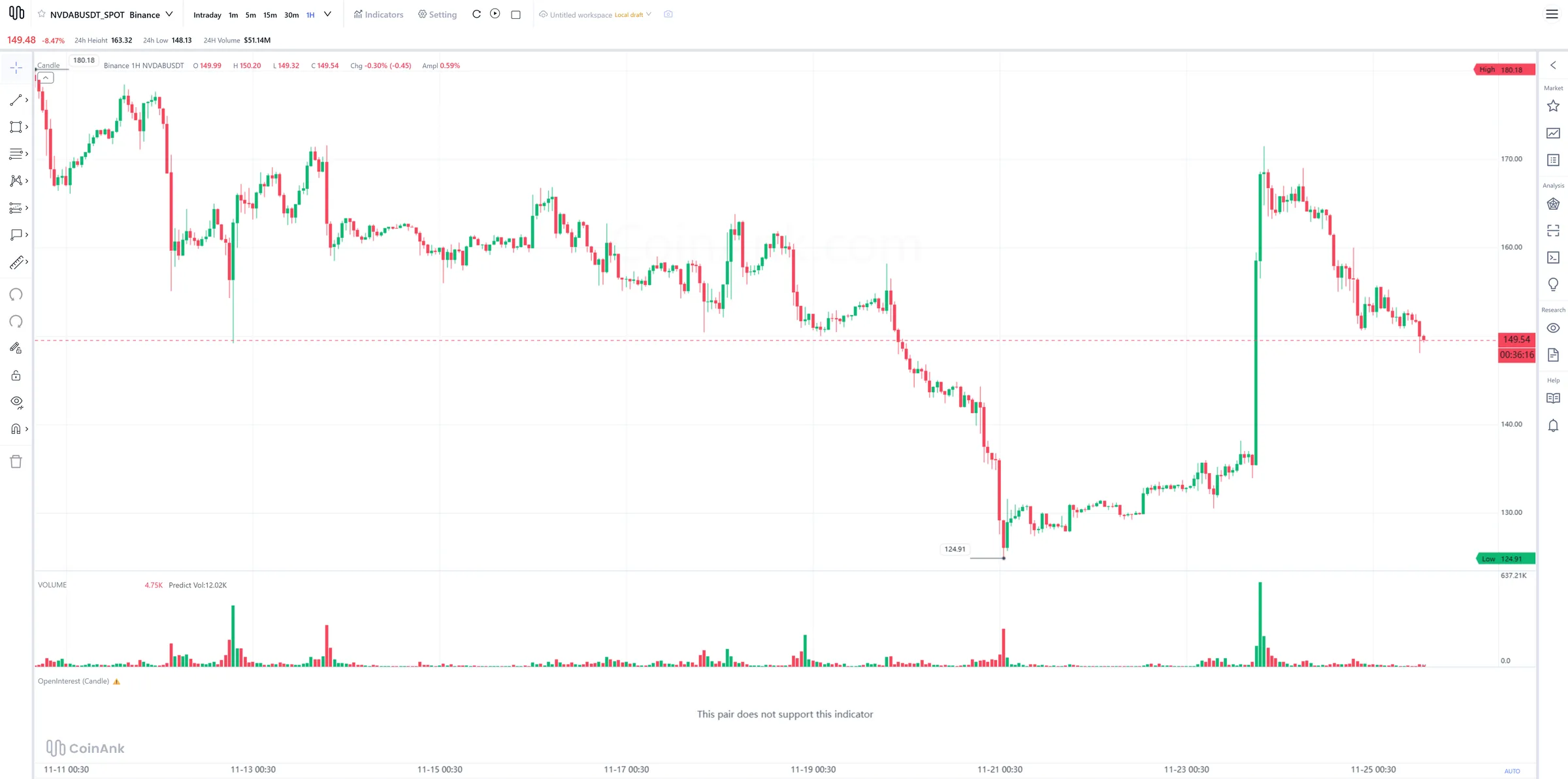
Nvidia stock fell about 7% on Tuesday, and tokenized NVDA — a blockchain-based token designed to track the price of the listed share — traded near $149.50 at the time of writing, down roughly 8.5% over 24 hours and testing support at $148 after surrendering more than half of its reinstatement rally.
The hourly chart captures the full round trip. The pair peaked at $180.18 on November 11, fell to a low of $124.91 on November 21, and then built a tight base between $130 and $137. The reinstatement news produced a single vertical candle from about $136 to $171 on the heaviest volume of the month.
Since that spike, price has stalled first near $170 and then at $160. Sellers are now pressing the $148 to $149 zone, which lines up with the 24-hour low and the November 12 wick. A firm hold above $148 keeps a retest of $160 in play, with $170 as the next barrier. A close below $148 would expose $140, and a deeper decline could pull the price back into the $130 to $136 range where the rally began.
Huang's return settles the leadership question, at least for now. Whether it sparks a second AI boom will depend on chip demand, the unresolved board fight and Washington's next move on China.
This article is for informational purposes only and does not constitute financial or investment advice. Readers should conduct independent research before making investment decisions.
This article first appeared on The Market Periodical.

