Nvidia Q3 Earnings Preview: AI Spending Risks and Governance Concerns Threaten Major Uptrend
Key Takeaways
- •Nvidia is scheduled to release fiscal Q3 2027 results after the US market close on 17 November 2026, with consensus forecasting revenue of US$108.84 billion, up 90.9% year-on-year, and EPS of US$2.47, up 90%.
- •Nvidia's board has launched an independent investigation into CEO Jensen Huang after allegations involving Alice Huang, a former executive at Singapore-based Megaspeed whom US intelligence officials reportedly identified as a Chinese intelligence asset.
- •The company's market capitalisation has fallen almost 30% in less than a month, from US$5.77 trillion on 6 October 2026 to US$4.07 trillion on 10 November, after the shares dropped 4.3% on 9 November following reports of the investigation.
- •Data Centre revenue, which surged 117% year-on-year to US$89.0 billion and represented roughly 92.5% of total revenue in Q2 FY2027, remains the principal growth driver, while management guided Q3 gross margin down to 74% from 75%.
- •Nvidia's Q3 revenue guidance assumes zero Data Centre compute revenue from China, so any incremental export approvals or improved market access would represent upside not currently counted in the company's outlook.
Nvidia (NVDA) heads into its fiscal Q3 2027 earnings report next Tuesday facing a critical test of investor confidence, as concerns over the sustainability of the artificial intelligence infrastructure spending boom are compounded by an emerging corporate governance controversy involving CEO Jensen Huang.
The company's shares fell 4.3% on Monday, 9 November 2026, wiping approximately US$190 billion from its market capitalisation, following reports of an investigation into whether Huang had been targeted by an alleged Chinese intelligence operation. The development has added a new layer of uncertainty over the company's leadership, its US-China regulatory exposure and its elevated valuation.
The world's most valuable company is now contending with a combination of macro and micro headwinds that have driven its market capitalisation down almost 30% in less than a month, from a peak of US$5.77 trillion on 6 October 2026 to US$4.07 trillion on Tuesday, 10 November 2026.
Earnings date and consensus expectations
Nvidia is scheduled to release its Q3 FY2027 results at approximately 4:20 pm US Eastern Time on Tuesday, 17 November 2026, followed by its earnings conference call at 5 pm ET, corresponding to 6 am Singapore time on Wednesday, 18 November 2026. Because the release lands after the US market close, the first trading reaction will come when US markets reopen for the following session, with investors expected to parse both the headline numbers and the call for clarity on the themes examined below.
Street consensus points to another period of outsized growth: revenue is expected to increase 90.9% year-on-year to US$108.84 billion, while earnings per share are forecast to rise 90% year-on-year to US$2.47.
Reflecting the elevated stakes, options markets were pricing an approximately ±10.6% move in Nvidia's shares as of 10 November 2026, above the stock's 10-year average peak earnings-day movement of ±7.8%, according to data from EarningsWatcher. That implied move represents the swing options traders were pricing in either direction around the report, underscoring how much event risk the market is attributing to this print relative to Nvidia's own earnings-day history.
Why Nvidia's earnings matter to the broader US stock market
Nvidia's upcoming results could carry significant implications for the S&P 500 and Nasdaq 100, given the company's substantial index weighting and its increasingly interconnected financial relationships across the US artificial intelligence ecosystem.
Nvidia accounted for approximately 8.18% of the Nasdaq 100 as of 20 October 2026, meaning a 5% movement in its shares alone could move the index by roughly 0.41 percentage points, assuming other constituents remain unchanged.
More consequentially, growing concerns over circular financing — arrangements in which Nvidia invests in, provides financing support to, or guarantees obligations involving AI infrastructure companies that subsequently purchase its chips — have raised questions about the independence and sustainability of AI-related demand.
In August, Nvidia announced a financing initiative targeting more than US$500 billion in third-party capital, with potential company-backed guarantees of up to US$125 billion.
These arrangements could amplify contagion risks: a slowdown in AI demand or tightening credit conditions could weaken data-centre operators' cash flows, restrict their ability to finance new chip purchases and ultimately weigh on Nvidia's future revenue growth. Such a development could trigger simultaneous selling across semiconductor manufacturers, hyperscalers, AI infrastructure providers and private-credit-exposed financial institutions.
Consequently, a stronger-than-expected earnings beat paired with robust forward guidance could restore confidence in the broader AI investment cycle, while disappointing results or signs of weakening end-user demand could accelerate the recent sell-off in the Nasdaq 100 and S&P 500.
With that backdrop in place, here are the six key fundamental factors traders should monitor.
1. Data Centre revenue: the principal earnings growth driver
Nvidia's Data Centre division remains the dominant earnings engine, supported by massive AI infrastructure investment from hyperscalers, cloud service providers and sovereign AI projects.
In Q2 FY2027, Data Centre revenue surged 117% year-on-year to US$89.0 billion, accounting for approximately 92.5% of total revenue. Overall Q2 revenue reached US$96.2 billion, up 106% year-on-year. With the segment generating roughly 92.5% of the top line, the quarter's trajectory effectively rests on AI infrastructure demand rather than on the remaining businesses.
For Q3, management previously guided to total revenue of US$108 billion, plus or minus 2%, while consensus expectations have since risen to approximately US$108.8 billion. The critical issue is whether the company can continue delivering substantial sequential growth as its revenue base expands.
2. Blackwell and Vera Rubin: maintaining the technological edge
Nvidia's ability to retain its dominant position in AI accelerators depends heavily on the successful deployment of its Blackwell architecture and its next-generation Vera Rubin platform.
In its Q2 results, management confirmed that Vera Rubin had entered full production, with deployments progressing across major cloud partners including Microsoft Azure, Google Cloud, Oracle Cloud Infrastructure and CoreWeave.
Attention will focus on production capacity, customer deployment schedules, advanced packaging and the availability of high-bandwidth memory, alongside competition from AMD and hyperscalers' internally developed AI chips.
3. Gross margins: a critical test of pricing power
Nvidia's Q2 non-GAAP gross margin held at 75%, reflecting its exceptional pricing power within the AI accelerator market.
However, management guided Q3 gross margin lower to 74%, plus or minus 50 basis points, as higher manufacturing, packaging and memory costs potentially weigh on profitability.
With quarterly revenue expected to exceed US$108 billion, even a relatively small change in gross margin can translate into a substantial difference in operating profit. Traders will assess whether Nvidia can offset rising infrastructure component costs through higher selling prices, product mix and manufacturing efficiencies.
4. Forward guidance: the biggest fundamental catalyst
Nvidia's earnings reaction will likely depend more on its Q4 FY2027 revenue outlook than on its reported Q3 performance.
The market will be looking for confirmation that AI infrastructure orders remain resilient into early 2027, particularly after recent concerns over hyperscaler capital expenditure, AI financing arrangements and the profitability of large-scale AI deployments.
Nvidia has also announced partnerships involving Apollo, BlackRock, Blackstone, Brookfield, Goldman Sachs and KKR intended to mobilise substantial third-party capital for AI infrastructure development, subject to definitive agreements.
While these arrangements could broaden financing capacity, investors will scrutinise whether AI infrastructure spending is supported by sustainable end-user demand and cash generation.
5. China export controls and geopolitical risks
China remains both a substantial potential market and a major source of regulatory uncertainty for Nvidia.
Notably, the company's Q3 revenue guidance assumes no Data Centre compute revenue from China, reflecting existing restrictions and uncertainties surrounding advanced AI chip exports. Because the outlook already embeds zero China Data Centre compute revenue, any incremental export approvals or improved access would represent revenue not currently counted in the company's guidance.
Attention will focus on whether Nvidia can improve its access to Chinese customers, obtain additional export approvals or face tighter restrictions. The factor is particularly important given that Nvidia's proprietary CUDA software ecosystem and its position in the global AI accelerator market depend in part on the breadth of its international customer base.
6. Jensen Huang investigation: a new governance and national security risk
The most significant new non-earnings catalyst heading into Nvidia's Q3 announcement is the reported governance matter surrounding its chief executive.
According to Reuters reports published on 8–9 November, Nvidia's board launched an independent investigation after allegations that Jensen Huang had a relationship with Alice Huang, a former executive at Singapore-based Megaspeed, whom US intelligence officials reportedly identified as a Chinese intelligence asset.
From an equity valuation perspective, the greater concern is that the investigation could create a prolonged governance discount, especially if it introduces uncertainty over leadership continuity, US export approvals or regulatory compliance.
The development also coincides with a period of heightened investor scepticism towards the broader AI trade, amplifying the risk of a negative reaction to any earnings disappointment. Moreover, any evidence of a security breach, regulatory enforcement action, leadership disruption or additional material disclosures could trigger a sustained valuation derating, even if the company delivers strong earnings.
Fundamental bottom line: what matters most for traders
According to the analysis, Nvidia's Q3 earnings reaction will likely hinge on five key factors: Data Centre revenue growth, Blackwell/Rubin execution, gross margin resilience, Q4 guidance and the implications of the Jensen Huang investigation — with the sustainability of hyperscaler AI spending remaining the overarching fundamental driver.
The bull case, as outlined, combines a clean earnings beat, accelerating AI infrastructure demand, stronger-than-expected Q4 guidance and resilient gross margins, accompanied by reassuring developments in the corporate governance investigation. This combination could trigger a sharp recovery in Nvidia's shares and potentially restore confidence across the wider semiconductor and AI-related technology sectors.
The bear case centres not necessarily on disappointing headline earnings, but on evidence that AI infrastructure spending is losing momentum or that higher costs are beginning to erode profitability. More importantly, any material escalation in the investigation — particularly involving regulatory enforcement, confirmed security breaches or leadership disruption — could introduce a prolonged governance discount even if Nvidia's underlying earnings remain strong.
Technical analysis: potential transition into a major downtrend phase
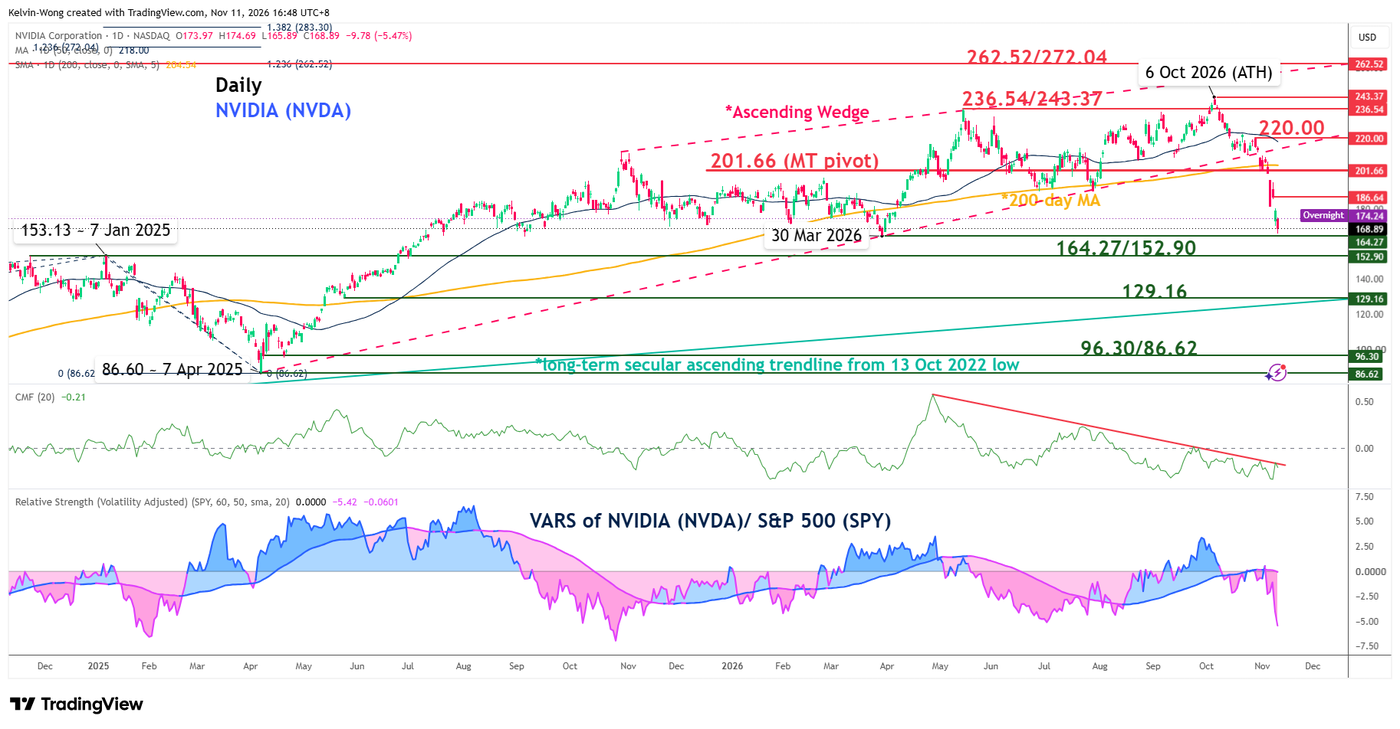
From a charting perspective, the analysis argued that NVDA has staged a bearish breakdown. On 30 October 2026, the stock broke down from its 200-day moving average and the support of an "Ascending Wedge" configuration — identified as a major bearish reversal pattern that formed from the 7 April 2025 low of 86.60 to the all-time high of 243.37 printed on 6 October 2026.
In addition, the Chaikin Money Flow indicator, a combination of price and volume momentum, has continued to exhibit a bearish momentum condition below the zero centreline. Nvidia's volatility-adjusted relative strength (VARS), measured against the broader S&P 500 exchange-traded fund (SPY), also continues to show NVDA underperforming.
Taken together, these observations suggest, per the analysis, that NVDA is in a potential major downtrend phase below the 201.66 key medium-term pivotal resistance, which also coincides with the 200-day moving average. A break below 152.90, the intermediate support, would in the first instance expose the medium-term support at 129.16 — also the long-term secular ascending trendline running from the 13 October 2022 low. Conversely, a clearance and daily close above 201.66 would invalidate the bearish scenario, opening the door to a potential recovery towards the medium-term resistance at 220.00, which also marks the 50-day moving average.
Attribution
This article is a rewrite of analysis published by OANDA MarketPulse on 11 November 2026. The opinions expressed in the original analysis are the author's and do not necessarily reflect those of OANDA Business Information & Services, Inc. or any of its affiliates, subsidiaries, officers or directors. The original publication is provided for informational and educational purposes only.
Original source: Nvidia (NVDA) Q3 earnings preview: AI spending risks and governance concerns threaten major uptrend

