Nvidia earnings could reveal cracks in the AI boom
Key Takeaways
- •Nvidia is scheduled to release second-quarter results after trading ends on Wednesday, August 26, with a conference call set for 2 p.m. Pacific Time.
- •Data center hardware remains Nvidia’s main business, with the segment contributing $75.2 billion of the company’s $81.6 billion in revenue in the most recent reported quarter.
- •Nvidia will begin separating data center revenue into hyperscale customers and AI clouds plus industrial and commercial markets.
- •The company’s outlook assumes no data center compute sales to China, reflecting a sharp decline in its market share there.
- •Analysts and investors are watching whether cloud providers can sustain rising capital spending and keep translating AI infrastructure investment into Nvidia orders.
After trading ends on Wednesday, August 26, Nvidia will report second-quarter results, a release that will matter far beyond the company’s own share price. Chipmakers, cloud providers, and equipment suppliers across the AI supply chain will be watching closely to see whether the surge in infrastructure spending is translating into real orders for Nvidia’s hardware.
According to Nvidia’s investor relations announcement in July, the results will be released at about 1:20 p.m. Pacific Time, followed by a conference call at 2 p.m. Pacific Time.
Why the AI market is watching one report
Few earnings announcements carry this much importance across an entire sector. Nvidia chips are embedded in the data centers being built by Microsoft, Alphabet, Amazon, Meta, and Oracle, which means the company’s sales figures serve as a real-time gauge of how quickly the AI buildout is advancing. The same figures double as a read on the component chain behind that buildout, from memory and networking suppliers to the equipment vendors that fit out the same facilities.
In August, TrendForce raised its forecast for AI server shipments in 2026 to nearly 31% growth year over year, citing stronger orders from major cloud providers for Nvidia’s rack-scale infrastructure strategy. The research firm also said spending by the eight largest cloud companies this year is expected to rise by about 90% to more than $886.7 billion. IDC has reported a similar pattern, saying global server spending climbed 30.7% in the first quarter of 2026, driven by GPU adoption.
What makes up Nvidia’s earnings
For Nvidia, data center hardware remains the core of the business.
When the company last reported results on May 20, data center sales hit a record $75.2 billion, out of total revenue of $81.6 billion. The remaining $6.4 billion came from Edge Computing, Nvidia’s category for PCs, consoles, robotics, and automotive chips.
Nvidia has also decided to split its data center reporting into two categories. One will cover Hyperscale customers, including public clouds and the largest internet companies. The other will cover AI clouds, as well as industrial and commercial markets. The split will make it possible to track those groups separately, at a moment when investors are focused on exactly which customers are driving demand and who is capturing the returns.
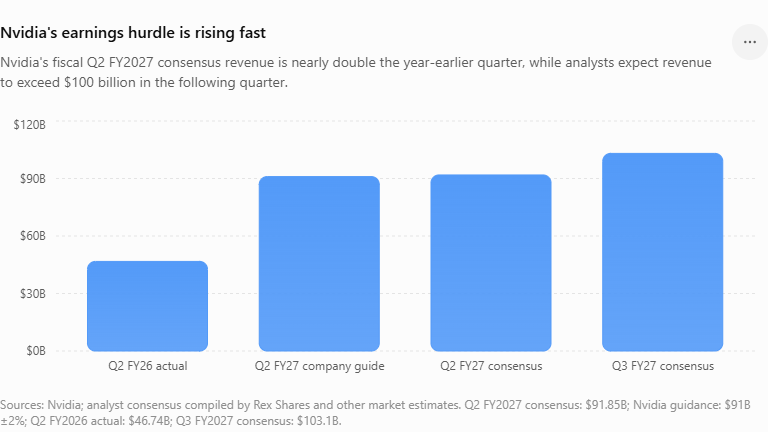
In the first quarter, data center revenue rose 85% year over year, and the company projected total revenue of about $91 billion for the quarter now ending. Wednesday’s report will show whether results reached that bar, and the guidance Nvidia issues for the quarter ahead will be watched just as closely, given how central the company’s outlook has become to expectations across the AI hardware market.
The spending question behind the numbers
The central question ahead of Wednesday’s report is whether cloud computing budgets can keep rising at the current pace.
A Reuters report in July said major hyperscalers are expected to spend more on capital expenditures than they generate in free cash flow by 2027, with capex increasing by about $534 billion, far outpacing growth in operating cash.
“Investors are underestimating how fundamentally AI is changing the Big Tech business model,” Futurum Equities strategist Shay Boloor told Reuters, arguing that AI is turning asset-light software companies into infrastructure-heavy businesses.
Those companies are also Nvidia’s biggest customers. If they slow their spending, Nvidia’s order growth would feel the impact quickly.
Nvidia’s China exposure is already reduced
Nvidia’s outlook also excludes one major market.
The company’s roughly $91 billion forecast assumes no data center compute sales to China, reflecting how much ground it has lost there. Cryptopolitan previously reported that Nvidia’s share of China’s AI chip market could fall to about 8% in 2026 from nearly 40% a year earlier, according to a Bernstein estimate, as Huawei and other domestic suppliers move above half of the market.
Chief executive Jensen Huang has said Nvidia “largely conceded that market” after years of tighter U.S. export restrictions. Small shipments of H200 accelerators have started returning under case-by-case licenses, but Chinese companies are increasingly redirecting budgets toward domestic chips.
The question of who captures the returns
Another recent development is Nvidia’s reported warning to major customers that AI-server prices could rise more than 15% from early 2027, largely because of higher memory costs. That could affect gross margins and the economics of the broader AI infrastructure buildout. For Nvidia’s customers, an increase of that size would land on the same capital budgets that Reuters projects will exceed free cash flow by 2027.
Reuters reported last week that investors are increasingly shifting from asking how much Big Tech is spending to asking who is actually capturing the economic returns. Strong cloud demand and continuing capacity constraints have so far helped ease concerns about AI spending, but Nvidia’s challenge is now more specific: whether more than $700 billion of hyperscaler spending can continue to translate into faster chip revenue growth. Wednesday’s results, the new customer breakdown, and the guidance for the quarter ahead will offer the first concrete evidence on that question since the debate shifted.

