Nvidia's $1 Trillion Wipeout: CoinCodex Forecast Sees Gradual NVDA Recovery Through 2027
Key Takeaways
- •Nvidia's stock has declined about 25% from its recent peak, wiping out more than $1 trillion in market capitalization amid the controversy involving CEO Jensen Huang.
- •Shares fell 4.3% on November 9, erasing roughly $192 billion in value, even as the S&P 500 gained 2.35% and the Nasdaq Composite climbed 2.7% the same session.
- •A shareholder lawsuit in California accuses Nvidia and Huang of misleading investors about his alleged relationship with a former Megaspeed executive, though the board says it has no reason to believe company secrets or national security were compromised.
- •CoinCodex forecasts Nvidia averaging $223.06 by December 2027, roughly 34.7% upside, while the average Wall Street 12-month target stands near $325.78, with individual targets ranging from $300 at Goldman Sachs to $400 at Bernstein.
- •Competitive pressure is rising as Alphabet develops custom Tensor Processing Units with Broadcom, with Wells Fargo estimating Alphabet's TPU sales could reach $99 billion in 2027.
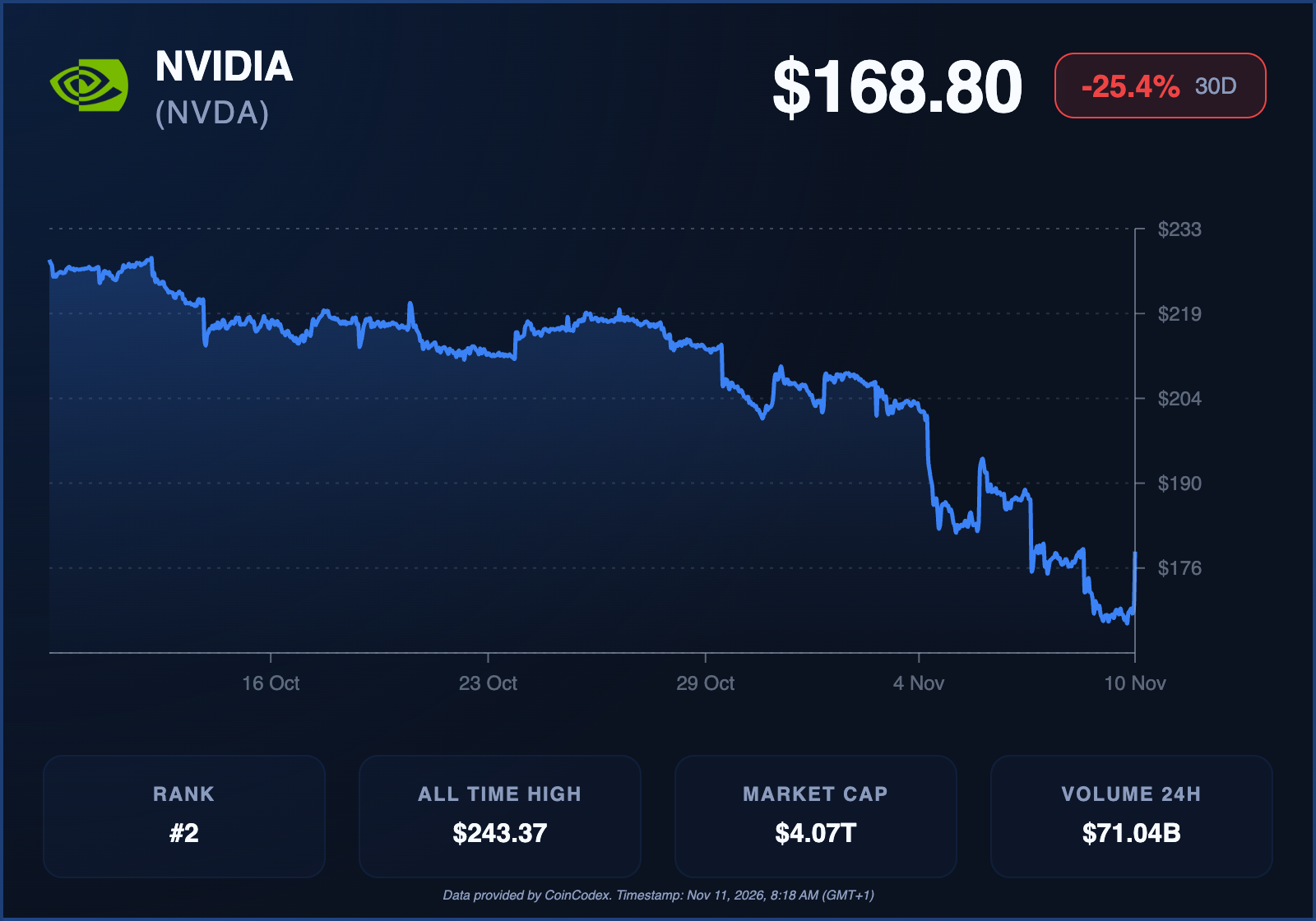
Nvidia is navigating one of its most turbulent stretches in years. The chipmaker's stock has slid roughly 25% from its recent peak, erasing more than $1 trillion from its market capitalization, and the selling has intensified since reports emerged of a national security investigation involving CEO Jensen Huang. The turmoil has added another layer of uncertainty to an already fragile artificial intelligence trade. Even so, the latest CoinCodex forecast for the chipmaker projects a gradual recovery through 2027, with gains of more than 30% across the forecast period.
Nvidia Shares Slide as CEO Investigation Deepens Investor Concerns
Nvidia shares fell 4.3% on November 9, wiping out roughly $192 billion in market value even as the broader US market staged a strong recovery. The S&P 500 gained 2.35% and the Nasdaq Composite climbed 2.7% the same session, underscoring how the company's specific troubles have begun to outweigh improving market sentiment.
The drop followed Nvidia's announcement of an independent investigation into reports that Huang had been targeted by a foreign intelligence operation. The controversy deepened after Huang acknowledged an extramarital affair, and President Donald Trump confirmed that the FBI was examining the matter.
A shareholder lawsuit filed in California has since accused Nvidia and Huang of misleading investors about the executive's alleged relationship with Alice Huang, a former executive at Singapore-based Megaspeed. The complaint raises questions about potential national security exposure and the company's earlier disclosures. The allegations remain subject to investigation and legal proceedings, and Nvidia's board has stated it has no reason to believe company secrets or national security were compromised.
The developments arrive at a difficult moment for shareholders. After becoming the first company to surpass $5 trillion in market capitalization in 2025, the semiconductor giant has endured a steep valuation contraction as Wall Street reassesses the sustainability of AI infrastructure spending.
Analysts are particularly focused on Huang's importance to Nvidia's long-term strategy. Dan Ives, partner and senior managing director at Yorkville Ives & Co., described the CEO as central to the company's identity and AI ambitions, arguing that his leadership would be extremely difficult to replace. Citi analysts identified two major risks: whether the investigation could threaten Huang's position, and whether potential regulatory consequences might restrict Nvidia's business operations.
Not every market observer believes the controversy will fundamentally damage the company's outlook. Nigel Green, CEO of deVere Group, suggested the situation remains primarily a personal scandal unless investigators uncover more serious issues.
AI Infrastructure Spending Could Support the Recovery
Despite the recent volatility, Nvidia remains one of the most important suppliers in the global AI infrastructure market. Its graphics processing units power advanced AI systems developed by companies including Alphabet, Meta, and Anthropic, and its hardware continues to underpin major cloud computing investments.
Alphabet's expansion illustrates why demand for AI processors could remain substantial. The Google parent company expects to spend between $195 billion and $205 billion on infrastructure in 2026, with Nvidia and Broadcom among the semiconductor suppliers benefiting from its investments. Google Cloud revenue more than doubled to $33.7 billion in the third quarter, operating profit reached $11.1 billion, and the division's $561 billion backlog points to considerable demand for cloud computing capacity in the years ahead.
These developments could benefit Nvidia as technology companies continue expanding their computing infrastructure. Goldman Sachs estimates that global AI cloud revenue could reach $2 trillion by 2030, signaling a substantial long-term opportunity for semiconductor manufacturers.
Competition, however, is becoming increasingly relevant. Alphabet is developing custom Tensor Processing Units with Broadcom, while other major technology companies are exploring alternatives to Nvidia's GPUs. Wells Fargo analysts estimate that Alphabet's TPU sales could reach $99 billion in 2027, illustrating the potential scale of the emerging custom-chip market. Nvidia still holds a dominant position in AI accelerators, but investors increasingly question whether its premium valuation can be sustained as competition expands and customers demand stronger returns from their infrastructure investments.
The company's November 17 earnings report could therefore become an important catalyst. Investors will be watching revenue growth, data center demand, profit margins, and management's guidance for evidence that the underlying AI business remains resilient despite the leadership controversy.
CoinCodex Nvidia Price Prediction: Can NVDA Recover Through 2027?
According to the latest CoinCodex NVDA price forecast, the stock could begin a gradual recovery before gaining stronger momentum in the second half of 2027. The forecast points to a relatively measured rebound rather than an immediate return to previous highs, suggesting investors may need patience as Nvidia works through its current challenges.
CoinCodex projects an average price of $180.23 for November 2026, with the stock potentially reaching $183.06 during the month. December's average forecast rises to $184.72, while the upper estimate reaches $186.50, indicating expectations of modest near-term appreciation.
The outlook turns more constructive in early 2027. Average projected prices climb to $188.65 in January and $193.16 in March, approaching $198.37 by June. The progression suggests the forecasting model anticipates steady improvement through the first half of the year, though the projected gains remain relatively moderate.
Momentum could strengthen considerably during the summer. CoinCodex expects Nvidia's average price to reach $208.82 in July and $215.19 in August, with September's upper estimate climbing to $221.84. The stronger second-half projections suggest the model anticipates improving market conditions after a slower initial recovery.
By December 2027, CoinCodex forecasts an average Nvidia share price of $223.06, with a potential high of $225.56, representing approximately 34.7% upside relative to the reference price used in the forecast. Notably, the model does not anticipate a major sustained downturn during 2027: even the comparatively slower months of April and May show gradual price appreciation, and November's projected average of $218.32 represents only a modest pullback from October's $220.96.
The overall pattern points toward a recovery that accelerates in the second half of 2027, potentially allowing Nvidia to regain some of the market value lost during its recent correction.
Wall Street Analysts See Nvidia Rebounding Toward $300 to $400
While CoinCodex's quantitative forecast sketches a gradual recovery, several major Wall Street firms maintain considerably higher price targets despite the selloff. Analyst estimates compiled by StockAnalysis show an average 12-month target of approximately $325.78 across 62 analysts, suggesting substantial recovery potential compared with Nvidia's November 9 closing price of $178.67.
Goldman Sachs analyst James Schneider reiterated a Buy rating with a $300 price target on November 10, implying roughly 68% upside from that closing level. Wells Fargo also maintained a positive outlook, though it lowered its target from $315 to $300, reflecting a more cautious assessment of the company's near-term prospects. RBC Capital Markets analyst Srini Pajjuri kept a $330 target, representing potential upside of nearly 85%. Bank of America analyst Vivek Arya remained more optimistic, maintaining a $350 price target that would imply gains of approximately 96% if achieved.
Bernstein analyst Stacy Rasgon holds one of the more aggressive forecasts among major investment firms, maintaining a $400 target on November 9. That level would represent approximately 124% upside from Nvidia's November 9 close, suggesting some analysts continue to see considerable long-term value despite the company's recent difficulties.
These targets contrast sharply with CoinCodex's projected December 2027 average of $223.06. Where the quantitative model anticipates a recovery of roughly one-third from its reference price, Wall Street's more bullish scenarios suggest Nvidia could regain a much larger portion of its lost valuation if earnings growth remains strong and investor confidence returns.
Analysts are not uniformly optimistic, however. Aletheia Capital downgraded Nvidia to Hold on November 9, while Wells Fargo's reduced target illustrates how the controversy and broader AI spending concerns are beginning to influence expectations.
The gap between these forecasts reflects contrasting assumptions about Nvidia's future. CoinCodex's model projects a comparatively steady recovery based on its quantitative methodology, which generates algorithmic projections from historical price data rather than fundamental company research, while Wall Street price targets incorporate analysts' expectations for earnings growth, valuation multiples, competitive positioning, and AI infrastructure demand. The key question is whether Nvidia can deliver enough earnings growth to justify the more ambitious $300 to $400 targets. Continued expansion in AI computing demand could support those valuations, but additional regulatory uncertainty or weaker technology spending could make the more conservative CoinCodex trajectory appear increasingly realistic.
Can Nvidia Rebuild Its Lost Market Value?
Nvidia's recent decline has exposed how quickly sentiment can shift around even the largest beneficiaries of the AI boom. The company remains central to the global semiconductor supply chain, but the investigation involving Huang has introduced risks that investors cannot evaluate through earnings forecasts alone.
CoinCodex's projection of a potential move toward $225 by the end of 2027 offers a cautiously optimistic scenario, while Wall Street targets ranging from $300 at Goldman Sachs to $400 at Bernstein suggest considerably greater upside if Nvidia can restore confidence and sustain its earnings momentum.
The immediate focus will be the November 17 earnings report and any developments in the board's investigation. Beyond that print, updates on hyperscaler capital-spending plans and progress on custom-chip alternatives such as Alphabet's TPUs will provide additional checkpoints on the demand and competitive backdrop investors are weighing. Strong financial results could help restore confidence in the underlying business, while additional legal or regulatory complications could keep pressure on the stock despite its longer-term growth prospects.
For now, Nvidia's next major move may depend as much on restoring investor trust as on maintaining its leadership in AI computing.

