Nvidia Targets Physical AI With New Jetson Orin Nano 2 Edge Platform
Key Takeaways
- •Nvidia unveiled the Jetson Orin Nano 2, an edge AI platform for real-time robots, drones and vision AI systems, with availability expected in the first half of 2027.
- •The company claims the platform offers twice the performance of the previous generation or up to 40% lower energy consumption at the same performance level.
- •Initial customers Cognex, Doosan Bobcat and Matic span industrial, commercial and consumer applications.
- •Nvidia says the platform runs small and medium language and vision-language models in real time, with Nemotron 3.5 Lightning reaching roughly 115 tokens per second on Jetson.
- •Omdia analyst Alexander Harrowell cautioned that memory capacity is likely the limiting factor for what the Orin Nano 2 hardware can support.
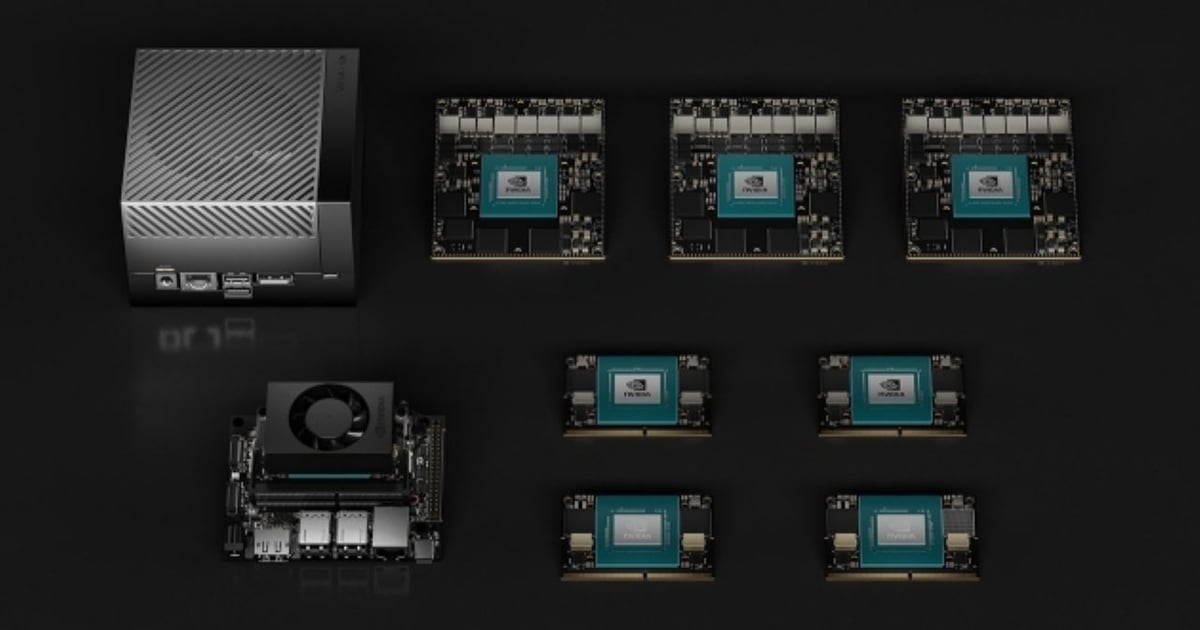
Nvidia has introduced the Jetson Orin Nano 2, a new edge AI platform designed for building robots, drones and vision AI systems that operate in real time, as the chipmaker continues its push to bring physical AI — machines that sense and act in the physical world rather than only generate text or images — into the real world.
The platform, unveiled on Tuesday and expected to be available in the first half of 2027, is based on a new version of Nvidia's Ampere architecture silicon. Nvidia named machine vision company Cognex, construction equipment maker Doosan Bobcat and robot vacuum startup Matic as initial customers, a lineup spanning industrial, commercial and consumer applications.
According to Nvidia, the Nano 2 offers twice the performance of the previous generation, or up to 40% lower energy consumption at the same level of performance. Because edge systems run AI directly on the device rather than in a data center, both numbers matter for battery-powered robots and drones that must react in real time without a server's power or cooling budget.
Speaking at a media briefing, Deepu Talla, vice president of robotics and edge AI at Nvidia, said the release responds to model accuracy reaching a "tipping point."
"What used to take a large data center and many GPUs, now can be run on Nvidia Jetson," he said. "We can now achieve the same frontier accuracy as the largest models from last year."
This increased accessibility of high-performance AI models bodes well for the robotics industry and, Talla said, is finally making sophisticated physical AI practical at the edge.
"Robotics is a three-computer problem," he said. "The first computer is where we do all the training of intelligence, and the second computer in the middle is where we do all the testing and policy evaluation. The last computer, the third computer, is the runtime or the robot brain, and that's Nvidia Jetson."
Real-Time Models at the Edge
Nvidia says the Orin Nano 2 can run the latest small and medium-sized language and vision-language models in real time. Talla pointed to Nvidia's own Nemotron models as an example, noting that the latest Nemotron 3.5 Lightning can run at around 115 tokens per second on Jetson.
That performance is enabled not only by hardware improvements but also by advances in model training. Talla attributed the progress to better training data, improvements in model architecture and the ability to use larger models to train, or distill, smaller ones. The result, he said, is a robotic training framework that will be faster and easier than previous systems.
Bringing Down the Robotics Bill
"In the past robotics programming was extremely time-consuming and expensive," Talla said. "But now, with autonomous capability, robot programming is going to become extremely easy, and we're already seeing an explosion of AI applications at the entry level."
The shift could make robotics economical beyond high-volume industrial applications, as AI models automate more programming tasks.
The Jetson family, which Nvidia has marketed to developers since 2014, has long anchored its edge computing business, and the company is not alone in the segment: Qualcomm, AMD and Intel also sell processors aimed at edge AI workloads.
Ben Lee, a professor at the School of Engineering and Applied Science at the University of Pennsylvania, said Nvidia's existing position in edge AI gives it a strong starting point as robots require increasingly capable models to operate locally.
"Nvidia has had a significant market in edge AI chips with the Jetson platform," Lee said. "Integrating more capable AI processors and providing additional software support for inference could enable the use of newer AI models in robotics and other autonomous systems."
Lee also highlighted the economics of deploying robots beyond traditional industrial environments, saying a more mature software stack could reduce the engineering burden that has historically made robotics difficult to justify for lower-value applications.
"For robotics, the challenge is that engineering costs are hard to justify for general, lower-value use cases," he said. "A mature software stack that makes these robots and processors easier to program will reduce engineering effort and lower costs."
Small Models, Bigger Footprint
Nvidia's pitch to the robotics market lands amid a broader shift in what counts as a small model in the first place, according to Alexander Harrowell, an analyst at Omdia, a division of Informa TechTarget.
"It's definitely true that more AI is going into robots, with small multimodal transformers becoming more common in that space," Harrowell said.
That distinction matters for how the industry should read Nvidia's specifications, he suggested.
"Although small AI models are getting much better and more important, what we see as a small model is changing," he said, noting that a typical model on Hugging Face has grown from roughly 10 to 100 million parameters to 3 to 8 billion. Hugging Face is a widely used public repository where AI models are shared.
Harrowell was more skeptical about what the Orin Nano 2's hardware can actually support.
"Looking at the Nano 2 specs, the limiting factor is memory capacity," he said.
With availability not expected until the first half of 2027, how much memory the final hardware carries — and which models fit within it — will be among the key details developers weigh as they plan systems around the platform.
Source: AI Business

