Nvidia's Post-Huang Era Begins: Colette Kress Takes Charge as Backlash Builds
Key Takeaways
- •Colette Kress, Nvidia's CFO since 2013, is serving as interim CEO while Harvey C. Jones has become the company's first-ever board chair, and the permanent CEO search has no set timeline.
- •The board's Wachtell-led investigation into Huang's conduct, including reports of a relationship with a suspected Chinese intelligence asset, remains open, and Huang has agreed to testify before Congress on December 3.
- •An internal employee post urging Huang's reinstatement drew more than 1,600 comments, and a Blind poll of 232 Nvidia employees found 88% believed he should stay.
- •NVDA shares opened down 13.1% on Thursday, their second-worst start to a session since at least 2020, before recovering to close 4.3% lower at $166.19, and remain about 28% below their October 6 record close.
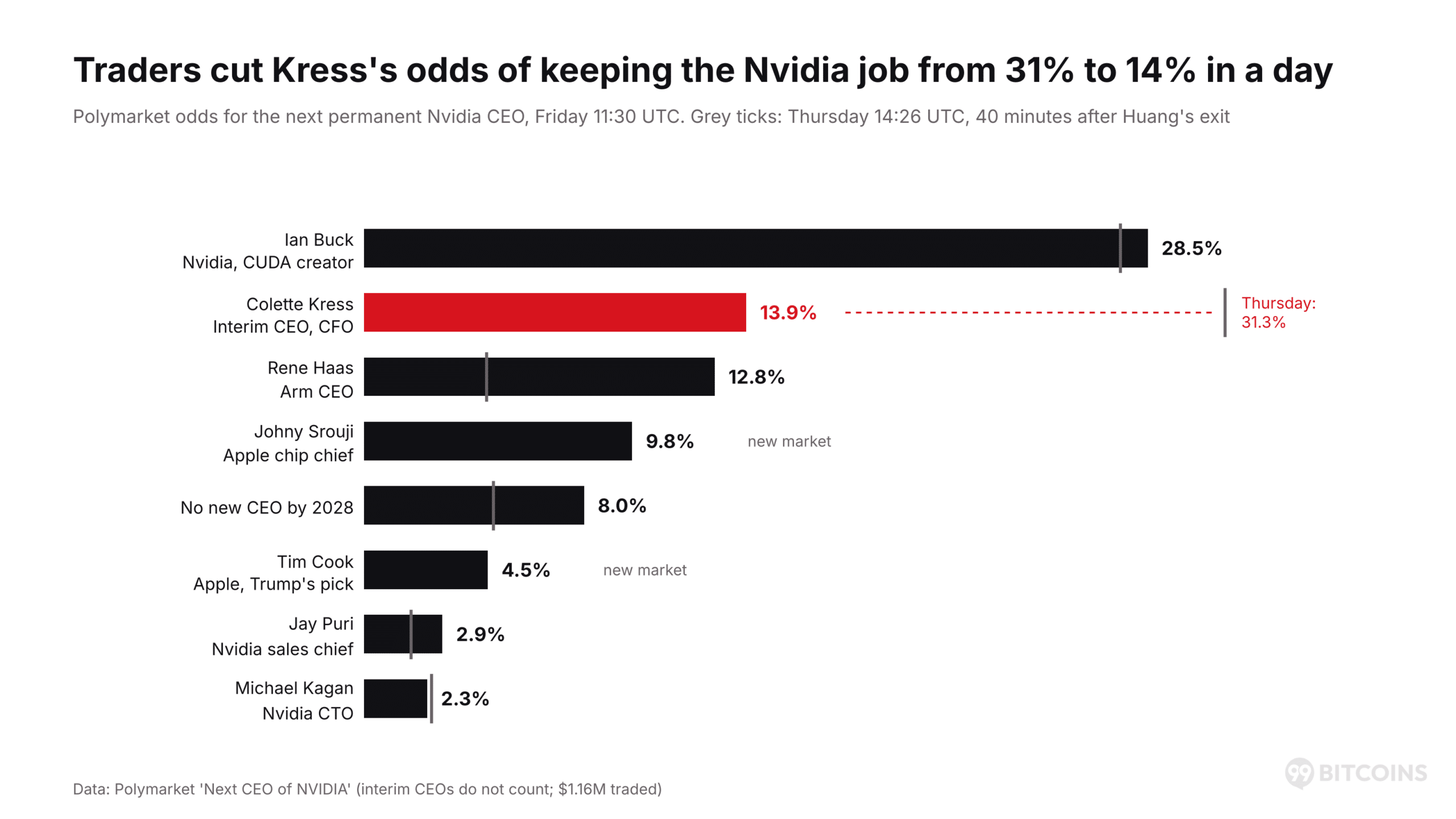
- •On Polymarket, odds that Kress becomes the permanent CEO fell from 31.3% to 13.9%, with data center computing head Ian Buck now leading at 28.5% and Huang given a 29% chance of rejoining by the end of 2027.
Nvidia entered its first full day under interim CEO Colette Kress on Friday, November 13, one day after co-founder Jensen Huang resigned, closing out a 33-year tenure at the chipmaker he co-founded. Huang co-founded Nvidia in 1993 and built it into the leading supplier of the processors behind the artificial-intelligence boom. The aftermath kept unfolding through the day: Congress is seeking Huang's testimony, the board's investigation into his conduct remains open, and the company is scheduled to report quarterly results on Tuesday.
The manner of his exit has drawn sustained criticism. Employees flooded Nvidia's internal message board with calls to “bring the boss back” after his departure, technology leaders from Binance founder Changpeng Zhao to Epic Games CEO Tim Sweeney described the resignation as a mistake, and President Donald Trump called it “a horrible thing.”
BREAKING: An internal post urging Nvidia's, $NVDA , board to reinstate Jensen Huang has drawn over 1,600 comments, with the majority in “full support” of reinstating him, per WIRED. The post urges the Board of Directors to “consider employee sentiment” regarding Jensen Huang's…
— The Kobeissi Letter (@KobeissiLetter) November 13, 2026
Nvidia stock opened 13.1% lower on Thursday — its second-worst start to a trading day since at least 2020 — before recovering to close down 4.3%. Tokenized NVDA, which trades around the clock on crypto exchanges, pointed to a higher open heading into Friday's session.
This roundup covers what has changed since the resignation, why so many people are upset, and what traders are betting on next.
Kress Takes Charge as Board Reshapes Leadership
Nvidia's board announced on Thursday that Huang had resigned as president, CEO and director with immediate effect. The main developments since then:
New leadership: Kress, chief financial officer since 2013, is running the company as interim CEO while keeping her finance role. Harvey C. Jones, a director since 1993, has become Nvidia's first-ever board chair. The board will evaluate both internal and external candidates for a permanent CEO and has set no timeline for the decision. Handing the role to a CFO who has worked alongside Huang for more than a decade is a conventional continuity move, and the newly created chair position gives the board dedicated leadership while it runs both the search and the investigation.
Investigation, Congress and Legal Matters
The board's probe, run by the law firm Wachtell, Lipton, Rosen & Katz — a firm that specializes in steering boards through corporate crises — continues. It covers reports of Huang's relationships, including one with a woman described as a suspected Chinese intelligence asset. The board has said it has “no reason to believe” that any national security or company secrets were compromised.
Congressional attention is mounting. House Foreign Affairs Committee chair Brian Mast said Huang has agreed to appear before lawmakers. Senate Banking Committee chair Tim Scott, whose panel oversees banks and financial markets, separately asked him to testify on December 3.
On the legal front, Huang has hired the law firm Paul Weiss, known for high-stakes litigation and crisis work, and the Rosen Law Firm has launched a shareholder class action, which lets investors sue on behalf of a larger group of shareholders who bought stock over the same period.
Earnings remain the near-term focal point: Kress will present third-quarter results on Tuesday, November 17, in her dual capacity as interim CEO and CFO. The call is the next scheduled update from the company itself, and the first with Huang no longer at the helm.
Employees, Tech Leaders and Trump Push Back on Huang's Exit
Huang admitted on November 8 that he had been “unfaithful” to his wife, and the reports only grew from there. Even so, a vocal contingent believes the board moved too far, too fast.
Employees: A post on Nvidia's internal suggestion board drew more than 1,600 comments, most of them backing Huang. “If you believe in this company's mission, bring the boss back,” one employee wrote. Staff are also asking why Huang left before the investigation was finished. In a Blind poll of 232 Nvidia employees conducted on November 9 and 10, 88% said he should stay. Blind is an anonymous workplace app where verified employees discuss their companies without attribution.
Tech and crypto leaders: Binance founder Changpeng Zhao wrote on X that it was “a mistake for Nvidia to let Jensen resign.” Solana co-founder Raj Gokal called the exit a “generational fumble” for the company. Tim Sweeney described it as “a sad day,” and podcaster Lex Fridman compared it to Apple firing Steve Jobs.
Wall Street: Cantor Fitzgerald's C.J. Muse cut his price target to $250 from $350 and warned that the United States is “giving up the lead in AI” to China. At least two other banks, Stifel and Baird, also lowered their targets.
The White House: Trump called Huang's exit “a horrible thing” and said Apple's Tim Cook should replace him.
The other side has a case as well. Some governance experts argue the board had little choice once Congress, the Justice Department and a potential security risk became involved. Investor Jason Calacanis urged shareholders to wait for the investigation's findings before passing judgment.
Traders Doubt Kress Will Keep the CEO Job
The uncertainty is showing up on prediction markets. Polymarket lets traders buy contracts on real-world outcomes, and prices move toward 100% as an outcome becomes more likely — so the figures below reflect live trading rather than opinion polling. On Polymarket's next Nvidia CEO market, which does not count interim CEOs, odds were compared 40 minutes after the announcement with those on Friday morning:
- Colette Kress: down from 31.3% to 13.9%, less than half her earlier level.
- Ian Buck: the head of Nvidia's data center computing business and the creator of CUDA, now leads at 28.5%.
- Outsiders gained: Arm CEO Rene Haas rose from 4.5% to 12.8%. Apple chip chief Johny Srouji, added to the market on Thursday, stands at 9.8%. Tim Cook, Trump's pick, sits at 4.5%.
Trading activity has jumped as well. About $1.16 million has changed hands on the market, up from $311,000 on Thursday afternoon. A separate, much smaller market gives Huang a 29% chance of rejoining Nvidia by the end of 2027, up from 15% when it opened on Thursday evening.
NVDA Price Analysis: Tokenized NVDA Points to a Higher Open
Thursday's session was turbulent. NVDA opened at $151.01, down 13.1%, and fell as low as $148.80 before buyers stepped in; the stock closed at $166.19, down 4.3%. Only August 5, 2024 produced a worse start since 2020.
Tokenized NVDA kept trading after the closing bell. Tokenized stocks are blockchain representations of listed shares that track the underlying price, letting traders react to news while U.S. markets are closed. On Hyperliquid, xyz:NVDA changes hands at $170.65, up about 6% over 24 hours, on $1.9 billion of volume. NVDA traded at $171.10 ahead of the U.S. open, up 3%. The stock is still down 28% from its record close of $239.24 on October 6.
On the 4-hour chart — where each candle covers four hours — xyz:NVDA remains below its 50-period exponential moving average (EMA), an average that gives recent prices more weight, at $178.57. The 200-period EMA sits much higher at $200.65.
- Resistance: $178.37, the November 11 high, sits right next to the 50-period EMA; above that, $200.65, the 200-period EMA.
- Support: $162.45, Friday's low, followed by $148.86, Thursday's low.
What Comes Next
Tuesday's results are the next major test. Beyond the earnings call, the calendar holds Huang's requested December 3 testimony before the Senate Banking Committee, while the Wachtell-run investigation and the permanent CEO search continue without announced timelines. Kress has to show that the business runs without Huang, while employees, investors and traders continue to argue over whether he should have gone at all.

