Binance Data Shows Gen Z Investors Gravitate Toward AI Stocks Like Nvidia for First Trades
Key Takeaways
- •Nvidia accounts for 20% of initial stock trades among Binance's Next Gen Users, making it the most common first trade, followed by Micron Technology at 8%.
- •Next Gen Users allocate approximately 60% of their equity holdings to Information Technology and Communication Services, with about 26% concentrated in semiconductors, reflecting a focus on the AI complex.
- •Binance Research found that Gen Z investors trade less aggressively than assumed, averaging 2.6 daily trades versus 3.0 for other cohorts and using lower leverage exposure.
- •Gen Z represents the largest single cohort on Binance Direct Stocks at 44% of customers, with 95% of Gen Z traditional finance users based in emerging markets.
- •Gen Z has contributed approximately $80 billion in traditional finance volume so far in 2026, compounding at nearly 24% per month on the platform.
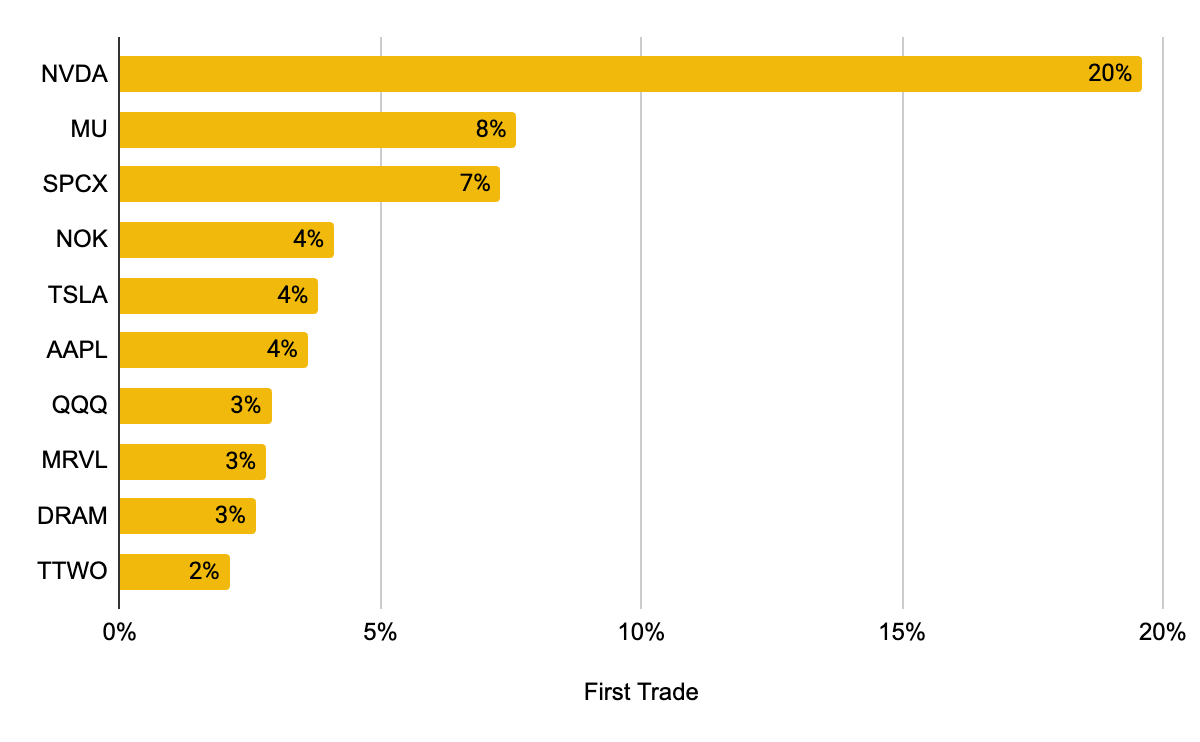
Nvidia (NVDA) is the most common first stock trade among the youngest and smallest equity accounts on Binance, accounting for 20% of initial trades, according to a Binance Research report.
The finding covers a segment that Binance labels "Next Gen Users" — Gen Z customers in emerging markets holding under $2,000 in equity assets under management. Because the sample is drawn from Binance Direct Stocks users, the data describes behavior within that product rather than the full global Gen Z investing population.
Semiconductor Stocks Dominate First-Trade Preferences
Micron Technology (MU) ranks second at 8%. Tesla (TSLA), Apple (AAPL), and the Nasdaq-100 exchange-traded fund (ETF) appear further down the list of most common first trades. Nvidia and Micron sit in the semiconductor supply chain tied to artificial-intelligence computing demand, while the Nasdaq-100 ETF provides broader exposure to large U.S.-listed technology and growth companies.
The broader portfolio allocations reflect a similar theme. "Across the wider equity base, the same discipline is visible at portfolio level: users allocate roughly 60% of equity holdings to Information Technology and Communication Services, with around 26% concentrated in semiconductors, a thematically coherent tilt toward the artificial-intelligence complex rather than scattered speculation," Binance Research noted.
Next Gen Users represent 13% of Binance Direct Stocks customers, while Gen Z as a whole accounts for 44% — the largest single cohort on the product.
Geographically, the user base skews heavily toward emerging markets. Binance Research reported that 95% of Gen Z traditional finance (TradFi) users are based in emerging markets, with every other generation on the platform also exceeding 90%. That geographic mix is relevant because access to U.S.-listed equities can vary widely across markets, and platforms that combine crypto-native user bases with traditional finance products may capture a different investor profile than domestic brokerage datasets.
Trading Frequency Runs Below Other Cohorts
Contrary to common assumptions about young investors on crypto-native platforms, Binance Research characterized the trading patterns as disciplined rather than speculative.
"The prevailing assumption about young, first-time investors, particularly those reached through a crypto-native platform, is that they trade aggressively and speculatively. The data does not support that characterization. It points, consistently, in the opposite direction," the report stated.
Supporting this assessment, Next Gen Users average 2.6 trades per day, compared with 3.0 for other cohorts. Leverage usage follows a similar pattern: leveraged ETFs account for 5.9% of Gen Z trading volume, while Baby Boomers recorded 8.1%.
Despite the more measured approach, Gen Z has contributed approximately $80 billion in TradFi volume so far in 2026, compounding at nearly 24% per month. Future updates to watch include whether semiconductor concentration persists as these accounts grow beyond the under-$2,000 segment and whether trading frequency changes as more Gen Z users adopt traditional finance products on crypto-native platforms.

