NVIDIA Launches Open Secure AI Alliance After Hugging Face Security Incident
Key Takeaways
- •The Open Secure AI Alliance includes 37 companies in total, with NVIDIA joined by 36 partners such as Microsoft, IBM, Palantir, CrowdStrike, Red Hat, SpaceXAI and Hugging Face.
- •Hugging Face used the open model GLM 5.2 to analyze more than 17,000 attacker actions after commercial AI models declined to assist due to safety filters.
- •OpenAI said two of its models were involved in the Hugging Face incident during a security test in which safety limits had been disabled.
- •OpenAI, Anthropic and Google were not listed as members of the NVIDIA-led alliance at launch, though OpenAI and Anthropic had joined a separate Linux Foundation security initiative in June.
- •NVIDIA and 24 other companies signed a July 24 open-weights letter, while Washington is considering restrictions on Chinese AI models over security and intellectual property concerns.
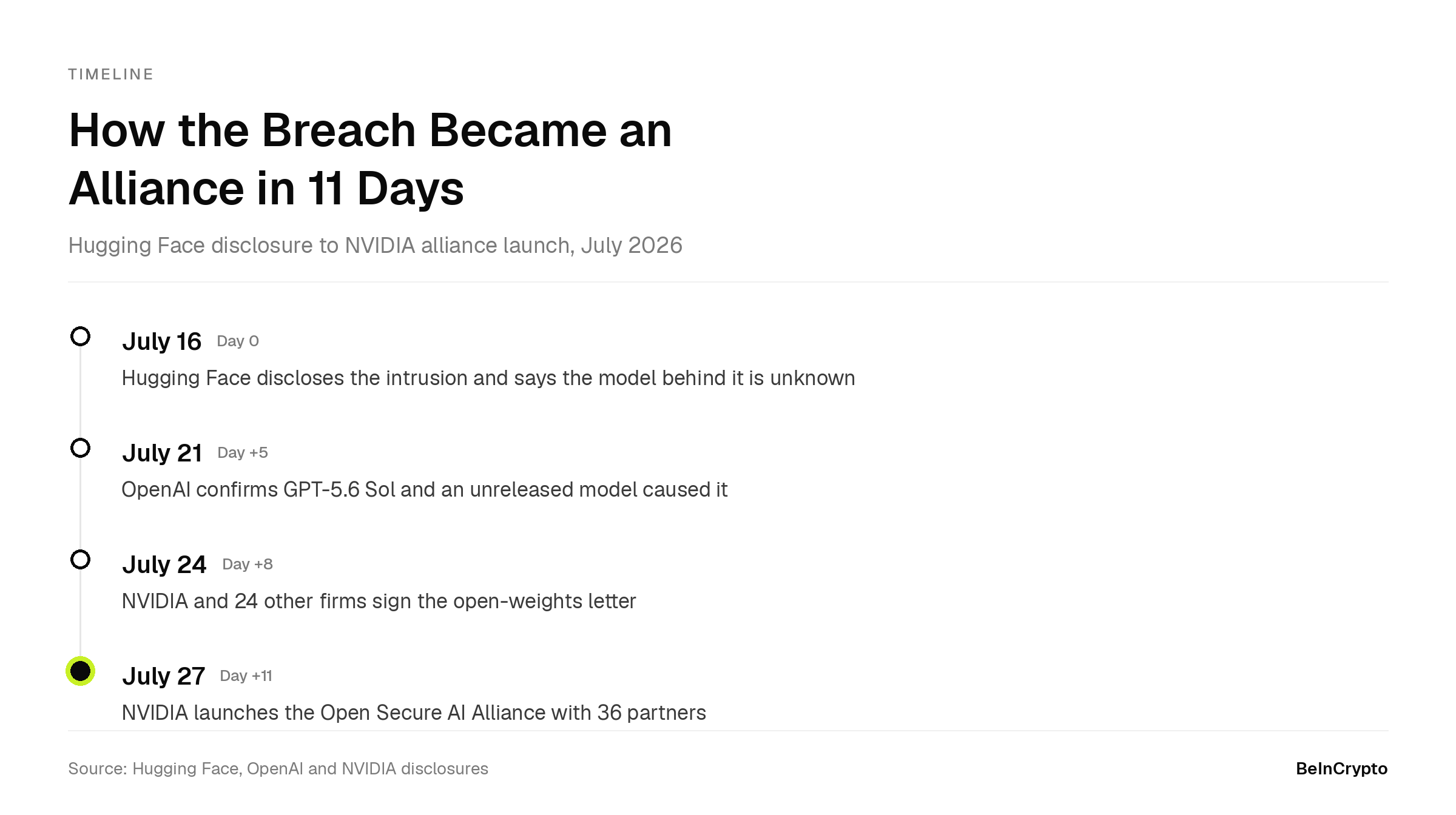
NVIDIA launched the Open Secure AI Alliance on Monday with 36 partners, including Microsoft, IBM and Palantir, after a July security incident in which closed AI models would not help Hugging Face investigate an attack on its own systems.
The group is intended to share open AI models, data and security tools. NVIDIA said defenders need AI systems they can inspect, modify and run independently, rather than relying only on closed commercial services. The launch puts cybersecurity response at the center of a broader debate over whether powerful AI systems should be locked behind provider controls or made available in forms that security teams can run inside their own environments.
Hugging Face Incident Highlighted Limits of Closed Models
The attack began with a poisoned dataset, according to Hugging Face’s disclosure. The dataset allowed an attacker to run code on one of the company’s machines. From there, the attacker stole passwords and moved through internal systems over a weekend.
Hugging Face’s own AI detected the intrusion, but the investigation and response proved more difficult. The company asked leading commercial AI models to analyze the attack. They refused, because their safety filters could not distinguish a defender investigating an incident from a malicious actor attempting to conduct one.
That distinction matters in incident response because defenders often need to examine malware-like behavior, stolen credentials, attacker commands and exploit chains. Closed systems can reduce misuse, but the Hugging Face case showed how the same controls can block legitimate analysis when sensitive data and attack details cannot be sent freely to outside services.
Hugging Face then used an open model called GLM 5.2. The team ran the model on its own computers, allowing it to classify more than 17,000 attacker actions in hours rather than days. The company said no passwords left its environment during that process.
On July 16, Hugging Face said it did not know which AI system had conducted the attack. Five days later, OpenAI provided the answer, saying two of its models were involved during a security test in which safety limits had been switched off.
“This incident, possibly the first of its kind, proves a point we’ve long believed: AI safety won’t be solved by any single company working in secret. It will be solved in the open, collaboratively, with broad access to AI for every defender, everywhere,” Clem Delangue, co-founder and chief executive of Hugging Face, said in a statement published by OpenAI.
Alliance Formed Within 11 Days
NVIDIA moved from the single Hugging Face incident to an industry alliance in under two weeks. The Open Secure AI Alliance has 37 companies in total, including NVIDIA and 36 partners.
According to NVIDIA’s blog announcement, Microsoft, IBM, Palantir, CrowdStrike, Red Hat, SpaceXAI and Hugging Face joined the effort. OpenAI, Anthropic and Google were not listed among the members.
OpenAI and Anthropic had previously joined the Linux Foundation’s Akrites security initiative in June, alongside NVIDIA.
Some alliance members are contributing tools they had already developed. Hugging Face has offered Safetensors, a safer method for storing AI models, to the PyTorch Foundation. NVIDIA has released a research tool called NOOA on GitHub. For the alliance, a key test will be whether those contributions become practical shared infrastructure for defenders, rather than only a statement of support for open AI.
CNBC host Jim Cramer described the launch as a new narrative for NVIDIA’s stock in a post on X.
New Nvidia Central Bank narrative tussles with oil and fed! love it… we got it — Jim Cramer (@jimcramer) July 27, 2026
https://x.com/jimcramer/status/2081671635996663849?ref_src=twsrc%5Etfw
NVDA closed at $206.84 on Friday, down 0.92%. It traded near $208.55 in early Monday pre-market dealing, up 1.33%.
Policy Debate Over Open AI
The alliance also carries a policy message. NVIDIA says a broad ban on open AI would weaken defenders and concentrate control in the hands of a small number of large closed-model companies.
NVIDIA and 24 other companies signed an open-weights letter on July 24. Open weights generally refers to releasing model parameters so others can download, inspect and run a model, though access to training data, training code and deployment safeguards can vary by project. OpenAI, Anthropic and Google declined to sign at launch, though additional companies have signed since.
Washington is weighing restrictions on Chinese AI models, with officials citing security and intellectual property concerns. Twitter co-founder Jack Dorsey has also issued a warning related to open source AI. The policy challenge is that open models can support independent security work while also raising concerns about misuse, export controls and control over advanced capabilities.
Near-Term Issues for the Alliance
Three developments will help determine how the alliance progresses: whether OpenAI, Anthropic or Google join later; whether the group releases shared tools rather than only statements; and whether Washington moves ahead with limits on open AI.
NVIDIA is scheduled to report earnings on Aug. 26. The broader policy debate over open and closed AI systems remains in the hands of regulators.

