NVIDIA Earnings Explained: What Revenue, Data Center Growth and Guidance Mean for NVDA Stock
Key Takeaways
- •NVIDIA generated $81.615 billion in Q1 fiscal 2027 revenue, an increase of 85% year over year and 20% sequentially.
- •Data Center revenue of $75.246 billion represented approximately 92% of total revenue, confirming the segment as NVIDIA's primary earnings engine.
- •NVIDIA guided Q2 fiscal 2027 revenue to $91.0 billion, plus or minus 2%, raising the benchmark for continued AI infrastructure demand.
- •The company reported zero Data Center Hopper shipments to China in the latest quarter, compared with $4.6 billion in the prior-year period, reflecting current export policy restrictions.
- •NVIDIA disclosed $119 billion in manufacturing, supply, and capacity commitments as of April 26, 2026, with $95 billion expected to be paid during the remainder of fiscal 2027.
Quick Answer
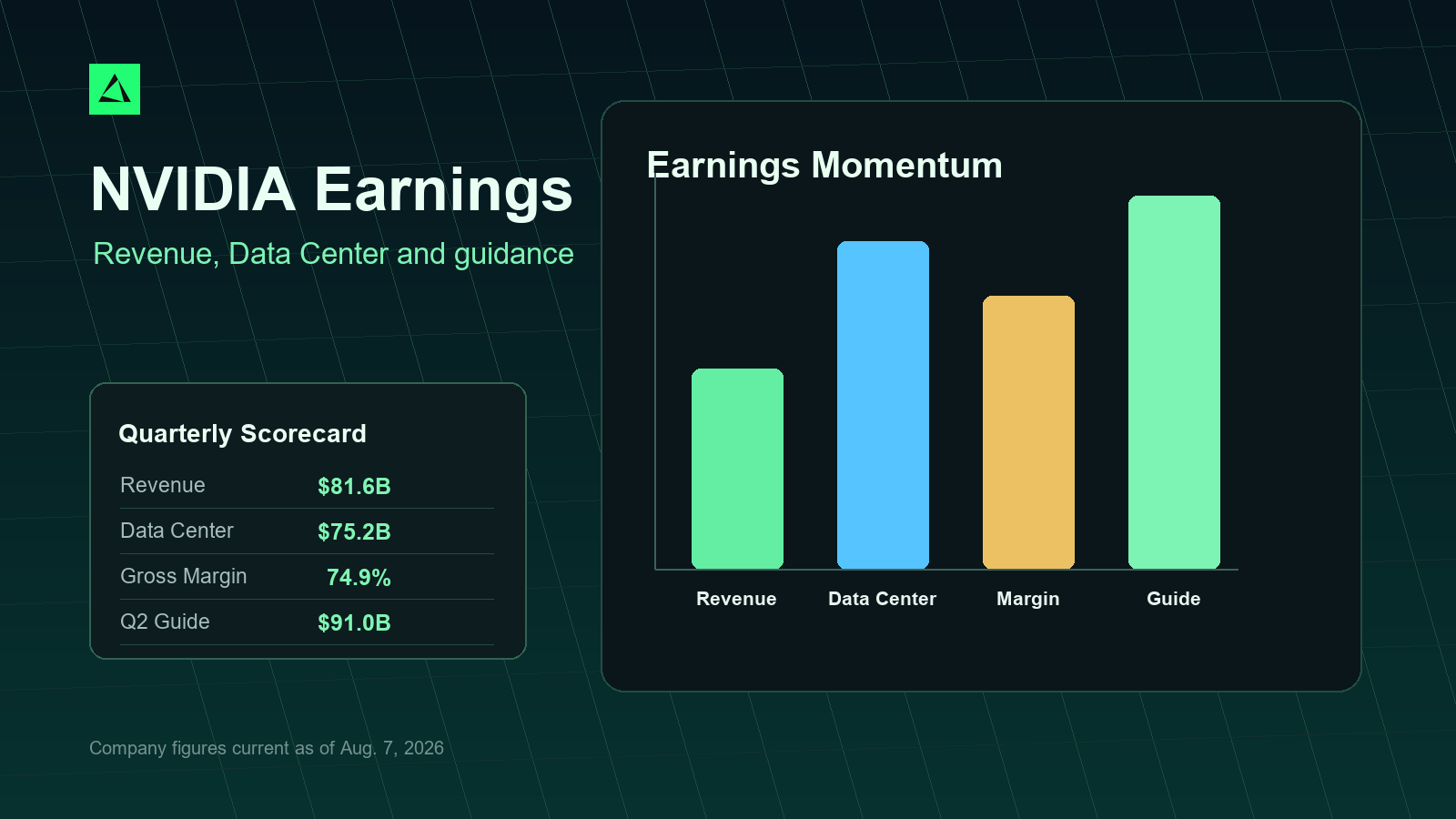
NVIDIA earnings matter for NVDA stock because the company has become the clearest financial signal for AI infrastructure spending. The latest official quarter showed $81.615 billion of revenue, $75.246 billion of Data Center revenue, 74.9% gross margin and guidance for $91.0 billion of Q2 fiscal 2027 revenue. Those numbers support the bull case, but the stock reaction depends on the quality of growth: Data Center breadth, Blackwell supply, gross margin, customer concentration, China exposure and whether guidance implies durable demand rather than one-time capacity urgency.
Information and cited company figures are current as of August 7, 2026. NVIDIA's next earnings release, official filings, policy changes and market price can change the investment setup.
Why NVIDIA Earnings Now Carry Market-Wide Weight
NVIDIA's earnings report is no longer just a semiconductor update. It is a readout on AI capital expenditure, cloud infrastructure, high-bandwidth memory demand, advanced packaging, networking and the willingness of customers to pay for accelerated computing at scale. When NVIDIA reports, investors are effectively asking whether the AI buildout is still converting from narrative into cash.
That is why the latest quarter matters. NVIDIA reported Q1 fiscal 2027 revenue of $81.615 billion, up 85% from the year-earlier quarter and 20% from the prior quarter. Those are extraordinary growth rates for a company already operating at megacap scale. Yet the market does not reward size alone. It rewards evidence that the next dollar of revenue can still come with strong margins and visibility.
The broader business model behind those numbers matters because each earnings report tests whether NVIDIA's AI infrastructure thesis is still turning into revenue, margins and cash flow.
The Numbers That Define the Latest Quarter
NVIDIA's Q1 fiscal 2027 filing gives investors the cleanest official base for analysis. Total revenue was $81.615 billion. Data Center revenue was $75.246 billion. Gross margin was 74.9%. Net income was $58.321 billion. Diluted EPS was $2.39. The company guided Q2 fiscal 2027 revenue to $91.0 billion, plus or minus 2%.
| Metric | Q1 Fiscal 2027 Result | Why Investors Care |
|---|---|---|
| Revenue | $81.615 billion | Shows AI infrastructure demand is still scaling at a rare pace |
| Data Center revenue | $75.246 billion | Confirms the segment remains the core earnings engine |
| Gross margin | 74.9% | Signals pricing power, supply execution and product mix quality |
| Net income | $58.321 billion | Shows how much revenue is converting into profit |
| Q2 revenue guidance | $91.0 billion, plus or minus 2% | Sets the next hurdle for the stock |
Revenue Growth Is Necessary, but Not Sufficient
The headline growth rate explains why NVDA remains a core AI trade. A company does not produce more than $80 billion of quarterly revenue by selling a speculative idea. Customers are deploying real capital for AI systems, and NVIDIA is converting that spending into recognized revenue.
But revenue growth alone does not settle the investment debate. The more important question is whether the growth is durable. If customers are buying because AI usage is rising, inference is expanding and capacity remains short, the earnings quality is strong. If customers are pulling forward orders because supply is scarce or because they fear being left behind, the same revenue can carry more future-cycle risk.
Data Center Is the Earnings Report
Data Center generated roughly 92% of NVIDIA's total revenue in the quarter. That concentration explains why NVDA trades like an AI infrastructure stock rather than a diversified chipmaker. Gaming, professional visualization, automotive and OEM still matter, but they do not define the current earnings power.
The updated market-platform disclosure also matters. NVIDIA split Data Center into Hyperscale revenue of $37.869 billion and AI Clouds, Industrial and Enterprise revenue of $37.377 billion. That near-even split gives investors a better way to watch whether demand is broadening beyond the largest cloud customers.
The Data Center result is also the reason investors need to look beyond the headline income statement. The segment can support unusually large earnings power, but that power also depends on customer concentration, supply availability, networking attach rates and the pace of AI infrastructure spending.
Hyperscale Demand Sets the Near-Term Bar
The largest cloud platforms and model developers can move NVIDIA's quarterly revenue because they buy at enormous scale. Their spending plans therefore become a direct input into earnings expectations. If hyperscaler capital expenditure stays aggressive, investors can keep underwriting strong Data Center demand. If those buyers pause, even a dominant supplier can face a sharper growth debate.
The important distinction is whether spending is backed by usage. AI training clusters are highly visible, but inference and enterprise adoption are the longer-duration test. The market will reward NVIDIA more if management commentary and customer signals suggest that capacity is being absorbed into revenue-generating workloads.
ACIE Is the Breadth Signal
AI Clouds, Industrial and Enterprise is a crucial disclosure because it points to a broader buyer base. Sovereign AI, specialized clouds, enterprise deployment and industrial systems can make the demand story less dependent on a small group of hyperscalers. That would support a more durable earnings multiple.
Still, investors should not overread one quarter. ACIE growth needs to persist across product cycles. Enterprise demand can be slower and less uniform than cloud demand. The next few earnings reports should show whether this category is becoming a second pillar or simply moving with the same initial AI capacity wave.
Gross Margin Is the Quality Check
NVIDIA's 74.9% gross margin is one of the most important earnings signals. It tells investors that demand is not only large but economically attractive. Customers are paying for complete AI systems, performance, software compatibility, networking and availability.
The risk is that complex systems can pressure margins over time. Blackwell, Rubin, advanced packaging, high-bandwidth memory and networking scale can all raise the operational difficulty of meeting demand. A high gross margin is therefore both a strength and a hurdle. It gives NVIDIA exceptional earnings power, but it also gives investors a specific line item to watch for early signs of pricing or cost pressure.
Guidance Is Where the Stock Reprices
The quarter that has already happened matters, but guidance is often where NVDA moves. NVIDIA guided Q2 fiscal 2027 revenue to $91.0 billion, plus or minus 2%. That figure tells investors the company expects momentum to continue. It also raises the bar for the next report.
Guidance should be read with margin expectations, supply commentary and customer mix. A high revenue guide with margin pressure would tell a different story than a high revenue guide with stable profitability. Likewise, strong demand that depends heavily on a few customers deserves a different risk discount from demand that is broadening across AI clouds, enterprises and sovereign buyers.
The Market Reaction Starts Before the Release
NVIDIA earnings are unusual because the stock often moves on the difference between reported strength and embedded expectations. Investors may enter a report already assuming rapid Data Center growth, healthy margins and confident guidance. That means the result does not need to be weak to create volatility. It only needs to be less forceful than the market's best-case positioning.
Earnings analysis works better when "beat" and "miss" are not treated as the entire story. A revenue beat with cautious commentary can feel worse than a smaller beat with broader demand evidence. A strong guide can be questioned if margin assumptions look stretched. A high gross margin can be discounted if investors think supply commitments or customer concentration raise future risk. The stock reaction is therefore an expectations reset, not a simple grade on one quarter.
For NVDA, the cleanest question after each report is whether the company added evidence to the long-duration AI thesis. Did more customers enter the demand map? Did management sound confident about Blackwell availability? Did guidance imply that demand is still outrunning supply for economic reasons, not just because customers are rushing to secure capacity? Those questions determine whether earnings support a higher valuation or merely defend the existing one.
China and Supply Commitments Remain Part of the Earnings Story
NVIDIA's earnings strength does not erase policy risk. The company reported no Data Center Hopper shipments to China in the latest quarter, compared with $4.6 billion in the year-earlier period. Management also described the China data-center compute market as effectively closed under the current policy environment.
Supply commitments are another earnings variable. NVIDIA disclosed $119 billion of manufacturing, supply and capacity commitments as of April 26, 2026, with $95 billion expected to be paid during the remainder of fiscal 2027. Those commitments help secure capacity in a supply-constrained market. They also matter if demand changes, because committed supply is easier to justify when revenue visibility remains strong.
Cash Flow Shows Whether Growth Is Self-Funding
The income statement gets most of the attention, but cash flow matters because NVIDIA's AI cycle requires operational scale. Large supply commitments, advanced system ramps and customer support all need capital discipline. A company can report strong revenue while still facing questions if working capital absorbs too much cash or if commitments rise faster than demand visibility.
NVIDIA's current position is strong because profitability gives it room to fund capacity, invest in roadmaps and return capital. Still, investors should watch whether cash conversion stays aligned with reported earnings. If revenue growth remains high while cash flow and margins hold, the market can treat the AI cycle as financially self-reinforcing. If cash conversion weakens, the debate shifts toward how much capital the cycle requires before it produces the next layer of returns.
What Earnings Mean for Valuation
NVIDIA's results support the bull case, but valuation depends on what investors believe comes next. A strong quarter can still be followed by multiple compression if the market thinks growth is peaking. Conversely, a premium multiple can hold if earnings show that AI demand is becoming broader, more recurring and more profitable.
That evidence flows directly into the valuation debate. The income statement shows what NVIDIA has already delivered. The market then asks how much of that future path investors are already paying for.
Trade NVIDIA Perpetuals on edgeX - 24/7, No KYC Required
NVIDIA's story doesn't pause when markets close. For traders who want continuous exposure to NVDA price action - without the constraints of traditional market hours - edgeX offers a compelling alternative.
What Is edgeX?
edgeX is a decentralized exchange built for active traders who value both performance and privacy. The platform combines institutional-grade execution with true self-custody, meaning users retain full control of their funds and private keys at all times. No centralized custodian. No platform holding your assets on your behalf.
Why Trade NVDA/USDC Perpetual Futures on edgeX?
For those tracking NVIDIA's momentum, edgeX lists NVDA/USDC perpetual futures with up to 10x leverage and no expiration date - so positions can be held as long as the thesis holds. Settlement is transparent and on-chain, and because edgeX requires no KYC, traders can get started anonymously without lengthy onboarding.
- 24/7 trading - NVDA exposure around the clock, not just during NYSE hours
- Deep liquidity - $10M of depth within a one-basis-point spread, with sub-0.1 bps slippage on larger trades
- 10x leverage - amplify directional conviction on NVIDIA moves
- 100% trading fee rewards - fees earned back through the platform's Trade-to-Earn program
- Self-custody - assets stay in your wallet; every fund movement requires your explicit authorization
- Censorship resistance - a permissionless, decentralized structure with on-chain settlement
Explore NVDA/USDC Perpetual Futures
Whether NVIDIA's next catalyst is an earnings print, a product launch, or a broader AI sector rotation, having a venue that trades around the clock - and keeps you in control - matters.
Explore NVDA/USDC perpetual futures on edgeX and see what decentralized derivatives trading looks like at institutional scale.
Bottom Line
NVIDIA earnings are the market's clearest scorecard for AI infrastructure demand. The latest official quarter showed exceptional scale, strong Data Center concentration, high gross margin and ambitious guidance. That is enough to keep the bull case alive.
The harder question is whether the next earnings reports keep proving durability. Investors should watch Data Center breadth, gross margin, Blackwell execution, China exposure, supply commitments and Q2 guidance conversion together. A single revenue number can impress. A durable earnings cycle requires several signals to keep lining up.
Frequently Asked Questions
What was NVIDIA's latest reported quarterly revenue?
NVIDIA reported $81.615 billion of revenue for Q1 fiscal 2027, the quarter ended April 26, 2026. That figure was up 85% year over year and 20% sequentially.
Why does Data Center matter so much for NVIDIA earnings?
Data Center produced $75.246 billion of revenue in the latest official quarter, or roughly 92% of total revenue. It is the segment most directly tied to AI infrastructure demand and therefore the main driver of NVDA's earnings debate.
What should investors watch in NVIDIA guidance?
Investors should watch revenue guidance, gross margin, supply commentary, customer mix, China exposure and management's description of AI demand visibility. Guidance matters because it sets the next hurdle for the stock.
Does a strong NVIDIA quarter automatically mean NVDA stock should rise?
No. A strong quarter helps the bull case, but the stock reaction depends on expectations, guidance, margins and valuation. NVDA can be volatile if investors believe growth is slowing or if the market had already priced in exceptional results.
How do China restrictions affect NVIDIA earnings?
China restrictions can reduce the addressable market for high-performance Data Center products and increase policy uncertainty. NVIDIA reported no Data Center Hopper shipments to China in the latest quarter, compared with $4.6 billion a year earlier.

