Nvidia Q2 Earnings Preview: Revenue, Guidance, Buybacks and China in Focus
Key Takeaways
- •Nvidia stock has retreated in recent days but is still about 30% above its lowest level this year.
- •The company is due to report financial results on Wednesday, and investors will focus on revenue, margins, and earnings.
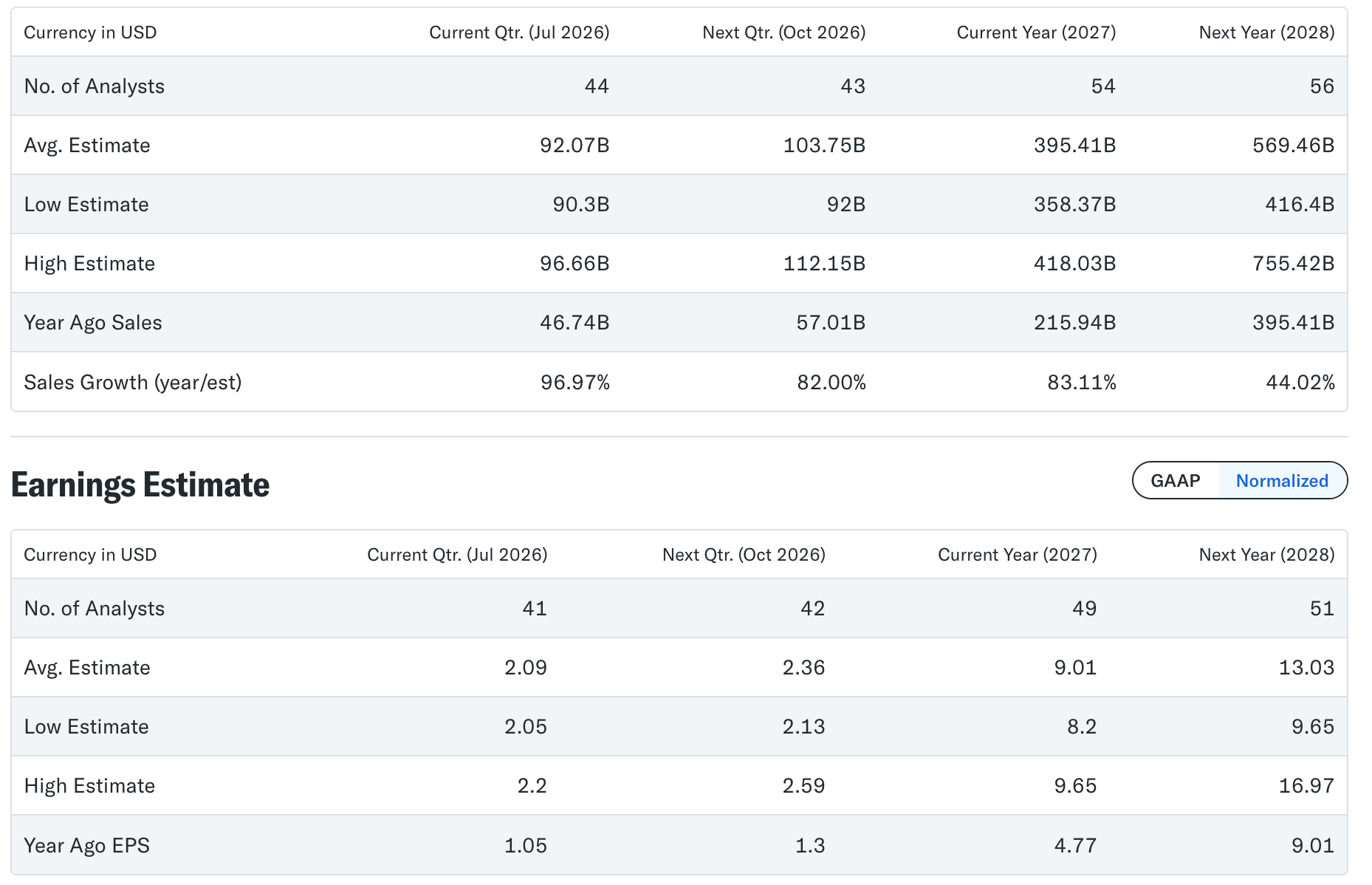
- •Analysts expect second-quarter revenue of about $92 billion and third-quarter revenue guidance near $103 billion.
- •Market participants will watch for updates on potential price increases for GPUs and servers, with reported increases of up to 15% next year.
- •Nvidia’s China shipments and any change to its share repurchase program are also expected to be important points in the report.
Nvidia (NVDA) shares have pulled back sharply in recent days, sliding from this month's high of $228 to about $214, though the stock remains roughly 30% above its lowest level of the year. The chipmaker is scheduled to publish its financial results on Wednesday, and the report will be watched closely across several fronts. Nvidia is now one of the most valuable publicly traded companies and one of the largest weights in the S&P 500, and because its data center business generates the bulk of its revenue, its results are widely treated as a read on AI infrastructure spending across the technology industry.
Key insights:
- Nvidia stock has pulled back over the past few weeks.
- The company will publish its financial results on Wednesday.
- Focus will be on the company's revenue growth and its buybacks.
Headline Figures
The headline numbers will be one of the most important catalysts for NVDA shares. In its last earnings report, Nvidia guided for second-quarter revenue of $91 billion, plus or minus 2%.
Historically, the company has been highly conservative in its forecasts, meaning actual results have tended to come in above its guidance. The average analyst estimate currently stands at $92 billion, up 96% year over year, while expectations based on historical patterns suggest actual revenue could exceed $95 billion.
Nvidia has also guided for non-GAAP gross margins of between 74.9% and 75%, a figure that is likely to come in higher than expected. Analysts estimate earnings per share of $2.09, well above the $1.05 the company reported in the same quarter last year.
Guidance Will Be Crucial
Forward guidance is the other major catalyst for the share price. Nvidia typically guides on quarterly revenue, gross margins, and operating expenses.
Analysts are optimistic that the outlook will be strong, pointing to robust recent earnings from several of Nvidia's largest customers, including Amazon, Microsoft, and Meta Platforms. Those companies are among the biggest buyers of Nvidia's data center chips, and their capital spending plans for AI infrastructure have become a leading indicator of demand for its products. The average estimate calls for third-quarter revenue to rise 82% to $103 billion, while full-year revenue guidance is expected to reach $395 billion, well above last year's $215 billion.
Strong revenue and profitability guidance would be viewed as a signal that the AI boom remains intact. On top of that, the company may decide to increase its buyback, which some market watchers see as supported by the stock's current valuation. Nvidia has repeatedly expanded its repurchase program in recent years, including an additional $50 billion authorization announced in August 2024, so any increase would extend an established pattern.
Server and GPU Price Increases
The market will also be watching for comments on the reported price increases for Nvidia's GPUs and servers. According to Bloomberg, the company has already sent notices to clients saying it will raise prices by as much as 15% next year. Nvidia has justified the increases by pointing to ongoing tight supply conditions and the surge in memory prices, which have been rising industry-wide as AI demand strains supply of high-bandwidth memory.
There are two potential implications for the company. First, customers may boost their purchases before the end of the year in order to take advantage of current prices. Second, there is a risk that Nvidia's largest clients accelerate the shift toward custom ASIC chips. Google is already planning to expand its TPU production through its recent partnership with Marvell Technology, and Microsoft and Amazon are pursuing similar efforts as they try to reduce their reliance on Nvidia, with Amazon developing its Trainium chips and Microsoft working on its Maia accelerators.
China Business Growth
Nvidia's China business is another important catalyst for the stock. The company has already started shipping a limited number of H200 chips to its Chinese clients, and the upcoming results should provide greater insight into the business and what to expect through the rest of the year. US export controls have restricted which Nvidia chips can be sold into China in recent years, so any expansion of shipments would widen the company's addressable market.
China is viewed as an important market because of its potential, with companies such as Alibaba, ByteDance, and Moonshot investing billions of dollars in the AI space this year. Signs that Nvidia's Chinese business is growing would likely be received positively by the market.
Recent Investments in the AI Industry
Any comments on Nvidia's investments across the AI industry will also draw attention. The company has announced that it will back OpenAI's chip plant in Ohio, a project that will be powered by Nvidia chips.
Nvidia is also expected to comment on its investments in companies including Nebius, CoreWeave, Lumentum, and Intel. In addition, the company has announced a plan to help AI companies raise $500 billion from large financiers such as BlackRock, Blackstone, and Goldman Sachs. The investment program has drawn scrutiny from some analysts because several of the companies Nvidia backs are also large buyers of its chips, a dynamic critics have described as circular financing, even as Nvidia frames the deals as a way to expand the overall market for AI computing.
Source: The Market Periodical

