How NVIDIA’s Data Center Business Powers NVDA: GPUs, Networking and AI Infrastructure
Key Takeaways
- •Data Center revenue reached $89.0 billion in Q2 FY27, rising 18% quarter over quarter and 117% year over year, and accounted for roughly nine-tenths of NVIDIA's $96.2 billion total revenue.
- •NVIDIA reported 75.0% gross margins on both GAAP and non-GAAP bases and GAAP operating income of $63.734 billion, profitability that is economically dominated by Data Center mix.
- •Third-quarter FY27 guidance calls for revenue of approximately $108.0 billion and gross margin of 74.0% plus or minus 50 basis points, assuming no China Data Center compute revenue.
- •The Vera Rubin platform has entered a full manufacturing ramp, following the Blackwell generation on NVIDIA's roughly annual architecture cadence.
- •NVIDIA returned about $26.0 billion to shareholders in the quarter with roughly $99.0 billion of buyback authorization remaining, while facing competition from AMD's Instinct accelerators and custom silicon from Google, Amazon, and Microsoft.
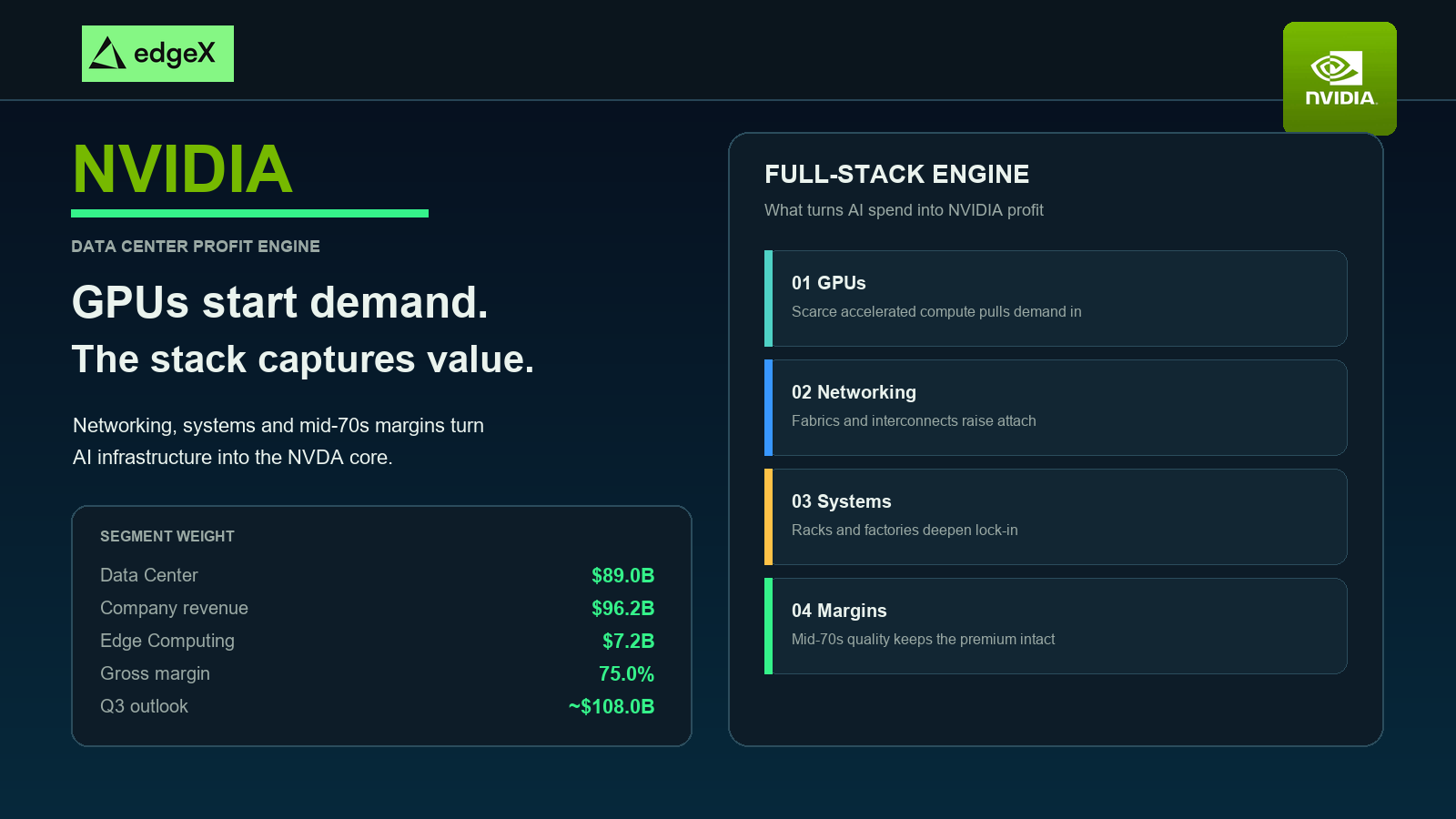
NVIDIA’s equity story is often told as an AI chip story. That shorthand is incomplete. What investors are really underwriting is a Data Center franchise that turns scarce accelerated computing, networking, systems, and software into an unusually profitable infrastructure stack. In the second quarter of fiscal 2027, that franchise produced $89.0 billion of Data Center revenue inside a $96.2 billion company print. The segment is not a side business. It is the engine that decides whether NVDA’s premium still makes sense.
This article explains why Data Center sits at the center of the NVIDIA investment case: how GPU demand, networking attach, platform transitions, and margin quality fit together. It is not an earnings-reading checklist and not a valuation model. For how to interpret the quarterly print itself, see NVIDIA earnings explained. For duration and multiple debates after the same figures, see NVIDIA stock valuation.
Quick Answer
NVIDIA’s Data Center business powers NVDA because it concentrates the company’s scarcest products, richest mix, and strongest customer lock-in in one segment. GPUs create the demand spike, but networking, systems, and software help turn that spike into a platform. After the $89.0 billion Q2 FY27 Data Center print, the practical question is no longer whether AI infrastructure demand exists. It is whether NVIDIA can keep monetizing that demand through architecture cycles, competitive pressure, and geographic constraints while defending mid-70s margins. Treat Data Center as the profit engine; treat everything else as supporting context.
Why Data Center Is the Center of the NVDA Thesis
At NVIDIA’s current scale, the company can post strong total revenue and still leave investors uneasy if Data Center momentum fades. That is because roughly nine-tenths of the latest quarterly revenue sits in the segment that carries the AI-infrastructure premium. Edge Computing, gaming adjacency, automotive, and robotics can diversify the narrative over time. They do not, today, replace the economic weight of Data Center.
The segment also concentrates the qualitative claims that justify a premium multiple. Investors paying for NVIDIA are paying for scarce accelerated computing capacity, a software ecosystem that raises switching costs, networking that makes large clusters usable, and the ability to migrate customers through successive platforms. Those claims live or die inside Data Center first. A company-level beat that is not backed by Data Center quality is a weaker NVDA signal than the headline suggests.
That is why Data Center analysis should stay separate from both a broad company primer and a pure earnings-reaction guide. The NVIDIA stock guide explains the wider business. This article asks a narrower question: what makes the Data Center franchise the profit engine, and which operating proofs keep that engine intact? If those proofs weaken, NVDA can re-rate even while absolute profits remain historically large.
The Data Center Profit-Engine Scorecard
The August 26, 2026 NVIDIA newsroom release for the quarter ended July 26, 2026 gives a clean view of how large and how profitable the franchise has become. The table below is not a celebration scoreboard. It is a map of the inputs investors should track when judging whether Data Center still deserves to dominate the NVDA thesis.
| Metric (Q2 FY27) | Reported figure | Why it matters to the Data Center thesis |
|---|---|---|
| Company revenue | $96.2B; +18% QoQ; +106% YoY | Shows total scale, but is incomplete without segment mix |
| Data Center revenue | $89.0B; +18% QoQ; +117% YoY | Primary demand and mix signal for AI infrastructure monetization |
| Edge Computing revenue | $7.2B; +13% QoQ; +27% YoY | Secondary growth vector; useful diversification, not the core premium |
| Gross margin (GAAP & non-GAAP) | 75.0% | Confirms that scale is still converting into elite profitability |
| GAAP operating income | $63.734B | Shows operating leverage after $8.408B in GAAP operating expenses |
| Q3 FY27 outlook | Revenue ~$108.0B ±2%; GM 74.0% ±50 bp; no China Data Center compute assumed | Next continuity test for demand and margin quality |
| Platform context | Vera Rubin in a full manufacturing ramp | Tests whether roadmap translates into manufacturable, attachable supply |
The scorecard’s message is blunt. Data Center is large enough to define NVIDIA’s growth path, profitable enough to define NVIDIA’s quality path, and central enough that guidance assumptions about China or margin bands should be read as segment-risk signals rather than footnotes. Investors who track only the company total will miss where the premium actually lives.
GPUs Create the Demand. The Stack Captures the Value.
Accelerated computing remains the entry point for most Data Center demand. Training and inference workloads still need dense GPU capacity, and NVIDIA’s ability to ship that capacity into AI factories is what first pulls customers into the franchise. Without scarce compute, the rest of the stack has less to attach to.
But a GPU-only reading of NVIDIA understates the business. Once a customer commits to large-scale AI infrastructure, the practical problem becomes building clusters that can move data, stay utilized, and be operated as a system. That is where networking, NVLink-class interconnects, Ethernet and InfiniBand fabrics, racks, software, and deployment tooling start to matter. The more complete the stack, the more NVIDIA can monetize not just the accelerator, but the environment around it.
Scarcity is the first profit lever
Data Center profitability depends on NVIDIA remaining a scarce supplier of high-ASP accelerated computing rather than a commoditized merchant silicon vendor. Scarcity supports pricing power. Pricing power supports mid-70s gross margins. Those margins, in turn, fund both roadmap investment and shareholder returns. If scarcity erodes faster than attach expands, the profit engine weakens even if unit volumes stay high.
Attach is the second profit lever
Networking and systems attach are how NVIDIA turns a GPU sale into a platform relationship. Higher attach can protect mix when architecture transitions rearrange the bill of materials. It can also deepen switching costs, because customers are not only buying chips; they are buying a way to build and run AI factories. For a deeper look at why networking belongs in the moat debate, see NVIDIA AI networking explained.
Networking, Systems and Software: The Moat Around the GPU
Investors often debate whether custom silicon or rival accelerators can take share from NVIDIA. That debate is real, but incomplete if it stops at the GPU. A customer can experiment with alternative accelerators and still remain dependent on NVIDIA for networking, systems integration, developer tooling, or deployment software. The Data Center franchise becomes more resilient when those layers remain attached to the growth cycle.
Systems matter because large AI deployments are increasingly bought and qualified as racks and factories, not as loose collections of boards. Software and developer ecosystems matter because they raise the cost of leaving. Neither layer needs to become the majority of revenue tomorrow to influence valuation today. They only need to improve retention, mix, and the probability that the next architecture cycle lands inside NVIDIA’s stack rather than outside it.
Platform transitions are the stress test. Vera Rubin entering a full manufacturing ramp is important less as a product slogan than as evidence that NVIDIA can translate roadmap into manufacturable supply and customer migration. If transitions preserve attach and pricing power, the Data Center engine compounds. If transitions scramble mix, delay qualification, or invite share shift, the same revenue base becomes less valuable.
Margins Tell Investors Whether the Engine Is Still Premium
Revenue answers whether demand arrived. Margins answer whether Data Center demand is still the kind of demand investors want to underwrite. In Q2 FY27, NVIDIA printed GAAP and non-GAAP gross margins of 75.0% alongside GAAP operating income of $63.734 billion. Those figures are company-level, but they are economically dominated by Data Center mix. When nearly all revenue sits in the AI-infrastructure franchise, company margins become a practical proxy for segment quality.
That is why the guided Q3 gross-margin band of 74.0% ±50 basis points belongs in a Data Center analysis. A modest step-down can still support a premium franchise if the mid-70s remain durable through architecture and cost cycles. A deeper slide would force investors to ask whether networking attach, software mix, or pricing power is weakening just as the revenue base gets harder to grow in percentage terms.
Cash conversion reinforces the same point. A Data Center engine that generates distributable cash can fund roadmap intensity and still support buybacks. In Q2 FY27, NVIDIA returned about $26.0 billion to shareholders and still had roughly $99.0 billion of buyback authorization remaining. Capital returns do not prove the segment thesis by themselves. They do show that the profit engine is producing more than accounting earnings. When cash and margins both hold, investors can underwrite quality even as percentage growth normalizes.
What Can Weaken the Data Center Thesis Without Ending It
The Data Center franchise can lose valuation support long before it stops being a large, profitable business. Competitive accelerators and custom silicon can cap pricing power or shorten the period during which NVIDIA outgrows the overall accelerator market. Supply transitions can hurt mix even when absolute shipments remain high. China policy can remove a demand pool from the near-term forecast, as NVIDIA’s Q3 outlook already assumes by excluding China Data Center compute revenue.
Expectation risk matters too. After an $89.0 billion Data Center quarter and a company guide toward about $108.0 billion, the market’s patience for ordinary execution shrinks. A print that would have looked spectacular earlier in the cycle can still pressure the stock if investors decide duration is shortening or margin quality is rolling over. The business can remain excellent while the thesis becomes harder to underwrite at the previous premium.
Demand continuity versus narrative continuity
Investors should separate those two ideas. Narrative continuity says AI infrastructure remains strategically important. Demand continuity says customers are still spending at a rate that supports NVIDIA’s current growth and mix. Data Center analysis should privilege the second. Strategic importance without spending intensity is not enough to power NVDA the way the recent segment prints have.
Competition as a duration and mix problem
Rival silicon does not need to displace NVIDIA everywhere to matter. It only needs to reduce attach, pressure ASPs, or confine NVIDIA’s outperformance to a shorter window. That is why competitive monitoring belongs inside Data Center underwriting rather than in a separate binary “moat intact / moat broken” slogan.
How Investors Should Underwrite Data Center From Here
A practical Data Center framework stays close to four proofs. First, sequential demand continuity in the segment itself, not just company-level revenue. Second, evidence that networking and systems attach remain strong through platform transitions. Third, margin durability near the mid-70s as architectures and costs change. Fourth, guidance quality, including transparent geographic assumptions such as the current China exclusion.
Those proofs connect naturally to the rest of the NVIDIA cluster. Earnings readers can use the quarterly scorecard in NVIDIA earnings explained. Valuation-focused investors can translate the same segment quality into duration and multiple debates in NVIDIA stock valuation. Networking-focused readers can go deeper on fabrics and interconnects in NVIDIA AI networking explained. The common thread is the same: if Data Center weakens, the rest of the NVDA stack has less to lift.
The franchise remains extraordinary. The analytical mistake is treating that extraordinary status as self-executing. Data Center powers NVDA only for as long as NVIDIA keeps converting AI infrastructure demand into scarce supply, attached systems, and premium margins. That is the profit engine. Everything else is commentary around it. Keep the underwriting close to those proofs, and the rest of the NVDA debate becomes easier to organize.
Trade NVIDIA Perpetuals on edgeX - 24/7, No KYC Required
NVIDIA's story does not pause when markets close. For traders who want continuous exposure to NVDA price action without the constraints of traditional market hours, edgeX offers a decentralized alternative.
Continuous NVDA Market Access
edgeX lists NVDA/USDC perpetual futures with up to 10x leverage and no expiration date. Positions can be held as long as the thesis holds, with transparent on-chain settlement and no KYC requirement.
Institutional-Scale Execution With Self-Custody
edgeX is a decentralized exchange built for active traders who value performance and privacy. Users retain control of their funds and private keys. The platform cites $10 million of depth within a one-basis-point spread, sub-0.1-basis-point slippage on larger trades, and 100% trading-fee rewards through its Trade-to-Earn program.
Know the Risks Before Trading
Leverage can amplify gains and losses, including the risk of liquidation. Traders should verify current funding, fees, liquidity, product availability and contract specifications before opening a position. Explore NVDA/USDC perpetual futures on edgeX to see what decentralized derivatives trading looks like at institutional scale.
Frequently Asked Questions
These questions address the Data Center issues investors raise most often after NVIDIA’s latest results: why the segment dominates NVDA, how networking fits the thesis, and which proofs matter next.
Why is Data Center more important to NVDA than Edge Computing right now?
Because it carries most of the revenue and nearly all of the AI-infrastructure premium. In Q2 FY27, Data Center contributed $89.0 billion versus $7.2 billion from Edge Computing. Diversification matters, but it does not yet replace Data Center as the thesis core.
Are NVIDIA’s Data Center profits only about GPUs?
No. GPUs create the demand spike, but networking, systems, and software attach help capture more value and raise switching costs. A GPU-only reading understates the franchise.
How should investors use the Q3 FY27 outlook when analyzing Data Center?
Use it as a continuity and expectation test. The roughly $108.0 billion company guide, mid-70s margin band, and no-China Data Center compute assumption all speak directly to segment risk and near-term underwriting.
What would weaken the Data Center thesis even if revenue stayed large?
Weaker attach, a break in the mid-70s margin band, faster competitive share loss, or guidance that only works under perfect geographic and supply conditions. Absolute revenue can stay high while franchise quality deteriorates.
Where does networking fit in the Data Center moat?
Networking helps make large AI clusters usable and increases the chance that NVIDIA monetizes the environment around the GPU, not just the accelerator itself. That attach is part of why Data Center can remain a platform business rather than a pure component cycle.

