NVIDIA Data Center Business Explained: GPUs, Networking and the AI Infrastructure Profit Engine
Key Takeaways
- •NVIDIA's Data Center segment produced $75.246 billion in Q1 fiscal 2027 revenue, representing roughly 92% of the company's $81.615 billion total and exceeding the annual revenue of most standalone semiconductor firms.
- •The Data Center business encompasses a full infrastructure stack including GPUs, Mellanox-sourced networking, system-level design, the CUDA software ecosystem, and multi-year customer roadmap support rather than functioning as a standalone chip operation.
- •NVIDIA's market-platform disclosure shows Data Center revenue split almost evenly between Hyperscale at $37.869 billion and AI Clouds, Industrial and Enterprise at $37.377 billion, indicating demand breadth beyond the largest cloud providers and capturing sovereign AI initiatives.
- •Three direct customers accounted for 21%, 17%, and 16% of total revenue respectively, creating concentration risk at a time when competition from AMD's Instinct MI300, Google TPUs, and Amazon's Trainium and Inferentium chips is intensifying.
- •NVIDIA reported zero Data Center Hopper shipments to China in the latest quarter compared with $4.6 billion in the prior-year period, demonstrating the material revenue impact of U.S. export controls on the segment's addressable market.
Quick Answer
NVIDIA's Data Center business matters because it is where the company's moat becomes visible in operating form. GPUs start the sale, but networking, systems, CUDA, deployment tools and customer support can turn a hardware order into a broader platform decision. Investors should read the segment through breadth and stickiness: who is buying, how much of the full stack they adopt, whether software reduces switching, and whether margins stay strong as deployments become more complex. That makes this article a segment-quality analysis, not another earnings recap.
Information and cited company figures are current as of August 7, 2026. NVIDIA's next earnings release, official filings, product updates, policy changes and market price can change the investment setup.
Data Center Is Now the NVIDIA Story
NVIDIA was once commonly discussed as a graphics-chip company with several promising growth markets. That framing no longer captures the financial reality. Data Center is now the company's core business, the main source of earnings power and the reason NVDA trades as the leading AI infrastructure stock.
In Q1 fiscal 2027, NVIDIA reported $75.246 billion of Data Center revenue. Total company revenue was $81.615 billion. That means Data Center represented roughly 92% of the company. When investors debate NVIDIA's valuation, margins or earnings quality, they are mostly debating the durability of this segment.
The broader company context shows how Data Center now sits at the center of NVIDIA's business. The investor question here is why this segment has become the profit engine and what could make that engine more durable or more fragile.
What NVIDIA Sells Into the Data Center
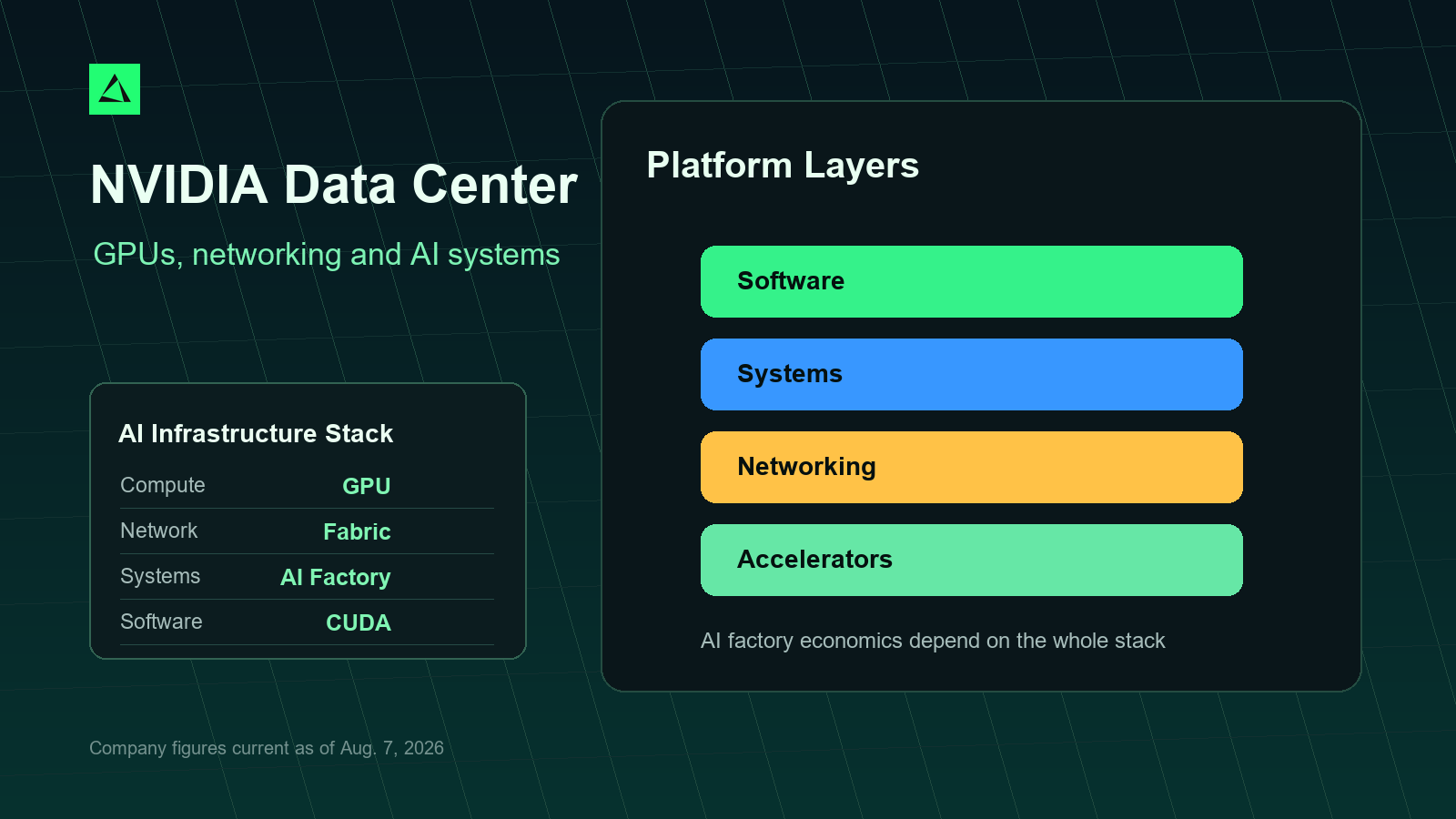
The Data Center business is often described as GPU demand, but that is too narrow. Modern AI infrastructure requires processors, high-speed networking, system design, software libraries, developer tools, memory, packaging and deployment support. Customers are not just buying chips. They are buying the ability to build, operate and scale AI systems.
That system-level role is central to NVIDIA's economics. A customer training large models or serving AI applications needs compute to work with networking and software. A bottleneck in one layer can reduce the value of the whole cluster. NVIDIA's advantage is that it can offer a coordinated platform rather than a single component.
| Data Center Layer | What It Does | Investor Importance |
|---|---|---|
| GPUs and accelerators | Run AI training, inference and accelerated workloads | Core revenue driver and performance anchor |
| Networking | Connects processors and systems inside large clusters | Expands NVIDIA's share of the AI system budget |
| Systems | Packages compute, networking and platform design | Raises value per deployment and execution complexity |
| Software ecosystem | Supports development, deployment and workload portability | Creates switching costs and platform familiarity |
| Customer support and roadmap | Helps buyers plan multi-year AI capacity | Supports demand visibility and product refresh cycles |
GPUs Start the Conversation
NVIDIA GPUs remain the visible anchor of Data Center demand because AI training and inference require massive parallel computation. Customers buying capacity for frontier models, recommender systems, coding assistants, search, robotics, scientific computing or enterprise AI need acceleration.
Still, a GPU comparison alone misses the commercial reality. Buyers care about performance, availability, software compatibility, power efficiency and the ability to deploy at scale. The winning product is not always the chip with the most impressive benchmark in isolation. It is the platform that reduces deployment risk.
Networking Expands the Moat
AI clusters need processors to communicate quickly. If data movement is slow, expensive accelerators sit underused. NVIDIA's networking assets therefore matter because they help make large AI systems more productive.
This is why NVIDIA's platform roadmap is closely linked to the Data Center story. New platforms are not only chip upgrades. They are system upgrades that include compute, networking and software.
Software Keeps the Platform Sticky
Software is harder to see in a quarterly segment table, but it is central to how investors should understand Data Center durability. CUDA, libraries, tools and deployment frameworks give developers a familiar environment for accelerated computing. That familiarity can reduce adoption risk for customers and make a hardware switch more complicated than a simple price comparison.
The valuation question is whether software remains only a support layer for hardware or becomes a larger economic layer of its own. Even when software is not the largest disclosed revenue line, it can protect hardware demand by preserving customer workflows. If enterprise AI deployments grow, tools that make models easier to deploy, optimize and operate can become more important to the buying decision.
For investors, this means the Data Center moat should be judged across the full stack. A cheaper accelerator can still be less attractive if it requires more engineering work, weaker software compatibility or a less mature deployment path. That does not eliminate competition, but it helps explain why NVIDIA's Data Center economics can remain stronger than a pure commodity-chip model.
Hyperscale and ACIE Give Investors a Better Map
NVIDIA's latest market-platform disclosure split Data Center into two large groups. Hyperscale revenue was $37.869 billion. AI Clouds, Industrial and Enterprise revenue, or ACIE, was $37.377 billion. The near-even split gives investors a clearer way to judge demand breadth.
Hyperscale customers remain vital. They have the budgets, infrastructure and urgency to deploy AI capacity at exceptional scale. Their spending plans can move NVIDIA's quarterly revenue and the market's near-term expectations.
ACIE is the broadening signal. It includes AI clouds, enterprise users, industrial deployments and other customers outside the largest hyperscalers. If ACIE continues growing, NVIDIA's Data Center business looks less like a narrow cloud capex cycle and more like a broad infrastructure platform.
The Data Center Bull Case
The bullish case is that AI computing becomes a long-duration infrastructure layer. Training large models is only the first phase. Inference, enterprise applications, sovereign AI, industrial automation, health care, robotics and scientific workloads can extend demand beyond the initial buildout.
In that scenario, NVIDIA benefits from product cadence and platform depth. Customers standardize on NVIDIA systems, expand deployments, refresh hardware and continue using the software ecosystem. Revenue becomes less dependent on one product generation and more tied to a recurring need for accelerated computing.
This is the operating foundation behind NVIDIA's premium valuation debate. A premium valuation is easier to defend if Data Center becomes a durable platform business rather than a temporary hardware spike.
Inference Is the Durability Test
Training demand is visible because it requires large clusters and major capital commitments. Inference may be more durable if AI applications become everyday products. Each user query, recommendation, code completion or enterprise workflow can create recurring compute demand.
The market will watch whether inference grows fast enough to absorb new capacity. If usage expands alongside deployment, Data Center revenue can continue to look high quality. If customers build capacity faster than AI products generate economic returns, investors may treat the segment as more cyclical.
The Main Risks Inside Data Center
The Data Center story has real strength, but it is not risk-free. Customer concentration is one issue. NVIDIA's filing showed three direct customers represented 21%, 17% and 16% of total revenue. Concentration can help growth during a boom, but it can also create volatility if a few buyers alter their plans.
Supply complexity is another risk. Advanced AI systems require leading-edge foundry capacity, advanced packaging, high-bandwidth memory and tight logistics. NVIDIA disclosed $119 billion of manufacturing, supply and capacity commitments as of April 26, 2026. Those commitments can secure supply, but they also raise the importance of demand visibility.
China policy remains material. NVIDIA reported no Data Center Hopper shipments to China in the latest quarter, compared with $4.6 billion in the year-earlier period. Export controls can reduce the addressable market and accelerate local alternatives.
Margin Quality Is the Segment's Real Proof Point
Data Center's importance is not only that it is large. It is that the segment supports unusually strong company-level profitability. A high revenue base with weak economics would not justify the same investor enthusiasm. The latest 74.9% gross margin shows that demand, product mix and platform value were still translating into strong profit quality.
The next test is whether margins remain resilient as systems become more complex. AI infrastructure increasingly depends on packaging, memory, networking, power, cooling and customer-specific deployment work. Those requirements can raise costs even when demand stays strong. If NVIDIA holds margins while scaling complete systems, the market can treat Data Center as a premium platform. If margins fall quickly, investors may begin treating the segment more like a capital-intensive hardware cycle.
Competition Can Pressure Economics Without Taking the Whole Market
AMD, custom silicon and cloud-designed accelerators do not need to defeat NVIDIA completely to affect valuation. They can pressure pricing, win specific workloads or give customers more negotiating leverage. NVIDIA's ecosystem is a strong defense, but investors should not treat it as a permanent exemption from competition.
The question is not whether competitors exist. They do. The question is whether NVIDIA keeps enough performance, software, supply and system-level advantage to maintain premium economics as the market grows.
How to Read Data Center in Future Earnings
Investors should read future earnings reports through several Data Center checkpoints. Revenue growth remains the first signal, but it needs context. Gross margin shows whether growth is profitable. Hyperscale and ACIE mix shows whether demand is broadening. Supply commentary shows whether orders can become revenue. China commentary shows policy exposure. Product transition commentary shows whether Blackwell and Rubin can sustain the cycle.
The best Data Center report would show growth, stable margins, broad customer demand, healthy guidance and smooth product execution. A weaker report could still show high revenue but reveal narrowing demand, margin pressure or more cautious customer behavior.
Quarterly results remain the proof point. Data Center strength appears in revenue, gross margin and guidance. The segment analysis explains why those numbers can persist, and what could pressure them.
Trade NVIDIA Perpetuals on edgeX - 24/7, No KYC Required
NVIDIA's story doesn't pause when markets close. For traders who want continuous exposure to NVDA price action - without the constraints of traditional market hours - edgeX offers a compelling alternative.
What Is edgeX?
edgeX is a decentralized exchange built for active traders who value both performance and privacy. The platform combines institutional-grade execution with true self-custody, meaning users retain full control of their funds and private keys at all times. No centralized custodian. No platform holding your assets on your behalf.
Why Trade NVDA/USDC Perpetual Futures on edgeX?
For those tracking NVIDIA's momentum, edgeX lists NVDA/USDC perpetual futures with up to 10x leverage and no expiration date - so positions can be held as long as the thesis holds. Settlement is transparent and on-chain, and because edgeX requires no KYC, traders can get started anonymously without lengthy onboarding.
- 24/7 trading - NVDA exposure around the clock, not just during NYSE hours
- Deep liquidity - $10M of depth within a one-basis-point spread, with sub-0.1 bps slippage on larger trades
- 10x leverage - amplify directional conviction on NVIDIA moves
- 100% trading fee rewards - fees earned back through the platform's Trade-to-Earn program
- Self-custody - assets stay in your wallet; every fund movement requires your explicit authorization
- Censorship resistance - a permissionless, decentralized structure with on-chain settlement
Explore NVDA/USDC Perpetual Futures
Whether NVIDIA's next catalyst is an earnings print, a product launch, or a broader AI sector rotation, having a venue that trades around the clock - and keeps you in control - matters.
Explore NVDA/USDC perpetual futures on edgeX and see what decentralized derivatives trading looks like at institutional scale.
Bottom Line
NVIDIA's Data Center business is the core reason NVDA carries an AI infrastructure premium. The segment is large, profitable and strategically central. It reaches beyond chips into networking, systems, software and customer roadmaps.
The investment debate is about durability. If Data Center demand broadens and inference becomes a recurring compute layer, NVIDIA's premium can remain defensible. If demand narrows, margins compress or customers question AI returns, the same segment can become the source of valuation pressure.
Frequently Asked Questions
How large is NVIDIA's Data Center business?
NVIDIA reported $75.246 billion of Data Center revenue in Q1 fiscal 2027, the quarter ended April 26, 2026. That represented roughly 92% of total company revenue.
Is NVIDIA Data Center only a GPU business?
No. GPUs are central, but the Data Center business also includes networking, systems, software, platform tools and ecosystem support. That broader stack is why investors analyze NVIDIA as an AI infrastructure platform.
What is ACIE in NVIDIA's disclosure?
ACIE refers to AI Clouds, Industrial and Enterprise. NVIDIA reported $37.377 billion of ACIE revenue in Q1 fiscal 2027, giving investors a way to track demand outside the largest hyperscale customers.
Why does inference matter for NVIDIA Data Center growth?
Inference can create recurring compute demand if AI applications are used at scale. Training is a major initial driver, but durable inference workloads can make the Data Center opportunity longer lasting.
What are the biggest Data Center risks for NVDA?
The main risks are customer concentration, supply complexity, margin pressure, China restrictions and competition from AMD, custom silicon and cloud-designed accelerators.

