What Could Weaken NVIDIA’s Moat: AMD, Custom Chips and AI Accelerator Rivalry
Key Takeaways
- •NVIDIA reported $96.2 billion in company revenue and $89.0 billion in Data Center sales in Q2 FY27, with gross margin at 75.0%.
- •The company guided Q3 FY27 revenue to about $108.0 billion, signaling continued scale in AI infrastructure demand.
- •AMD is identified as NVIDIA’s most visible merchant rival, but its impact depends more on wallet share and pricing leverage than on isolated benchmark wins.
- •Custom silicon developed by hyperscalers is described as a structural threat that could limit NVIDIA’s share of customer AI spending over time.
- •The article says the most important signs of moat compression would be weaker margins, lower systems and networking attach, and reduced software-driven switching costs.
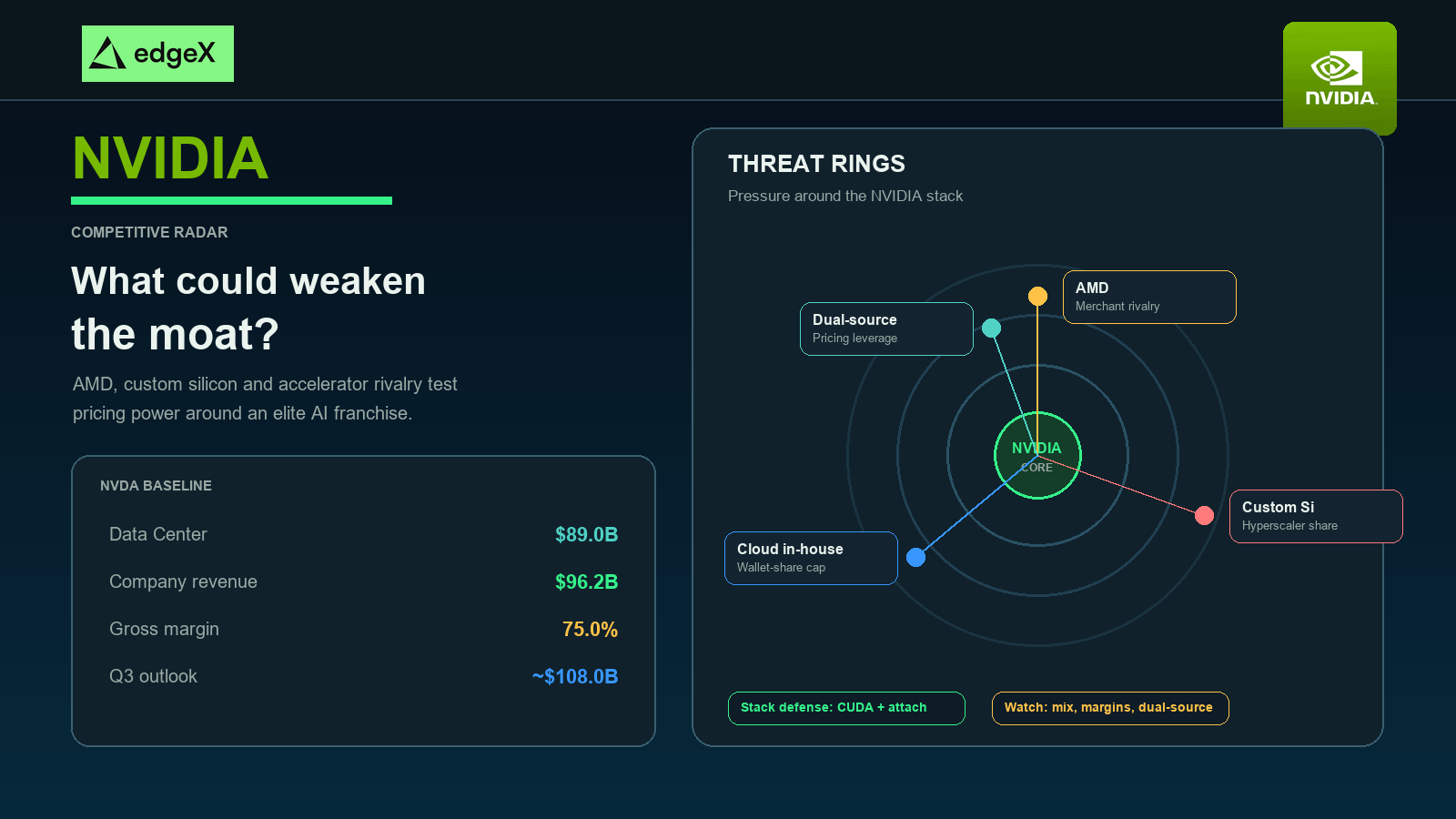
NVIDIA’s moat is easiest to overstate when the company is printing historic AI-infrastructure dollars. It is also easiest to understate when every rival demo is treated as proof that NVDA’s pricing power is already broken. The useful question sits between those extremes: what could actually weaken NVIDIA’s advantage in accelerators, systems, networking, and software, and what would that mean for the stock? In Q2 FY27, NVIDIA delivered $96.2 billion in company revenue and $89.0 billion in Data Center sales at 75.0% gross margins while pointing Q3 toward about $108.0 billion. Competition matters because that premium franchise is exactly what rivals, custom silicon programs, and cloud in-house chips are trying to compress.
This article maps the competitive pressure on NVDA: AMD as the most visible merchant rival, custom silicon inside hyperscalers as a structural share threat, and the broader AI accelerator market as a test of whether NVIDIA remains a full-stack platform or drifts toward more cyclical component economics. It is not a pure Data Center primer and not a networking deep dive. For segment economics, see NVIDIA’s Data Center business. For fabric attach, see NVIDIA AI networking.
Quick Answer
What could weaken NVIDIA’s moat is not one rival logo. It is any force that turns NVIDIA from a high-mix AI platform into a more interchangeable accelerator supplier. AMD can pressure merchant share and narratives. Custom silicon can quietly cap NVIDIA’s wallet share inside the biggest cloud buyers. Broader accelerator rivalry can matter if customers re-open architecture decisions during platform transitions. After Q2 FY27’s $89.0 billion Data Center print and a guide toward about $108.0 billion, competition is best underwritten as a pricing-power and duration risk around an already elite franchise, not as proof that the current machine has already stalled.
Why Competition Belongs at the Center of the NVDA Debate
A bull case that ignores competition is incomplete. A bear case that treats every rival announcement as fatal is also incomplete. NVIDIA’s current economics show extraordinary demand conversion. Competition belongs in the model because the market is not only paying for today’s billings. It is paying for the durability of NVIDIA’s ability to keep selling scarce, high-mix systems into AI factories.
That durability can erode in several ways. Customers can dual-source accelerators. Hyperscalers can shift incremental workloads to internal silicon. Software ecosystems can become less exclusive. Networking and systems attach can slip during architecture transitions. None of those requires NVIDIA to “lose” the market in a binary sense. They only require the franchise to look a little more cyclical, a little more price-sensitive, or a little less complete.
The NVIDIA stock guide covers the full business map. The NVIDIA valuation framework covers how much durability is already priced in. This article stays on the competitive mechanisms that could change that durability. After a quarter this large, the market is less interested in whether NVIDIA is “winning” in a slogan sense and more interested in whether the win remains expensive to contest.
An Investor Scorecard for Competitive Pressure on NVDA
The right scorecard starts with NVIDIA’s official baseline, then asks what competition would have to change.
| Competitive lens | Latest NVIDIA evidence | What would weaken the moat |
|---|---|---|
| Demand envelope | Data Center revenue $89.0B; company revenue $96.2B in Q2 FY27 | Rival supply that absorbs incremental AI-factory spend without NVIDIA economics |
| Profit quality | GAAP & non-GAAP gross margin 75.0%; GAAP operating income $63.734B | Sustained mix or ASP pressure that pulls the franchise off mid-70s quality |
| Platform completeness | Systems, Spectrum-class networking, and software ecosystem around the GPU | Customers buying boards while stripping attach, fabrics, or software gravity |
| Cadence hurdle | Q3 FY27 outlook ~$108.0B ±2%; GM 74.0% ±50 bp | Platform transitions where rivals or custom chips reopen architecture decisions |
| Expectation risk | Historic absolute scale already in the print | Competition that does not crush revenue yet still compresses the multiple through duration doubt |
The scorecard’s message is blunt. Competition does not need to erase an $89.0 billion Data Center machine overnight to matter. It needs to change the probability that NVIDIA keeps converting AI demand into premium mix, attach, and software-centered switching costs. In practical underwriting terms, that is a duration and pricing-power problem before it becomes a revenue-collapse problem.
AMD, Merchant Rivalry and the Public Competitor Narrative
AMD is the competitor investors can see most easily in public markets. That visibility matters. Merchant rivalry shapes media narratives, benchmark conversations, and the political economy of dual-sourcing. Even when NVIDIA retains a large lead in AI-factory deployments, AMD can influence how expensive the market is willing to capitalize that lead.
Where AMD pressure is real
Merchant competition is most dangerous when it gives large buyers a credible second source for enough workloads to change procurement leverage. The point is not that AMD must win every training cluster. The point is whether buyers gain enough alternative capacity to push NVIDIA toward sharper pricing, slower attach, or more defensive product packaging. Public rivalry also matters because it can make NVIDIA’s premium look less inevitable in valuation debates.
Where AMD pressure is often overstated
A rival that wins selected benchmarks or selected sockets does not automatically inherit NVIDIA’s systems, networking, and software stack. If customers still need NVIDIA fabrics, CUDA-centered workflows, or full AI-factory packaging, merchant share shifts can remain narrower than headline narratives imply. Investors should therefore judge AMD pressure by wallet-share and mix outcomes, not by demo-cycle volume.
Dual-sourcing as the practical middle path
The most realistic near-term competitive path is often dual-sourcing rather than wholesale displacement. Large customers may keep NVIDIA for the hardest or most software-integrated workloads while testing alternatives elsewhere. That can still weaken NVDA if it caps incremental share, pressures pricing at the margin, or reduces the automatic assumption that every new AI-factory dollar belongs to NVIDIA by default. Dual-sourcing is easy to dismiss because it does not look like a knockout. It is dangerous precisely because it can rewrite leverage without rewriting the leaderboard.
Custom Silicon and the Quiet Share Threat
Custom silicon inside major cloud platforms is a different competitive species. It may never show up as a clean public “GPU competitor” ticker, yet it can matter more to long-run NVIDIA wallet share than merchant branding wars.
Hyperscalers have incentives to design internal accelerators for cost, supply control, and workload fit. If those chips absorb a rising share of inference or specialized training demand, NVIDIA can remain essential for frontier systems while losing pieces of the broader accelerator budget. That is a classic moat-compression path: not sudden irrelevance, but a lower ceiling on how much of the customer’s AI compute bill NVIDIA captures.
Custom silicon also interacts with NVIDIA’s platform story. If internal chips force NVIDIA to compete more as a component and less as the default full stack, attach and software gravity become even more important. That is why networking and systems evidence belongs in competition analysis. See NVIDIA AI networking for the fabric side of that defense. A moat that depends only on die performance is thinner than a moat that still owns the factory design around the die.
Investors should not invent precise custom-silicon unit shares the company has not disclosed. The underwriting move is cleaner: treat custom silicon as a structural option for the largest buyers, then watch whether NVIDIA’s mix, attach, and absolute Data Center growth still compound around it. If they do, custom silicon is a ceiling debate. If they do not, custom silicon becomes a franchise-quality debate.
What Full-Stack Rivalry Would Have to Break
NVIDIA’s moat is hardest to weaken when the customer is buying an AI factory rather than a part number. Accelerators matter. So do NVLink-class scale-up, InfiniBand and Ethernet fabrics, systems integration, software tooling, and the habit of building teams around CUDA-centered workflows. Competition that only challenges the GPU die leaves much of that stack intact.
Pricing power
Pricing power weakens when alternatives are good enough, available enough, and integrated enough that customers can walk. After a 75.0% gross-margin quarter, the market is especially sensitive to any sign that mix is peaking. Competition becomes a stock issue fastest when it shows up as margin or attach deterioration rather than as a press-release rivalry.
Software and switching costs
Software is the quiet compounder. If developers, kernels, and deployment tooling remain centered on NVIDIA, rival silicon faces a longer qualification path. If abstraction layers, open tooling, or customer-owned stacks reduce that friction, accelerator rivalry becomes more dangerous. CUDA is not the whole moat, but it is one reason merchant and custom alternatives do not automatically translate into equal wallet share.
Platform transitions as attack windows
Architecture transitions are when customers reopen decisions. If NVIDIA’s next manufacturing ramp pairs compute with systems and networking continuity, the moat holds better. If transitions create gaps, rivals and custom chips get a cleaner entry point. That is why cadence and attach evidence belong in competitive underwriting even when the current print is already enormous. The attack window is not the existence of a rival chip. It is the moment when a customer can change architecture without paying an unacceptable switching cost.
Cash generation sits behind the same hierarchy. In Q2 FY27, NVIDIA returned about $26.0 billion to shareholders with roughly $99.0 billion of repurchase authorization remaining. Those figures do not prove the moat by themselves. They do show why competitive compression matters: the market is capitalizing a cash-rich platform engine, not a thin merchant-silicon cycle that must discount to fill every socket.
How Investors Should Underwrite Competitive Risk From Here
A practical competition framework uses four proofs. First, NVIDIA continues to convert AI-infrastructure demand into high absolute Data Center dollars without needing a pure volume race. Second, gross margins and mix stay consistent with a premium platform rather than a discounting merchant chip vendor. Third, systems and networking attach continue to travel with the accelerator roadmap. Fourth, software and customer workflow gravity remain strong enough that dual-sourcing and custom silicon do not quickly collapse switching costs. Those four proofs keep the competition debate measurable instead of dissolving into endless chip-launch theater.
Those proofs connect cleanly to the rest of the cluster. Segment readers can stay with NVIDIA’s Data Center business. Fabric readers can watch attach in NVIDIA AI networking. Valuation readers can translate competitive duration into multiples through the NVIDIA valuation guide. Comparative readers can continue into NVIDIA stock vs AMD stock when the merchant rivalry needs a direct frame.
Competition will not be settled by one quarter or one chip launch. After Q2 FY27’s $96.2 billion company print and $89.0 billion Data Center result, the live issue is whether NVIDIA’s moat remains a full-stack advantage or slowly compresses into a more contested accelerator market. AMD can pressure the public narrative and merchant leverage. Custom silicon can cap wallet share inside the largest buyers. Broader rivalry can matter if it weakens pricing power, attach, or software gravity. Keep all three in the model. Just keep them attached to mix, margins, and switching costs rather than to slogan-level “NVIDIA is done” or “NVIDIA can’t be touched” claims. If NVIDIA keeps selling AI factories, competition remains a managed pressure. If NVIDIA starts selling more interchangeable parts, competition becomes the main character.
Trade NVIDIA Perpetuals on edgeX - 24/7, No KYC Required
NVIDIA's story does not pause when markets close. For traders who want continuous exposure to NVDA price action without the constraints of traditional market hours, edgeX offers a decentralized alternative.
Continuous NVDA Market Access
edgeX lists NVDA/USDC perpetual futures with up to 10x leverage and no expiration date. Positions can be held as long as the thesis holds, with transparent on-chain settlement and no KYC requirement.
Institutional-Scale Execution With Self-Custody
edgeX is a decentralized exchange built for active traders who value performance and privacy. Users retain control of their funds and private keys. The platform cites $10 million of depth within a one-basis-point spread, sub-0.1-basis-point slippage on larger trades, and 100% trading-fee rewards through its Trade-to-Earn program.
Know the Risks Before Trading
Leverage can amplify gains and losses, including the risk of liquidation. Traders should verify current funding, fees, liquidity, product availability and contract specifications before opening a position. Explore NVDA/USDC perpetual futures on edgeX to see what decentralized derivatives trading looks like at institutional scale.
Frequently Asked Questions
These questions address the competitive issues investors raise most often after NVIDIA’s latest results: what could weaken the moat, how AMD and custom silicon differ, and what proofs to watch.
What is the biggest competitive threat to NVIDIA’s moat?
The biggest threat is any path that reduces NVIDIA from a high-mix full-stack AI platform to a more interchangeable accelerator supplier. That can come from merchant rivals, custom silicon, or weaker software and attach gravity.
Is AMD or custom silicon the more important long-run risk?
They matter differently. AMD is the most visible merchant rival and narrative force. Custom silicon may matter more to long-run wallet share inside the largest cloud buyers even if it never becomes a clean public competitor ticker.
Does strong Data Center growth mean competition no longer matters?
No. Q2 FY27’s $89.0 billion Data Center print shows demand conversion is elite. Competition still matters because the multiple depends on whether that premium can endure as alternatives improve and buyers dual-source.
What financial signals would show the moat is compressing?
Sustained mix or gross-margin pressure away from mid-70s quality, weaker systems/networking attach through transitions, and guide execution that increasingly relies on volume rather than platform pricing power.
What should investors monitor next on competition?
Merchant dual-sourcing behavior, hyperscaler custom-silicon adoption signals, NVIDIA attach and software gravity, and whether absolute Data Center dollars and margins stay consistent with a full-stack franchise.
