Nvidia Under Scrutiny Over H200 Chip Sales to Sanctioned Chinese Entities
Key Takeaways
- •An investigation said two approved H200 recipients were not operating at their listed addresses and were linked to sanctioned Chinese technology companies.
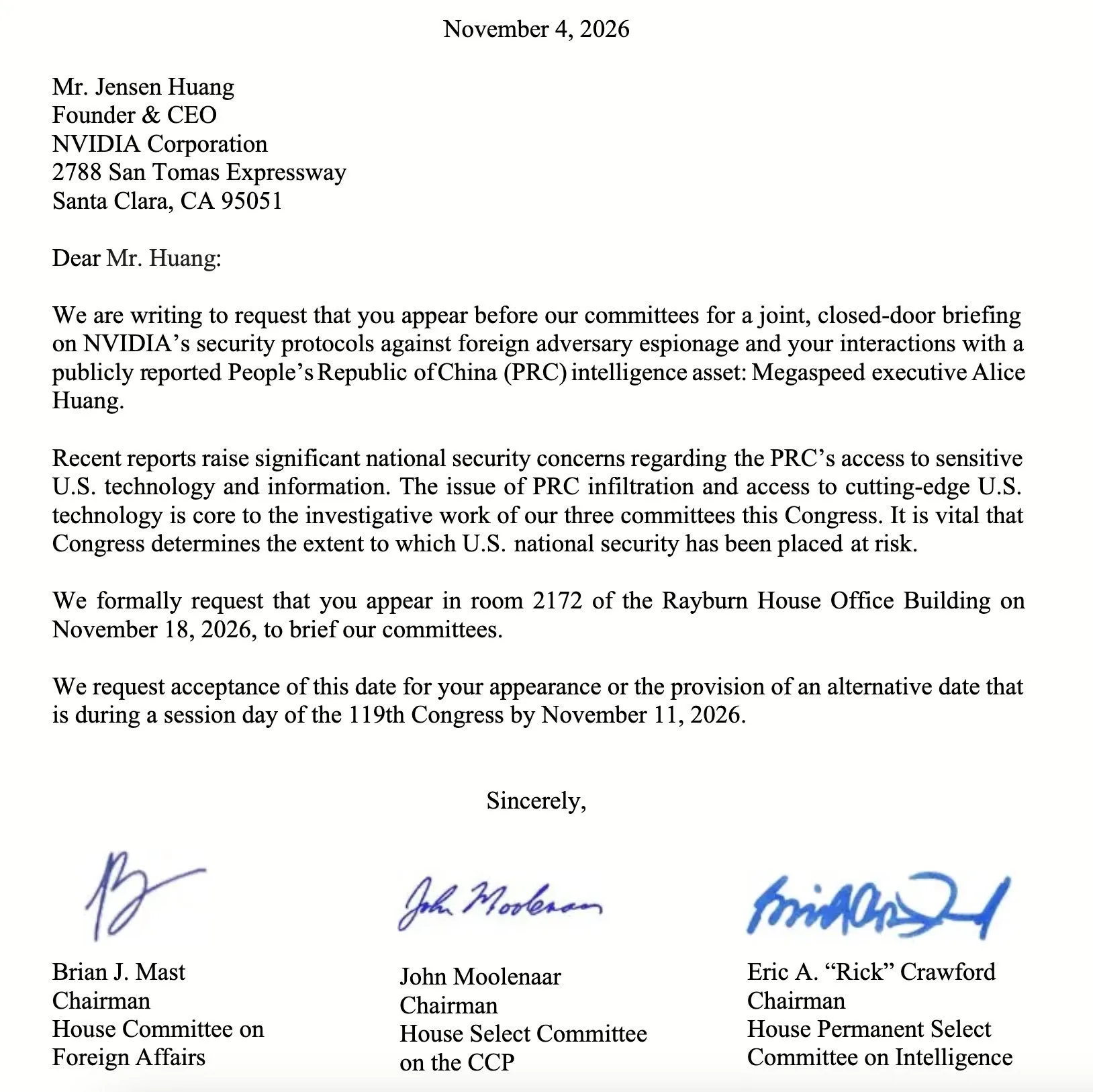
- •Three Republican committee chairmen requested a closed-door congressional briefing with Jensen Huang on Nov. 18.
- •Nvidia denied reports concerning Huang’s meetings with Alice Huang and said they involved routine business.
- •Nvidia shares rose 2.78% to $186.64 after falling 9.26% in the prior session.
- •The company is scheduled to report fiscal third-quarter 2027 results on Nov. 17, one day before the proposed briefing.
Nvidia faced renewed scrutiny on Nov. 7 after an investigation questioned U.S. approvals for Chinese buyers of its advanced chips. According to The New York Times, two of the entities approved to receive the company's H200 processors, high-end data center chips designed for artificial intelligence workloads, are not located at their listed physical addresses and are linked to sanctioned Chinese technology businesses. The report raised fresh questions about the vetting of approved chip buyers.
The findings followed a separate congressional request for Nvidia CEO Jensen Huang to explain reported intelligence concerns. Three Republican committee chairmen signed a summons, dated Nov. 4, requesting a closed-door briefing on Nov. 18.
Meanwhile, Nvidia shares closed at $186.64 on Friday, recovering 2.78% after Thursday's 9.26% decline. The stock is rebounding from last week's steep technology sell-off, though bearish sentiment lingers.
Congress Summons Nvidia CEO Over Relationship With Suspected Chinese Spy
The latest report adds to mounting pressure on Nvidia's ties to China. The country has historically accounted for one-fifth of Nvidia's revenue, but the U.S. has restricted sales of advanced chips, including the H200.
Underground networks have nevertheless bypassed export restrictions, allowing companies in mainland China to obtain the processors. While the U.S. cracks down on those channels, Nvidia CEO Jensen Huang has also reportedly lobbied President Trump to permit the company to sell some of its most advanced chips to China.
Huang is now under scrutiny over a personal relationship with a woman who has since been identified as a Chinese spy. According to The New York Times, U.S. intelligence officials suspected Alice Huang of collecting information for China's Ministry of State Security, the country's principal civilian intelligence agency. The report said she developed a close relationship with the Nvidia CEO while working at Singapore-based Megaspeed. The allegations do not establish that Jensen Huang knowingly shared sensitive information with Chinese intelligence.
Alice Huang is an executive at Megaspeed, a Singapore-based data center firm that is also a member of the Nvidia Cloud Partner network, an Nvidia partner program for cloud and data center providers offering services built on Nvidia's technology. Nvidia has denied the reports and says the meetings were routine business.
Congress has nonetheless summoned Huang to appear before the House on Nov. 18. The summons, dated Nov. 4 and signed by three Republican committee chairs, sets up a closed-door briefing with Huang on the matter.
Nvidia Stock Recovers After Sharp Technology Sell-Off
Nvidia stock closed at $186.64 on Nov. 6, gaining $5.04 from Thursday's $181.60 close. The rebound followed a 9.26% loss on Nov. 5, and the shares remained approximately 22.9% below their 52-week high of $243.37. Friday's trading range extended from $185.22 to $194.90, according to StockAnalysis. The stock also traded below $200, a level it had breached during the preceding decline.
The wider semiconductor sector recovered on Friday. However, concerns over artificial intelligence infrastructure spending and financing costs continued to weigh on investor sentiment. Political uncertainty presented another consideration: Democrats won control of Congress in the November midterm elections, though the results did not establish why Nvidia shares declined.
The company's China operations face separate regulatory questions. U.S. export controls on advanced chips are enforced through Commerce Department licensing, which determines which Chinese customers can obtain advanced processors, and future restrictions could affect Nvidia's sales opportunities. Still, the company's previous financial disclosures indicated limited recent H200 revenue from customers based in China.
Investors will also monitor Nvidia's upcoming third-quarter fiscal 2027 earnings. The company, whose fiscal year ends in late January, scheduled the results for Nov. 17, one day before the proposed congressional briefing. The earnings release could provide updated revenue figures, management guidance, and information about demand for artificial intelligence computing.
The congressional request remains unresolved. As of publication, Nvidia had not publicly confirmed whether Huang would attend the proposed Nov. 18 session. For Nvidia stock, the immediate developments concern earnings performance, export licensing, and congressional scrutiny.
This article provides market information, not investment advice. Equity prices carry financial risks, and regulatory developments do not guarantee future stock movements.
This article appeared first on The Market Periodical.

