NVIDIA Blackwell and Rubin Roadmap: What Next-Gen AI Platforms Mean for NVDA
Key Takeaways
- •NVIDIA generated $96.2 billion in total revenue in Q2 FY27, with Data Center sales contributing $89.0 billion and GAAP and non-GAAP gross margin at 75.0%.
- •The company guided Q3 FY27 revenue to roughly $108.0 billion with gross margin of 74.0% plus or minus 50 basis points, assuming no China Data Center compute revenue.
- •The Vera Rubin platform, which combines the Vera CPU with Rubin GPUs and a new NVLink generation, has entered a full manufacturing ramp.
- •NVIDIA has publicly committed to an annual platform cadence spanning Blackwell (2024), Blackwell Ultra (2025), Rubin (2026), and Rubin Ultra (2027), a faster rhythm than the roughly two-year gaps that separated Ampere, Hopper, and Blackwell.
- •During the Hopper-to-Blackwell transition in fiscal 2025, Data Center revenue climbed from $47.5 billion in fiscal 2024 to $115.2 billion, the only public precedent for an architecture change at scale.
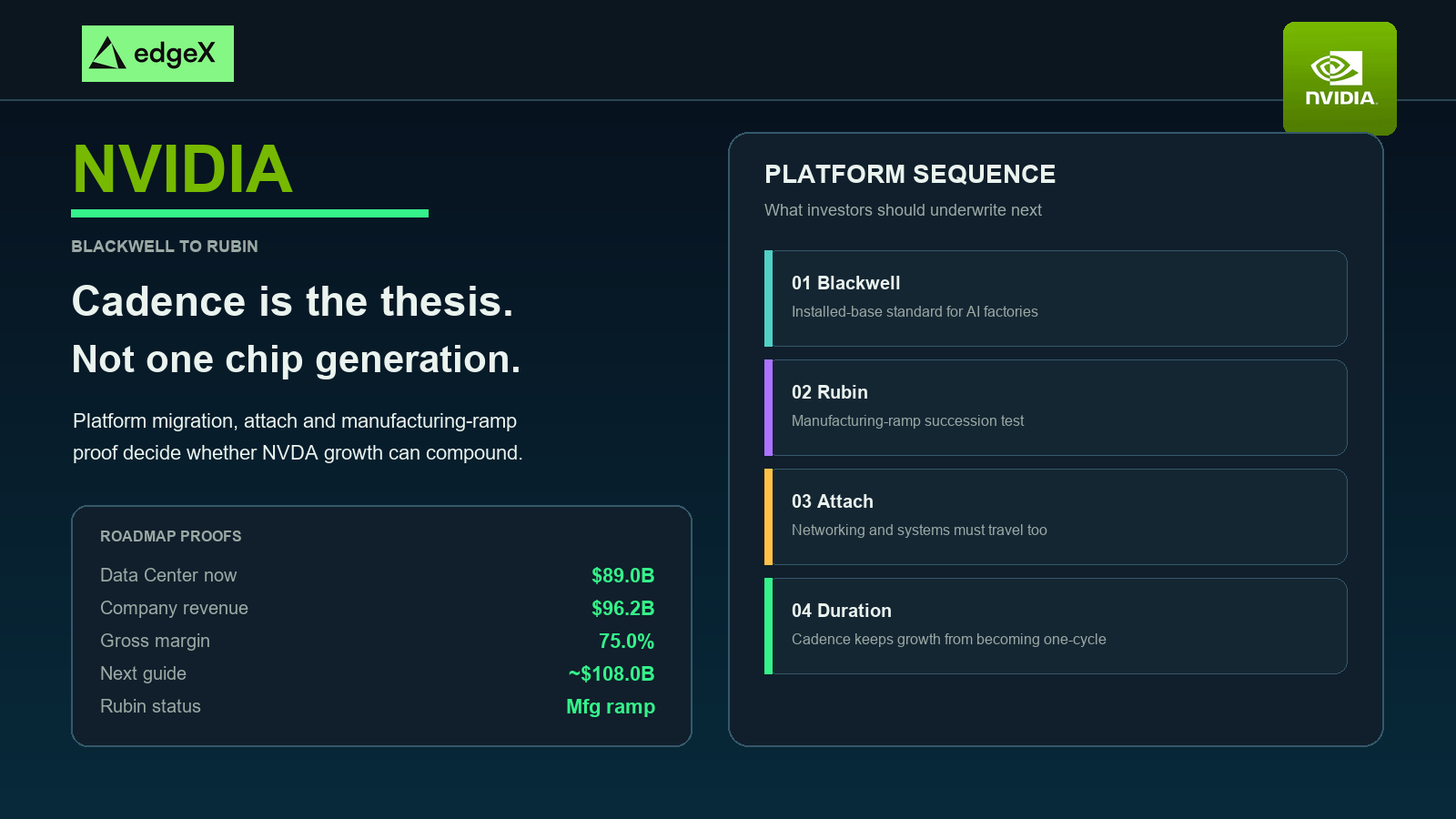
NVIDIA’s stock thesis does not survive on one hot chip generation. It survives on product cadence: the ability to move customers from one AI platform to the next without losing pricing power, attach rates, or deployment momentum. That is why the Blackwell-to-Rubin roadmap matters as much as any single quarterly beat. In the second quarter of fiscal 2027, NVIDIA printed $96.2 billion in revenue and $89.0 billion in Data Center sales while pointing to Vera Rubin entering a full manufacturing ramp. The market is no longer only asking whether AI demand is real. It is asking whether NVIDIA’s platform calendar can keep monetizing that demand.
This article is a roadmap guide for NVDA investors, not an earnings checklist and not a broad company primer. It focuses on what Blackwell and Rubin imply for growth duration, mix, networking attach, and competitive resilience. For segment economics, see NVIDIA’s Data Center business. For how to read the quarterly scorecard, see NVIDIA earnings explained.
Quick Answer
Blackwell and Rubin matter to NVDA because they turn AI infrastructure demand into a multi-generation franchise instead of a one-cycle boom. Blackwell is the platform that helped create today’s AI-factory run-rate. Rubin is the transition test: can NVIDIA keep customers inside its stack as architectures change? After Q2 FY27’s $96.2 billion company print and $89.0 billion Data Center result, the roadmap question is whether product cadence can sustain growth and premium margins as absolute scale rises and year-over-year comparisons get harder. Treat platform transitions as duration and mix evidence, not as marketing slides.
Why Product Cadence Is Now a Valuation Input
At NVIDIA’s current size, absolute growth can remain enormous while percentage growth inevitably cools. That shift makes cadence more important, not less. A company that can refresh architectures, preserve software stickiness, and keep networking attach intact can compound into a larger base. A company that ships one spectacular generation and then stumbles on the next invites multiple compression even if current profits are still historically large.
Roadmap analysis therefore sits between demand analysis and valuation analysis. Demand asks whether customers are still spending. Valuation asks how long that spending can support a premium. Cadence asks whether NVIDIA can keep converting spending into successive platforms before competitors, custom silicon, or digestion force a pause. After an $89.0 billion Data Center quarter, that conversion ability is one of the main things investors are paying for.
The NVIDIA stock guide covers the wider business model. This article stays narrower: what the Blackwell-to-Rubin sequence implies for NVDA’s ability to sustain growth quality through the next architecture cycle. If cadence holds, investors can underwrite a longer AI-infrastructure runway. If cadence slips, even excellent current profits can start looking fully priced.
A Roadmap Scorecard for NVDA Investors
The practical way to read NVIDIA’s platform calendar is to separate installed-base proof from next-generation proof. The table below uses the latest official financial baseline and the roadmap context around Vera Rubin’s manufacturing ramp.
| Roadmap lens | Latest evidence | What investors should infer |
|---|---|---|
| Installed-base demand | Data Center revenue $89.0B in Q2 FY27; company revenue $96.2B | Current platforms are still monetizing AI-factory spend at extraordinary scale |
| Profit quality | GAAP & non-GAAP gross margin 75.0%; GAAP operating income $63.734B | Cadence is landing in a high-ASP, high-mix franchise rather than a commoditized volume race |
| Next-platform execution | Vera Rubin in a full manufacturing ramp | Roadmap is translating into manufacturable supply and customer migration risk is becoming testable |
| Continuity hurdle | Q3 FY27 outlook ~$108.0B ±2%; GM 74.0% ±50 bp; no China Data Center compute assumed | Near-term spend and margin quality still have to clear a higher bar after a historic print |
| Secondary mix | Edge Computing $7.2B | Diversification exists, but the roadmap premium still lives primarily in Data Center platforms |
The scorecard’s point is discipline. A roadmap story without Data Center dollars is theater. Data Center dollars without a credible next platform are temporary. NVDA’s premium needs both. Investors should therefore read manufacturing-ramp headlines and quarterly segment prints as one underwriting package, not as separate conversations.
What Blackwell Already Proved
Blackwell matters because it showed NVIDIA could define the AI-factory generation rather than merely participate in it. The platform helped concentrate demand around NVIDIA’s accelerated computing stack at a moment when customers were racing to secure capacity. That is the first job of a lead platform: pull demand into a standard that NVIDIA can supply, attach, and support.
For investors, Blackwell’s importance is not nostalgia. It is installed-base proof. The $89.0 billion Data Center print did not appear from a blank page. It reflects customers already committed to NVIDIA’s current architecture family, software ecosystem, and cluster design patterns. That installed base is what makes the next transition valuable. The more customers are already inside the stack, the more a successful Rubin ramp can compound rather than restart the franchise.
Blackwell also raised the expectation bar. Once a platform generation sets an extraordinary run-rate, investors begin judging NVIDIA less by whether AI demand exists and more by whether the next generation can keep the spending cycle from fragmenting. That is a tougher standard, and it is the standard Rubin now faces. In practical terms, Blackwell converted NVIDIA from an AI beneficiary into the reference architecture many buyers plan around. Reference architectures create follow-on power, but they also create disappointment risk if the successor arrives late, thin, or weakly attached.
What Rubin Has to Prove Next
Rubin is the succession test. A full manufacturing ramp matters because investors paying for duration need evidence that NVIDIA can move from roadmap slides to qualified, shippable platforms. Manufacturing readiness does not guarantee perfect mix or perfect timing. It does reduce the risk that the next cycle stalls in the gap between announcement and deployment.
Migration without mix damage
The first proof is customer migration. NVIDIA needs buyers of the current generation to see a path into Rubin-era systems without a messy pause that opens the door to alternatives. If migration is orderly, attach can stay high and ASPs can remain supported. If migration is choppy, even strong absolute demand can arrive with weaker mix.
Attach across the stack
The second proof is that Rubin remains a platform transition, not a GPU-only refresh. Networking, systems, and software have to travel with the architecture. Otherwise NVIDIA risks selling more discrete accelerators while losing the fuller stack economics that support mid-70s margins. For why networking belongs in that underwriting, see NVIDIA AI networking explained.
Continuity after a historic base
The third proof is continuity on a giant base. Guiding toward about $108.0 billion in Q3 FY27 after a $96.2 billion quarter says management still expects sequential strength. Roadmap credibility helps explain why that continuity could persist. It does not make guidance destiny. Investors should use Rubin evidence to pressure-test duration assumptions, not to skip the quarterly proof process. A manufacturing ramp can support the story; only sustained Data Center monetization can confirm it.
How Roadmap Cadence Supports Growth Duration
Growth duration is the bridge between product strategy and equity valuation. If NVIDIA can keep customers advancing through Blackwell- and Rubin-class platforms, the company can monetize AI infrastructure spend for longer than a single shipment spike would imply. That longer window supports premium framing even as percentage growth normalizes.
Cadence also changes competitive math. Custom silicon and rival accelerators become more threatening when NVIDIA leaves a long gap between generations. In that gap, customers have more time to redesign clusters, qualify alternatives, and negotiate pricing. A tight, credible roadmap shortens that window. It does not eliminate competition. It reduces the amount of time competition has to turn experimentation into share shift.
There is a margin channel as well. Platform transitions can pressure mix through new costs, qualification friction, or temporary product gaps. They can also protect margins if networking and systems attach remain strong. That is why the guided Q3 margin band of 74.0% ±50 basis points belongs in roadmap analysis. Cadence that preserves mid-70s profitability is more valuable than cadence that only preserves unit volume. For NVDA, the market is paying for scarce platforms that stay profitable across generations, not for perpetual percentage acceleration from an already huge base.
What Can Break the Roadmap Thesis
The roadmap thesis can weaken without NVIDIA suddenly becoming a weak company. Manufacturing delays, weaker-than-expected attach, customer digestion between generations, or a China demand hole that stays closed can all shorten the effective duration of the current AI-factory cycle. The Q3 outlook’s assumption of no China Data Center compute revenue is a reminder that geographic and policy constraints remain part of platform underwriting.
Expectation risk is another break point. After historic prints, investors may treat any cadence slip as evidence that the easy part of the cycle is over. In that setting, roadmap communication becomes part of the earnings reaction function. Clear manufacturing-ramp evidence and stable mix help. Ambiguous transition chatter hurts. The paradox of success is that Blackwell’s strength made Rubin’s proof burden heavier: the next platform has to look like continuity, not rescue.
Cadence versus hype
Investors should separate roadmap marketing from roadmap proof. Announcements create optionality. Manufacturing ramps, customer migrations, and attached systems create cash flows. NVDA’s premium should stay tied to the second set, not the first.
Competition in the transition window
The most dangerous competitive moment is often the transition window, not the peak of an old generation. If rivals can offer “good enough” alternatives while NVIDIA is moving customers across architectures, share and pricing power can erode even if NVIDIA remains the overall leader. Cadence quality is how NVIDIA narrows that window.
How to Underwrite Blackwell and Rubin From Here
A practical roadmap framework stays close to four proofs. First, installed-base monetization remains strong in Data Center dollars, not just in narrative. Second, next-platform manufacturing and qualification evidence continues to accumulate around Rubin. Third, networking and systems attach stay visible through the transition. Fourth, margins hold near the mid-70s while guidance remains credible on both demand and geography.
Those proofs connect cleanly to the rest of the cluster. Segment readers can stay with NVIDIA’s Data Center business. Earnings readers can translate roadmap claims into quarterly scorecards via NVIDIA earnings explained. Networking readers can inspect the fabric layer in NVIDIA AI networking explained. The common question is the same: can product cadence keep NVIDIA’s AI-infrastructure franchise compounding after the current generation’s easy comparisons fade? If the answer is yes, NVDA remains a platform-duration story rather than a single-cycle trade.
Blackwell showed NVIDIA could set the standard for an AI-factory cycle. Rubin has to show NVIDIA can extend that standard. If it does, NVDA remains a multi-generation platform story. If it does not, the company can still earn a great deal of money while the market pays less for the duration of that earnings power. Keep the underwriting tied to migration, attach, margins, and sequential Data Center demand, and the roadmap debate stays grounded instead of sliding into slogan-driven optimism.
Trade NVIDIA Perpetuals on edgeX - 24/7, No KYC Required
NVIDIA's story does not pause when markets close. For traders who want continuous exposure to NVDA price action without the constraints of traditional market hours, edgeX offers a decentralized alternative.
Continuous NVDA Market Access
edgeX lists NVDA/USDC perpetual futures with up to 10x leverage and no expiration date. Positions can be held as long as the thesis holds, with transparent on-chain settlement and no KYC requirement.
Institutional-Scale Execution With Self-Custody
edgeX is a decentralized exchange built for active traders who value performance and privacy. Users retain control of their funds and private keys. The platform cites $10 million of depth within a one-basis-point spread, sub-0.1-basis-point slippage on larger trades, and 100% trading-fee rewards through its Trade-to-Earn program.
Know the Risks Before Trading
Leverage can amplify gains and losses, including the risk of liquidation. Traders should verify current funding, fees, liquidity, product availability and contract specifications before opening a position. Explore NVDA/USDC perpetual futures on edgeX to see what decentralized derivatives trading looks like at institutional scale.
Frequently Asked Questions
These questions address the roadmap issues investors raise most often after NVIDIA’s latest results: why Blackwell still matters, what Rubin must prove, and how cadence affects the NVDA thesis.
Why do Blackwell and Rubin matter more than a single chip launch?
Because NVIDIA’s premium depends on multi-generation platform cadence. One successful generation can create a boom. Sustained cadence can create a franchise.
What does Vera Rubin’s manufacturing ramp change for investors?
It turns the next platform from a slide into a testable execution event. Investors can start judging migration, supply, and attach instead of waiting on announcement rhetoric alone.
How should roadmap analysis use the latest financial baseline?
Use Data Center revenue, gross margin, and the next-quarter guide as proof that current platforms are still monetizing demand while the next platform ramps. Roadmap claims without those proofs are incomplete.
Can competition break the roadmap thesis without overtaking NVIDIA overall?
Yes. Rivals and custom silicon can pressure pricing, attach, or duration during transition windows even if NVIDIA remains the share leader.
What are the cleanest roadmap proofs to monitor next?
Manufacturing and qualification progress on Rubin-era systems, attach through networking and racks, margin stability near the mid-70s, and whether sequential Data Center demand remains firm after historic prints.

