Nvidia AI Server Prices Set to Rise More Than 15% as Memory Costs Surge
Key Takeaways
- •Nvidia has privately notified customers and server suppliers of AI server price increases above 15%, affecting early-2027 shipments of its Vera Rubin and Grace Blackwell platforms.
- •Rising DRAM and high-bandwidth memory costs, with global supply concentrated among Samsung, SK Hynix and Micron, are the main driver of the price hikes.
- •Server manufacturers are already passing the higher prices on to major data-center operators including Microsoft, Google and Oracle.
- •The increases could add billions of dollars to gigawatt-scale AI data-center budgets and may strengthen incentives for Amazon, Google, Microsoft and Meta to build more internal accelerators.
- •Nvidia is scheduled to report fiscal second-quarter results on August 26, with prior guidance calling for roughly $91 billion in revenue and a non-GAAP gross margin near 75%.
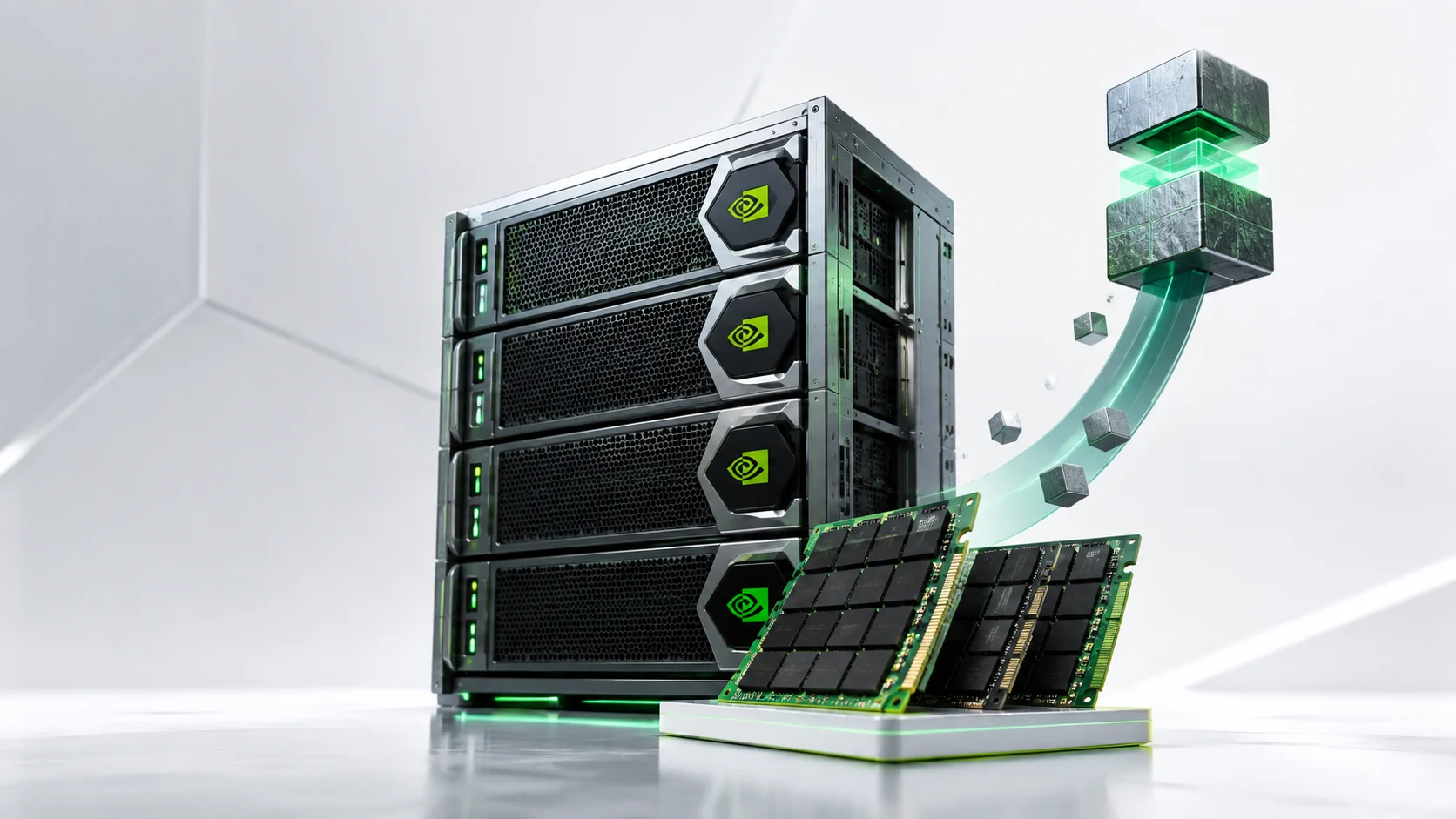
Nvidia customers are facing price increases of more than 15% on many AI server configurations as soaring memory costs feed directly into the next wave of data-center spending.
The increases are expected to affect systems shipped in early 2027, including Nvidia's flagship Vera Rubin and Grace Blackwell platforms. The exact increase varies by chip generation and memory configuration, and server manufacturers are already passing the higher pricing to major data-center operators including Microsoft, Google and Oracle, Fortune reported.
Nvidia has not publicly announced the changes. The pricing information was communicated privately to customers and server suppliers as the industry struggles to secure enough memory for rapidly expanding AI infrastructure, according to reports.
Memory Costs Hit Nvidia's Most Advanced AI Systems
Memory has become one of the tightest constraints in the AI supply chain, as increasingly powerful accelerators require larger amounts of DRAM and high-bandwidth memory. HBM works by stacking DRAM dies vertically and packaging them alongside the GPU so data moves fast enough to keep large AI models running, and each new accelerator generation has demanded more of it per chip.
Samsung Electronics, SK Hynix and Micron control most global DRAM production, giving the three suppliers increasing pricing leverage as hyperscalers compete for capacity. Those suppliers have also steered a growing share of wafer capacity toward HBM, which has tightened conventional DRAM supply and lifted contract prices across the memory market. Nvidia has already deepened its relationship with SK Hynix through a multiyear AI memory partnership covering future HBM products and infrastructure built around Vera Rubin. Because new memory fabrication capacity takes years to plan and build, supply cannot respond quickly to the surge in AI demand, which is why long-term supply commitments have become the norm for major buyers.
The latest pricing pressure arrives as Vera Rubin enters production, with Nvidia preparing shipments beginning this fall. The platform is designed as a rack-scale system for large AI factories and includes Rubin GPUs, Vera CPUs, networking, storage and other infrastructure working as a unified system.
Grace Blackwell systems are also unusually memory-intensive. The GB300 NVL72 architecture combines 72 Blackwell Ultra GPUs with 36 Grace CPUs and large pools of high-speed memory, making memory pricing a significant part of total system cost.
Higher Prices Add Billions to Data-Center Budgets
Even modest percentage increases become significant at hyperscale. A roughly 15% to 17% increase in advanced Nvidia systems could add billions of dollars to the cost of gigawatt-scale AI data centers, which are already facing higher spending on power, cooling, land and networking.
That pressure reaches companies such as CoreWeave, which has built its cloud business around massive deployments of Nvidia hardware. Nvidia previously agreed to purchase unused capacity under a $6.3 billion CoreWeave deal, illustrating how closely the chipmaker's economics are tied to the broader AI infrastructure buildout.
Higher hardware costs could also strengthen incentives for Amazon, Google, Microsoft and Meta to develop more internal accelerators. None has yet removed its dependence on Nvidia for large parts of its AI expansion, leaving customers exposed to both GPU availability and memory pricing.
Retail pricing provides a different picture. Nvidia raised the official DGX Spark price from $3,999 to $4,699 earlier this year because of memory constraints, although individual retailers have periodically discounted units below that MSRP. Those promotions reflect retail inventory and channel pricing rather than the economics of hyperscale Vera Rubin deployments.
Nvidia Earnings Put Margins Back in Focus
The increase comes days before Nvidia's next financial results, giving investors another metric to watch alongside revenue growth and demand.
Nvidia generated record quarterly revenue of $81.6 billion in its first fiscal quarter, including $75.2 billion from Data Center. GAAP gross margin reached 74.9%, leaving the company with considerably more pricing flexibility than most semiconductor suppliers.
The stock has nevertheless faced questions over AI spending and valuation after losing roughly $1 trillion from its May peak, briefly pushing Nvidia's forward valuation below 20 times earnings.
Nvidia will report its fiscal second-quarter results on August 26, with its previous guidance calling for approximately $91 billion in revenue and a non-GAAP gross margin near 75%.
Nvidia Stock Faces Monday Test Ahead of Earnings
Nvidia shares closed Friday at $214.72, down 0.95%, before reports of the server price increases emerged over the weekend. That leaves Monday as the first regular trading session in which investors can react to the reported price hikes.
A positive reaction would likely reflect the view that Nvidia still has enough pricing power to pass sharply higher memory costs through to customers without sacrificing demand, which could protect gross margins as Vera Rubin ramps into 2027. The same development also carries a bearish interpretation: servers that become more than 15% more expensive raise the total cost of AI infrastructure for hyperscalers and smaller cloud operators, potentially slowing deployments if memory inflation persists.
Nvidia is only three trading days away from its August 26 earnings report, where revenue guidance, Rubin demand and gross margins will carry considerably more weight than the weekend pricing report alone. Options traders were pricing roughly a 5.3% move in Nvidia shares through next Friday, leaving room for substantial volatility around the results. While a higher open on Monday is plausible if investors focus on Nvidia's pricing power, the pricing report by itself is not seen as strong enough to make a higher close the base case.

