Morgan Stanley: 91.7% of Nvidia's 2027 Revenue Rides on the $1.6 Trillion AI Capex Boom
Key Takeaways
- •Morgan Stanley calculates that 91.7% of Nvidia's projected 2027 revenue depends on AI infrastructure demand, the highest concentration among companies it tracks, ahead of Vertiv at 90% and Broadcom at 81%.
- •The bank forecasts hyperscaler and AI cloud spending of $1.58 trillion in 2027, rising to $1.8 trillion in 2028, with nearly $700 billion of the roughly $1 trillion in S&P 500 revenue landing at Nvidia.
- •SpaceX and Amazon Web Services together account for about 54% of Nvidia's 2027 hyperscaler revenue and 72% of its growth in Morgan Stanley's model, highlighting a narrow buyer base.
- •Key risks cited include a projected 32-gigawatt U.S. data center power shortfall through 2028, about $255 billion in unsecured bonds sold by hyperscalers this year, and component-cost inflation that lifted Amazon's spending plan from $200 billion to about $220 billion largely on memory prices.
- •Morgan Stanley argues that if spending plateaus, falling prices would erode suppliers' margins first, citing the late-2022 NAND downturn, while Nvidia, as the largest supplier in the chain, would be spared the worst disruption.
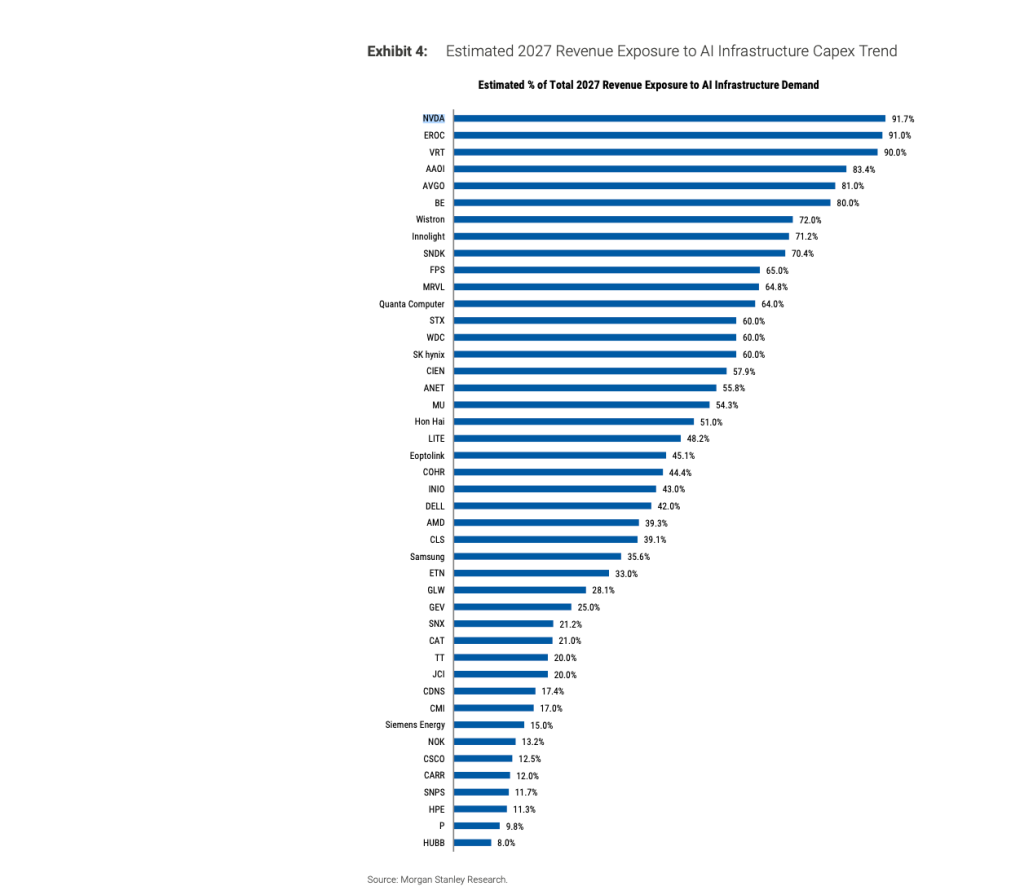
Nvidia's business is more concentrated on AI infrastructure than any other company tracked by Morgan Stanley, with 91.7% of its projected 2027 revenue tied to a single driver: AI infrastructure demand. Vertiv ranks second at 90%, followed by Broadcom at 81%, according to the bank.
The assessment comes from a 65-page Morgan Stanley research note published Oct. 15 and titled "Following AI's $1.6 Trillion Money Trail: Mapping the Revenue Generated by the Capex Boom." Produced by the bank's North America Insight team under Nicholas Lentini, the report includes a section headed "We Are Bullish This Spend" and names Nvidia the best risk/reward in the sector. Yet a substantial portion of the document is devoted to how the spending wave could come undone.
The bull case for the world's most valuable company and the bull case for the data center build-out have effectively merged into one, and the note makes both — along with a detailed map of what happens if the money trail runs dry.
A $1.58 trillion spending plan
Morgan Stanley estimates that hyperscalers and AI cloud providers will spend $1.58 trillion in 2027, up roughly 60% from about $980 billion this year, rising again to $1.8 trillion in 2028. Around $195 billion of the 2027 total consists of data center leases — arrangements that never appear as capital expenditure on a cash flow statement and that the report dubs "synthetic capex." Hyperscalers have disclosed more than $1.1 trillion in lease commitments that have yet to begin.
Roughly $1 trillion of the 2027 spending flows through as S\u0026P 500 revenue by the bank's estimate, with nearly $700 billion of that landing at Nvidia. Revenue from hyperscaler and neocloud customers represents 5% of total S\u0026P 500 revenue in 2027 but drives approximately 25% of the index's revenue growth.
Nvidia's own buyer list is narrower still. In Morgan Stanley's model, SpaceX and Amazon Web Services together account for about 54% of the chipmaker's hyperscaler revenue in 2027 and 72% of its growth.
The bull case
The bank's core argument is that Nvidia is inexpensive relative to what it does. The stock trades at 15 times fiscal 2028 earnings, and Morgan Stanley writes that multiple expansion "is also not required for the stock to work as numbers continue to go higher." It expects the capex wave to generate returns on invested capital of 25% to 50%, and calculates that Wall Street has underestimated compute cycles by an average of 38% across four previous technology cycles: PCs, the internet, mobile, and cloud.
Morgan Stanley even suggests its own Nvidia estimates may be too low, describing its SpaceX and Amazon projections as conservative and leaving "a low bar for remaining hyperscalers." Its model has Nvidia's share of other hyperscalers' spending easing from 18% in 2026 to 16% in 2027, while Nvidia itself expects to gain share.
Other arms of the bank have sounded more cautious. In March, Morgan Stanley's global investment committee said the bull market "rests, more than anything, on the durability of AI capital expenditures."
What could break
The report's risk section amounts to an inventory of everything the 91.7% exposure depends on.
Financing comes first. Morgan Stanley expects 2027 to bring the largest cash flow deficit of its forecast period, and with it more debt. Hyperscalers have already sold about $255 billion of unsecured bonds this year — roughly 30% of estimated 2026 spending. In what the bank calls a theoretical exercise, it models the cost of borrowing more: Amazon, Alphabet, Meta, and Microsoft, all rated AA or higher, would see combined interest coverage fall from about 31x to 12x, while Oracle and SpaceX would drop from 4x to 1.8x.
Some of the spending growth is simply inflation. A meaningful part of recent capex increases reflects higher component prices, the report says, citing Amazon's finance chief attributing most of the rise in Amazon's spending plan — from $200 billion to about $220 billion — to rising memory costs, with no change to the build plan itself.
Power presents another constraint. The $1.6 trillion projection assumes every chip ordered eventually gets switched on, but Morgan Stanley's own power model projects a 32-gigawatt U.S. shortfall for data centers through 2028, about one-third of the 97 gigawatts needed. Hyperscalers can keep buying scarce GPUs ahead of available power, which would hold up chip revenue for a while and "could produce hoarding and stranded inventory," the report notes. "But buying power-dependent equipment that cannot be turned on is hard to sustain," it adds.
Politics rounds out the list. The firm calls data center restrictions a wedge issue in the midterms and does not expect a federal pause, but sees tax breaks as "the consensus target regardless of who wins."
The supplier problem
Morgan Stanley's downside case is ultimately a timing problem. If spending plateaus, it argues, volumes can hold up while prices fall, and suppliers' margins disappear first. The bank points to the late-2022 memory downturn, when NAND shipments fell only about 5% while prices dropped 20% to 30%.
Nvidia, the bank argues, would be spared the worst. In a pause, "we're likely to see the most disruption at the tail of the bullwhip," hitting memory, optics, and other small-dollar parts most likely to be over-ordered. By the report's own map, Nvidia sits at the other end of the whip as the single largest supplier in the chain.
The same report that says Wall Street underestimates compute cycles by 38% also concludes that Wall Street "is underprepared for the depth of cuts to the downside," calling the risk of volume and price falling together underappreciated.
"It's the standard capital-cycle playbook," the report says, "just compressed by how concentrated the hyperscaler customer base is."
This story was originally featured on Fortune.com.

