Nvidia Unveils $500 Billion Wall Street Partnership to Finance AI Infrastructure
Key Takeaways
- •Nvidia has partnered with six major Wall Street firms to establish $500 billion in AI compute infrastructure financing for its clients across hyperscalers, AI labs, and enterprises.
- •The partnership represents a shift away from Nvidia's earlier circular financing model, where the company directly invested in clients like CoreWeave and OpenAI that were expected to buy its chips.
- •Wall Street participants in the deal assume depreciation risk on current-generation Blackwell GPUs, which could lose value if Nvidia releases new chip generations or competitors such as AMD advance their products.
- •Amazon, Microsoft, and Alphabet collectively plan to invest over $700 billion in data centers this year, while energy availability has become a primary bottleneck for expansion in regions including Northern Virginia and Texas.
- •Analysts project Nvidia's second-quarter revenue to have surged 96% year-over-year to approximately $91 billion, with the earnings report expected later this month.
Nvidia has unveiled a $500 billion partnership with major Wall Street firms to finance AI infrastructure development, a move designed to sustain the rapid pace of data center spending that has driven the company's growth and reinforce its dominant position in the AI accelerator market, where it holds an estimated 80% to 90% share.
Nvidia Secures $500 Billion in Wall Street Financing
According to a press release, Nvidia has partnered with BlackRock, Apollo, Goldman Sachs, KKR, Brookfield, and Blackstone to establish AI compute infrastructure financing platforms. The partnership will see these firms commit $500 billion to fund Nvidia's clients across hyperscalers, frontier AI labs, and enterprises. The capital is intended to support data center buildout, with participating clients expected to use the financing to purchase Nvidia hardware.
The deal is structured to benefit all three sides. Nvidia stands to gain as companies use the financing to acquire its chips. The funded firms benefit from accessing capital without relying on their own balance sheets. The Wall Street participants provide the financing, with Nvidia GPUs serving as backing. Nvidia has expressed the view that GPU-backed financing could emerge as a new asset class, comparable to commercial real estate — a framing that effectively positions compute capacity as a securitizable infrastructure asset, similar to how cell towers, pipelines, and data centers themselves have been financialized in prior decades.
However, the arrangement transfers depreciation risk to the Wall Street firms. Current-generation Blackwell chips are depreciating assets that could lose value if Nvidia introduces a new generation of GPUs. Additionally, chips could depreciate more rapidly if competitors such as AMD release more advanced products. AMD has been steadily expanding its Instinct MI300 series data center GPU lineup and has secured design wins with Microsoft and Meta, though it remains well behind Nvidia in both software ecosystem maturity and installed base.
Shift Away From Circular Financing Model
The partnership represents a shift from Nvidia's earlier financing approach. In recent months, the company had faced investor concern over a circular financing model in which Nvidia made substantial direct investments in its own clients — including CoreWeave, Nebius, OpenAI, and IREN — with the expectation that these firms would subsequently purchase Nvidia chips. The $500 billion Wall Street arrangement redirects the financing burden to third-party institutions rather than Nvidia's own balance sheet.
Data Center Spending Continues to Accelerate
The announcement comes as AI data center companies commit billions of dollars to infrastructure, with many needing additional capital to sustain the pace of spending. Bitcoin mining companies pivoting to the AI data center sector face an estimated funding gap of more than $50 billion. Separately, Google recently raised $85 billion through a combination of debt and equity.
Amazon, Microsoft, and Alphabet collectively plan to invest over $700 billion in data centers this year. Intel, a company that counts Nvidia as its largest shareholder, is raising $15 billion through stock issuance. The broader capital raise across the sector reflects a recognition that AI infrastructure requires not only chips but also power generation, cooling systems, and land — constraints that have made energy availability a primary bottleneck for data center expansion, with grid capacity limits in key regions such as Northern Virginia and Texas already delaying projects.
Stock Performance and Upcoming Earnings
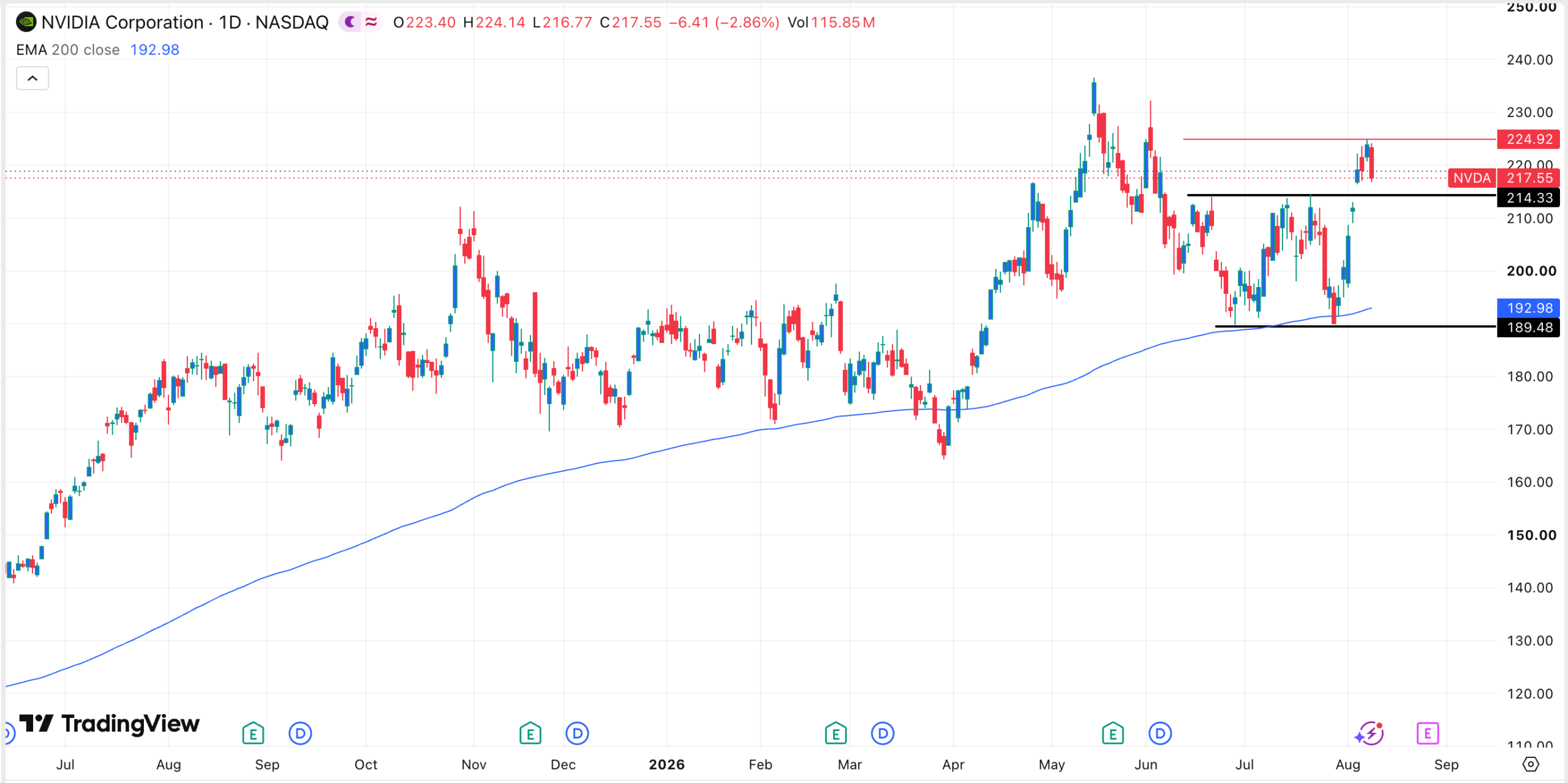
Nvidia shares dropped more than 2% on Monday, declining to $217, down modestly from last week's high of $224.90. The pullback comes as the recent rally stalled and investors await the company's earnings report later this month.
According to analyst estimates, Nvidia's second-quarter revenue is projected to have jumped 96% year-over-year to approximately $91 billion.
Ahead of Nvidia's own report, earnings from several portfolio companies are expected to provide further context on AI infrastructure demand. CoreWeave, Nebius, and Lumentum — companies Nvidia has invested in over the past several months — are scheduled to release their financial results in the near term.
Technical Indicators
On the daily chart, Nvidia's stock has bounced back in recent days, rising from a double-bottom level of $189.50, which marked its lowest points in June and July. The stock remains above the pattern's neckline at $214 and sits above both the 50-day and 100-day moving averages. The share price also sits above the Supertrend indicator. Nvidia's all-time high stands at $236.

