Nvidia Agrees to $290 Million Settlement in 2018 Crypto Mining Shareholder Lawsuit
Key Takeaways
- •Nvidia agreed to pay $290 million to settle a shareholder class action alleging it concealed that much of its 2017 GPU demand came from cryptocurrency miners rather than video game players.
- •The settlement was reached without an admission of wrongdoing, awaits court approval, and would conclude a lawsuit begun in 2018 by Swedish investment firm E. Ohman J: or Fonder AB.
- •The class includes investors who purchased NVDA stock between August 10, 2017 and November 15, 2018, and Nvidia's insurers will fund the majority of the payout.
- •Plaintiffs' attorneys are seeking 21% of the settlement fund, approximately $62 million, in legal fees.
- •Nvidia remains under separate pressure, including a class action naming CEO Jensen Huang, a planned congressional inquiry, and an ongoing internal investigation, while its stock has declined more than 10% over two days and lost over $2 trillion in market capitalization since its early October peak.
Nvidia has agreed to pay $290 million to settle a shareholder class action alleging that the chipmaker misled investors about how much of its graphics processing unit (GPU) sales during the 2017 cryptocurrency boom came from crypto miners rather than video game players. The company reached the agreement while denying any wrongdoing, and the settlement still awaits court approval. Should the court sign off, the payment would conclude a legal battle that began in 2018.
The lawsuit dates back to 2018 and was led by Swedish investment firm E. Ohman J: or Fonder AB. Nvidia saw a surge in GPU sales in 2017, at the peak of the Bitcoin bull cycle, which it attributed to demand from video gamers. However, sales fell in 2018 as cryptocurrency prices crashed, forcing the company to revise its revenue forecast — a swing that became the basis for investors' claims. That reversal highlighted how much of the era's GPU demand moved with crypto markets.
Nvidia fought to have the case thrown out, initially winning in 2021 before an Appeals Court revived some of the claims in 2023. The U.S. Supreme Court dismissed its review of the case in December 2024. On March 25, 2026, the district court granted the plaintiffs' motion for class certification — a ruling that formally allowed the case to proceed on behalf of the shareholder group — according to court documents.
Settlement Awaiting Court Approval
With a settlement now reached, the Swedish investment firm is asking the court to approve it, stating that the deal is fair. Investors who bought NVDA stock between August 10, 2017 and November 15, 2018 are covered under the class action — a window spanning the 2017 surge in GPU sales and the 2018 downturn that forced the revised forecast.
The settlement is unlikely to have much financial impact on the company, as Nvidia has stated that its insurers will fund the majority of the payout, meaning most of the $290 million would come from insurance coverage rather than Nvidia's own balance sheet. Meanwhile, lawyers representing the plaintiffs are seeking 21% of the settlement fund — approximately $62 million — as legal fees.
Nvidia Stock Falls 10% as Scrutiny Continues
While the settlement is unrelated to any recent legal action against the company, Nvidia still faces another shareholder lawsuit stemming from the events of the past few weeks. Some shareholders have already instituted a class action against both the company and CEO Jensen Huang, and Congress is also planning to investigate the incident.
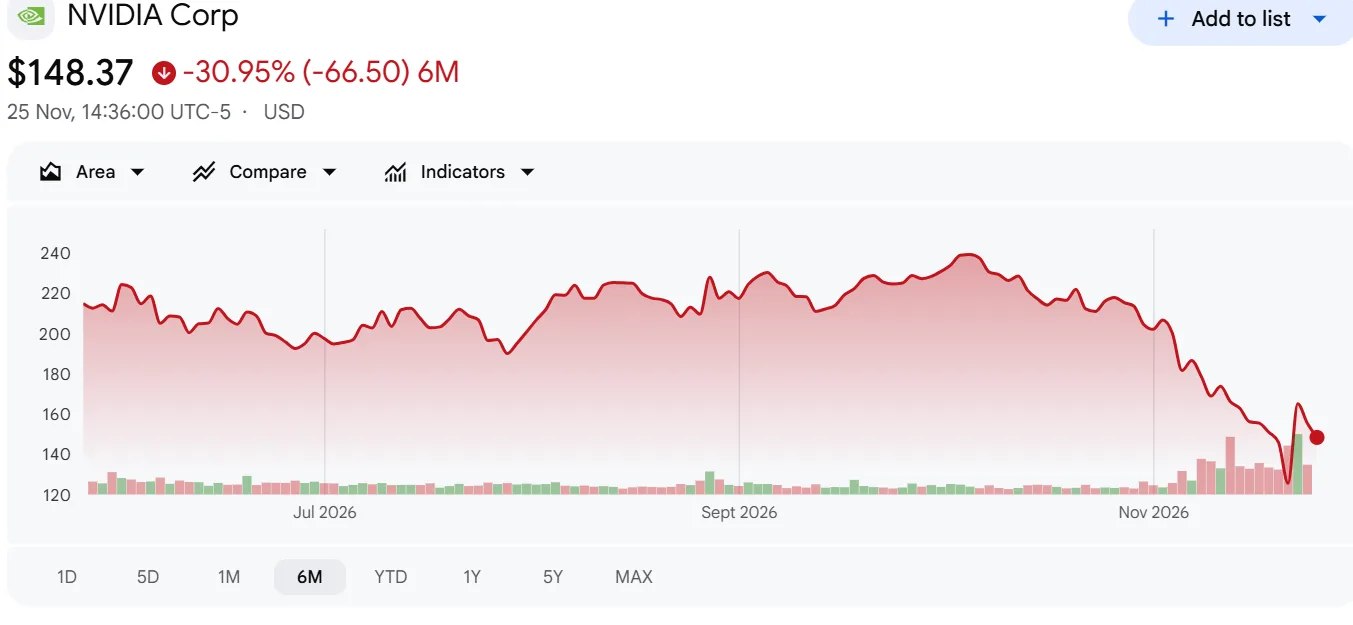
The mounting pressure has weighed on Nvidia's stock, which, according to Google Finance, is trading around $148, representing a 5% drop. The stock fell to $141 during intraday trading, an almost 10% decline, though it has since recovered slightly while remaining below recent peaks.
Over the past two days, NVDA has shed more than 10% of its value amid a broad market rout that has left the AI and crypto sectors in the red. The stock showed signs of recovery after Jensen Huang's reinstatement as CEO, rising 31%, but negative sentiment abounds: NVDA is still down 30% over the past month and has lost over $2 trillion in market capitalization since its peak in early October.
Meanwhile, Reuters reported on Nov. 25 that the U.S. Department of Justice had not formally investigated Huang before his reinstatement. Nvidia's independent investigation into the circumstances surrounding his resignation remains ongoing. For readers tracking the company's legal exposure, the markers to watch are the court's decision on the $290 million settlement, the progress of the separate class action against Huang and the company, the planned congressional inquiry, and the findings of Nvidia's independent investigation.
This article serves informational purposes only and does not constitute financial, investment or legal advice.
Source: The Market Periodical

