CLARITY Act Loses Key Law Enforcement Opposition as Senate Procedural Vote Nears
Key Takeaways
- •The National Sheriffs' Association shifted from opposing the CLARITY Act to a neutral position in a September 3 letter to Senate leaders.
- •The Senate's cloture vote on the motion to proceed to H.R. 3633 is scheduled to ripen on September 15 at 2:15 p.m., and contested cloture generally requires 60 votes.
- •The September 15 vote would only decide whether the Senate formally takes up the bill; final passage, House agreement on identical text, and presidential action would still be required.
- •The House has already passed its version of H.R. 3633.
- •The Federal Law Enforcement Officers Association endorses the bill while seeking revisions to DeFi provisions, and banking groups want Section 404 tightened to block deposit-like stablecoin rewards.
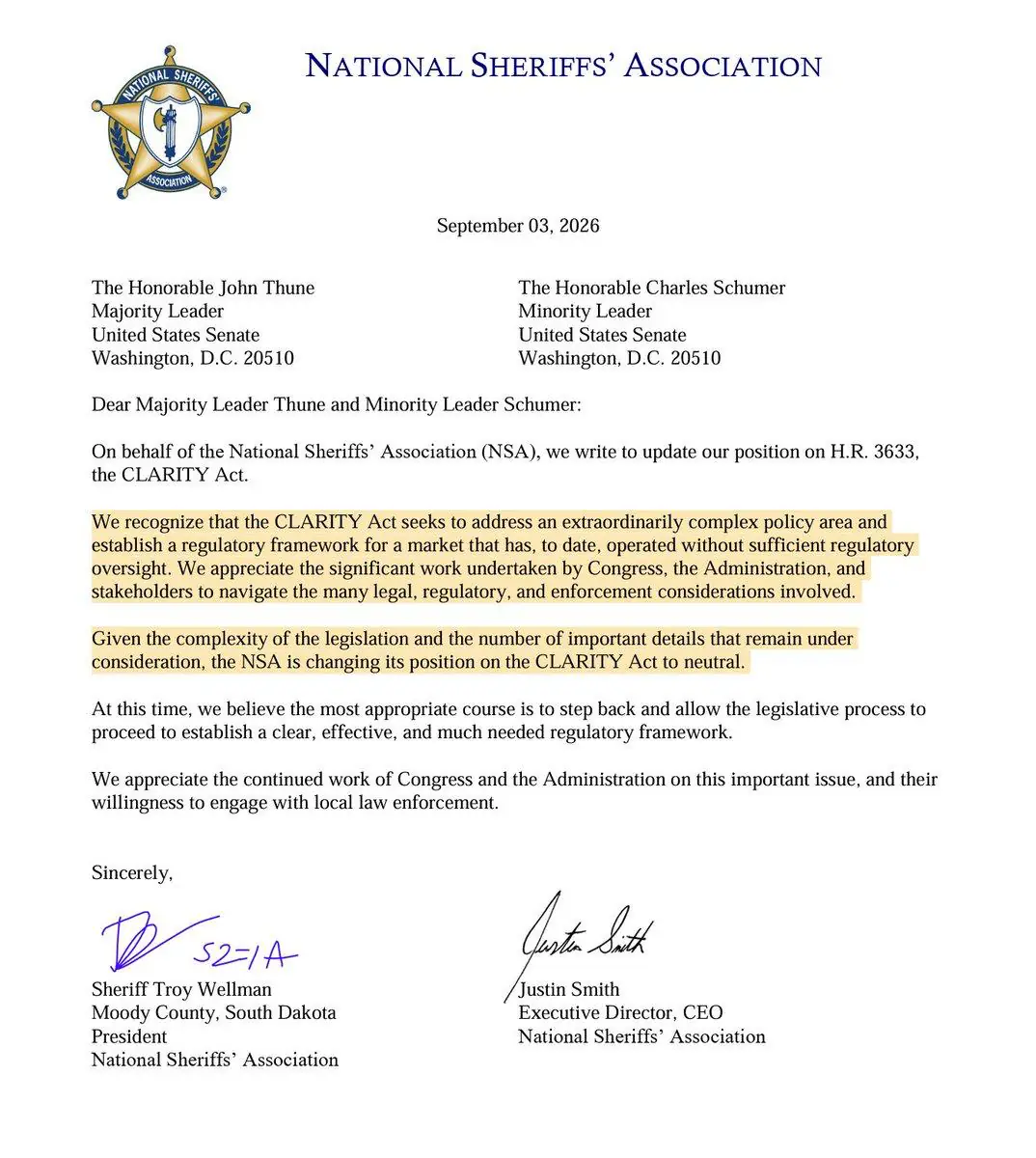
The National Sheriffs' Association (NSA) has shifted its stance on the Digital Asset Market CLARITY Act from opposition to neutrality, removing a notable law enforcement obstacle as the Senate approaches a key procedural vote on the bill.
The CLARITY Act, introduced as H.R. 3633, is a market-structure bill that would establish a federal regulatory framework for digital assets, including how crypto exchanges and other market participants are overseen and how jurisdiction is divided among regulators. Its backers argue the bill would give firms clearer rules, while critics have raised concerns about provisions covering decentralized finance and law enforcement authority.
According to Semafor, an administration official shared the association's September 3 letter to Senate leaders. "Given the complexity of the legislation and the number of important details that remain under consideration, the NSA is changing its position on the CLARITY Act to neutral," the letter states (Semafor).
The group is no longer urging senators to reject the bill, but it is not endorsing it either. In its letter, the association says it wants to step back and allow Congress to continue working on a digital-asset regulatory framework.
September 15 is a vote to begin, not finish
The Senate's published schedule indicates that cloture on the motion to proceed to H.R. 3633 will ripen on September 15 at 2:15 p.m. (Senate floor schedule). Senators are not voting that day on whether the CLARITY Act becomes law. They will first decide whether to end debate on the motion to proceed.
A successful cloture vote would clear the way for the Senate to vote on formally taking up the bill, after which CLARITY would enter floor consideration. Cloture on a contested measure generally requires 60 votes, making the outcome an early test of whether supporters have assembled a workable Senate coalition.
In short, the September 15 vote answers one narrow question: can the Senate formally take up CLARITY? Whether the bill becomes U.S. law remains undecided — the Senate still needs to debate and pass a final text, and the House and president have further roles to play.
Five more steps after a procedural win
Clearing the motion to proceed would open the following sequence, none of which is automatic:
- Senate takes up CLARITY. A separate motion-to-proceed vote would put the bill before the Senate.
- Senators amend the text. Floor debate can produce changes needed to win final support.
- Senate passes its version. The chamber must approve a final bill before it can send it back to the House.
- Congress agrees on one text. House and Senate must approve identical wording if the Senate changes the bill.
- The president acts. The agreed bill then goes to the president for signature or veto.
The House has already passed its version of H.R. 3633. If the Senate changes the bill during floor consideration, the two chambers must settle on identical wording before it can move to the president's desk.
Support has grown, while demands for changes remain
The NSA's neutral position follows an endorsement from the Federal Law Enforcement Officers Association (FLEOA). FLEOA supports CLARITY while seeking revisions to the provisions covering DeFi developers, protocol operators and criminal liability (Coindoo).
Banking groups are focused on a different part of the bill. The American Bankers Association, the Independent Community Bankers of America and 76 state banking associations want Section 404 tightened to prevent platforms from offering stablecoin rewards that function like interest on bank deposits (Coindoo).
The two campaigns could shape different parts of the Senate debate. Law-enforcement groups are concentrating on DeFi responsibility and investigative authority, while banks are pressing for stricter limits on deposit-like stablecoin rewards. Those pressure points indicate where amendments are most likely to be offered if the bill reaches the floor.
The Senate reached this stage after missing its August opportunity to take up the bill (Coindoo). Clearing the September 15 procedural vote would move those unresolved questions onto the Senate floor.
What the result will show
A yes vote on September 15 would put CLARITY on the Senate floor and begin the fight over amendments and final passage. A no vote would show that removing the NSA's opposition was not enough to assemble a 60-vote coalition.
September 15 will answer one narrow but important question: whether the Senate is ready to take up crypto market-structure legislation at all.
This article is for informational purposes and does not constitute legal, financial or investment advice.
