Norway weighs ban on facial recognition in smart glasses but sets no deadline
Key Takeaways
- •Norwegian Digitalisation Minister Karianne Tung announced plans to tighten smart glasses regulation, potentially including a ban on facial recognition in public spaces, but set no timetable and will first appoint an expert group.
- •Norway's Consumer Council, through digital policy head Finn Lützow-Holm Myrstad, called on retailers to remove smart glasses from shelves until legal questions are clarified, arguing a feature ban would not stop covert filming.
- •Documented incidents include women secretly filmed with Ray-Ban Meta glasses and clips posted to TikTok in January, and Nairobi-based contractors reviewing sensitive recordings while training Meta's AI in February.
- •Meta has faced broader scrutiny, including an April call from the ACLU and 75 organizations to scrap facial recognition on the glasses, a Texas attorney general investigation opened in May, and a July patch after users bypassed the recording indicator light.
- •As an EEA member, Norway is influenced by the EU's GDPR and the AI Act, which restricts real-time remote biometric identification in public spaces by law enforcement.
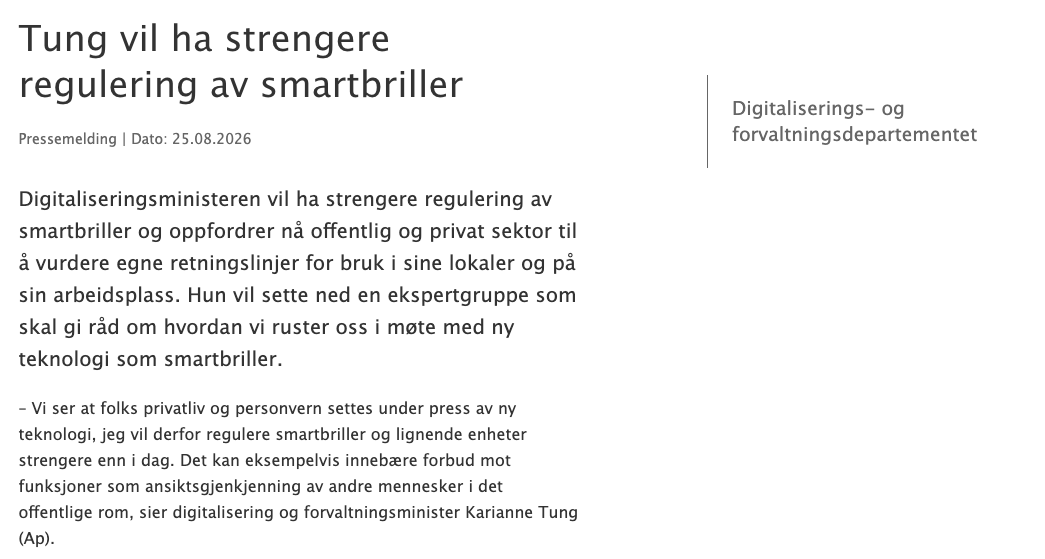
Norway will tighten regulation of smart glasses and could ban facial recognition in public spaces, according to Digitalisation Minister Karianne Tung. However, she has set no deadline for action and will first convene an expert group to advise the government. Any Norwegian move would unfold against a backdrop of broader European scrutiny of biometric surveillance: as an EEA member, Norway is shaped by the EU's GDPR privacy rules and the EU AI Act, which restricts real-time remote biometric identification in public spaces by law enforcement and is expected to influence how consumer facial recognition products are treated across the region.
Tung asks agencies and companies to write their own rules
Cameras and microphones are now embedded in everyday devices — from glasses to earbuds to caps — and are connected to artificial intelligence. Norway "must avoid this equipment being used to monitor other people in public spaces," Tung said.
The minister will establish an expert group to counsel the government on consumer protection. In the meantime, she has asked private companies and public agencies to draw up their own guidelines.
Myrstad says a ban would not stop covert filming
No timetable has been set. One example of what tougher rules could look like would be a ban on facial recognition technology.
Norway's Consumer Council went further than the minister. Finn Lützow-Holm Myrstad, the council's head of digital policy, said retailers should remove smart glasses from shelves until the legal questions are clarified.
Myrstad noted that Meta's facial recognition capability is already built and ready to ship. Banning that one feature, he argued, would not stop a wearer from filming strangers without their knowledge. He described the potential for abuse as "enormous."
Concerns around the devices are not hypothetical. In January, women approached in public were secretly filmed with Ray-Ban Meta glasses, and the clips were posted on TikTok. In February, contractors in Nairobi hired to train Meta's AI were reported to have reviewed recordings of people undressing, using bathrooms, and having sex.
In April, the ACLU and 75 other organizations called on Meta to scrap facial recognition on the glasses. In May, Texas Attorney General Ken Paxton opened an investigation.
In July, Meta patched its devices after users discovered a way to defeat the light meant to signal that recording is in progress.
The regulatory pressure comes as Meta pushes deeper into wearable computing. The Facebook maker launched its $799 Ray-Ban Display glasses in September 2025, its first Ray-Bans with a built-in augmented reality screen, as Cryptopolitan reported. Part of the device is managed by a neural band worn on the wrist that reads nerve signals from the forearm.
A less expensive Ray-Ban Meta model sells for $379. Those glasses include an LED that illuminates when the camera is recording. What to watch next is whether Norway's expert group recommends binding legislation or voluntary measures, and whether other European regulators follow its lead on facial recognition in consumer wearables.
