CES Shows Lackluster Nonfarm Payroll Growth While CPS Trend Raises Concerns
Key Takeaways
- •The CES establishment survey reports lackluster nonfarm payroll employment growth based on employer payroll data, while the CPS household survey shows a more worrying employment trend.
- •The CES counts jobs, meaning individuals with multiple positions are counted more than once, whereas the CPS counts employed individuals and includes self-employed and agricultural workers excluded from the CES.
- •Both surveys are closely scrutinized by the Federal Reserve, Treasury officials, and private economists as key indicators of employment, wage pressures, and overall economic momentum.
- •Persistent divergence between the CES and CPS has historically fueled debate about the true state of labor demand, especially when multiple jobholding or gig-economy activity widens the gap.
- •Analysts prefer tracking multi-month moving averages of both measures over single-month data releases, as each survey carries meaningful revision risk and sampling variability.
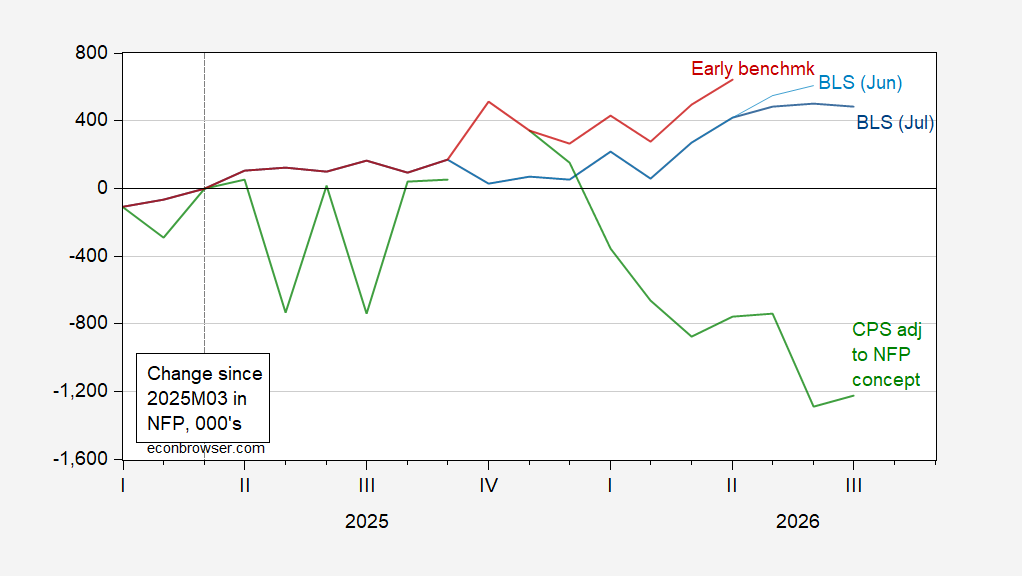
The latest estimates of nonfarm payroll employment present a mixed picture of the US labor market. According to the Current Employment Statistics (CES) survey conducted by the US Bureau of Labor Statistics, nonfarm payroll employment growth remains lackluster.
Meanwhile, the trend in the Current Population Survey (CPS) measure — also administered by the Bureau of Labor Statistics and commonly referred to as the household survey — is described as somewhat worrying.
The CES, also known as the establishment survey, draws its data from employer payrolls and is the primary source for monthly nonfarm payroll employment figures. The CPS, conducted jointly by the US Census Bureau and the BLS, gathers data directly from households and serves as the source for the national unemployment rate.
The two surveys can diverge due to differences in methodology and coverage. The CES counts jobs, meaning a worker holding two positions is counted twice, while the CPS counts employed individuals. Additionally, the CPS captures self-employed workers and agricultural workers, who are excluded from the CES.
The CES and CPS are among the most closely watched economic indicators released each month, scrutinized by the Federal Reserve, Treasury officials, and private-sector economists for signals about the trajectory of employment, wage pressures, and overall economic momentum. Persistent divergence between the two surveys has historically prompted debate about the true underlying state of labor demand, particularly when shifts in multiple jobholding, self-employment, or gig-economy activity widen the gap. Analysts typically track the two measures over multi-month moving averages rather than single-month prints, as both surveys carry meaningful revision risk and sampling variability.
Source: Econbrowser
