Cisco, NITDA and Meta Account for 85% of Nigeria's Digital Literacy Training as Dashboard Shows Just 5.54% of 2027 Target
Key Takeaways
- •NITDA's newly launched National Digital Literacy Dashboard records 2,769,512 training achievements from 252 reporting organisations since January 2022, representing about 5.54% of the 50 million-person goal tied to 70% digital literacy by 2027.
- •Cisco, NITDA and Meta are responsible for roughly 85% of all reported achievements, with Cisco's 1,073,604 total coming from only four trainings and Meta's 333,816 from five, indicating the national tally rests on a few large-scale programmes.
- •The dashboard lists 2,770,240 people as verified digitally literate, leaving 47,229,760 to be reached, roughly 17 times the current figure since tracking.
- •Youth under 35 account for about 76% of beneficiaries and informal-sector workers about 58%, while female participation stands at 32.9% and rural beneficiaries represent only around 2% of the total.
- •The 50 million-person target on the dashboard differs from the 30 million figure NITDA cited when the DL4ALL initiative began its first phase with National Youth Service Corps members across 12 states, and the announcement does not explain the discrepancy.
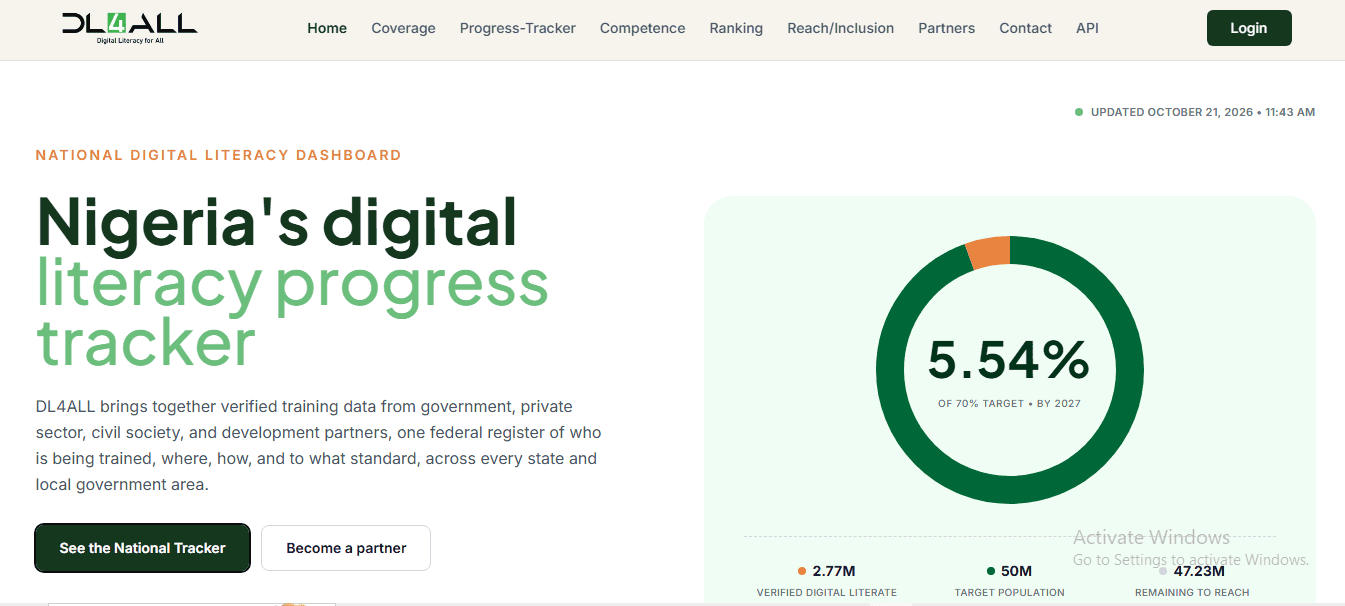
The National Information Technology Development Agency (NITDA) has launched a National Digital Literacy Dashboard recording 2,769,512 reported training achievements, with three organisations responsible for roughly 85% of the total and overall progress standing at 5.54% of the country's 2027 target.
The agency announced the dashboard in a post on its official X account. The figures cover 252 active reporting organisations, all 774 Local Government Areas and 14,664 communities, with data tracked since January 2022. The dashboard is publicly accessible online, so progress toward the national targets can be followed by anyone.
Who Is Doing the Training?
Cisco, the US networking equipment maker, reported 1,073,604 training achievements, about 39% of the total. NITDA follows with 960,424, roughly 35%, while Meta Platforms Inc., the parent company of Facebook, Instagram and WhatsApp, recorded 333,816, or about 12%. Together, Cisco and NITDA account for about 73%.
The contributor table highlights how uneven the counts are. Cisco's total derives from just four trainings and Meta's from five, while NITDA's figure comes from 38,554. In practice, the national tally rests on a handful of large-scale programmes rather than broad participation across the 252 reporting organisations.
The remaining 249 organisations share the leftover 401,668 achievements. Among them are Imo Digital City Limited, the Sokoto State Ministry of Innovation and Digital Economy, the Bureau for ICT and Digital Economy, and digital development agencies in Jigawa, Kaduna and Zamfara. The Centre for Information Technology and Development (CITAD) is also listed.
The 50 Million Target
The dashboard lists 50 million Nigerians as the number that must be reached for the country to attain 70% digital literacy by 2027. It currently shows 2,770,240 people verified as digitally literate, leaving 47,229,760 to go — roughly 17 times the number verified so far since tracking began in January 2022. A trend chart shows the share of the target reached rising each year since 2022, with the latest stretch drawn as a dotted line.
That figure differs from the 30 million NITDA cited when the Digital Literacy for All (DL4ALL) initiative began its first phase in partnership with the National Youth Service Corps, according to Techpoint Africa. The announcement does not explain the discrepancy.
DL4ALL's first phase deployed corps members as trainers across 12 states, including the Federal Territory. At the time, NITDA's Director-General, Kashifu Inuwa Abdullahi, said corps members were well placed to serve as “digital literacy champions” in their communities, according to the same report.
Who Is Being Reached?
Youth under 35 account for 2,092,697 of the total, about 76%, while female participation stands at 32.9%. Informal-sector workers make up 1,609,183, roughly 58%, and 17,156 beneficiaries are persons with disabilities. Rural beneficiaries number 65,767, only about 2%. Nearly all recorded trainings — 99.5% — sit at the foundation level, and most are delivered in person. The profile shows how much of the population the drive has yet to reach.
NITDA says the dashboard will help identify gaps, reduce duplication and improve resource allocation. The agency ties the targets of 70% digital literacy by 2027 and 95% by 2030 to President Bola Ahmed Tinubu's priority areas, including digitisation and industrialisation. Against that benchmark, the rural share, female participation and the concentration of output among three organisations are the figures to watch as the 2027 deadline approaches.

