Ninepoint launches first US-listed ETF betting on North American energy integration
Key Takeaways
- •Ninepoint Partners began trading the Ninepoint North American Energy Independence ETF (ENRG) on NYSE Arca on September 22, marking its first entry into the U.S. exchange-traded fund market.
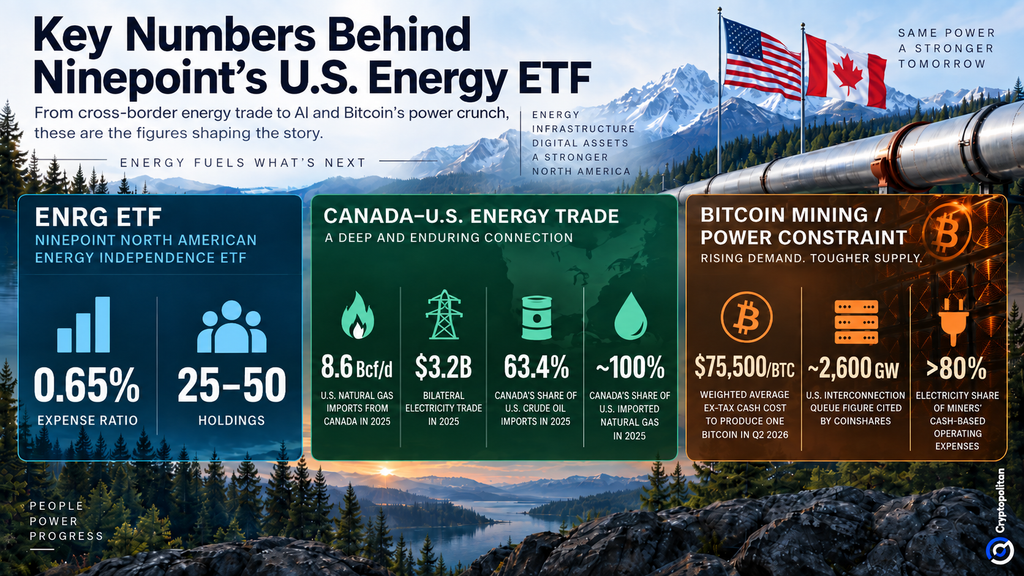
- •ENRG is an actively managed fund holding 25 to 50 stocks with a 0.65% expense ratio, covering oil and gas production, pipelines, nuclear power and uranium, and copper and critical minerals, with Tidal Investments as adviser and Ninepoint Partners as sub-adviser.
- •The fund's thesis relies on enduring Canada-U.S. energy integration, supported by 2025 figures showing Canada supplied 63.4% of U.S. crude oil imports and nearly 100% of U.S. natural gas imports.
- •Co-CEO John Wilson said about two-thirds of the fund's oil and gas producers will be U.S.-based, while Canadian operators will dominate its pipeline, uranium, copper, and metals holdings.
- •The launch connects to grid capacity constraints affecting both Bitcoin miners and AI data centers, with the U.S. interconnection queue near 2,600 GW and mining firms such as Core Scientific, Cipher, and IREN repurposing sites toward AI and high-performance computing.
Toronto-based asset management firm Ninepoint Partners began trading its first U.S.-listed fund on September 22, wagering that the energy links uniting Canada and the United States will endure beyond the trade rifts roiling the shared border. The product marks the firm's debut in the U.S. exchange-traded fund market.
The Ninepoint North American Energy Independence ETF, which trades on NYSE Arca under the symbol ENRG, aggregates companies involved in oil and gas production, pipelines, nuclear power and uranium, and copper and critical minerals into one actively managed portfolio.
That combination also places the fund at the center of a problem cryptocurrency miners know well: access to power. Grid connections and approved sites increasingly determine whether a Bitcoin miner continues mining or directs capacity toward artificial intelligence and high-performance computing (HPC), with miners and data centers now drawing from the same constrained pool of grid capacity.
What ENRG actually holds
ENRG holds between 25 and 50 stocks and charges an expense ratio of 0.65%. Its portfolio spans energy supply, transport infrastructure, nuclear energy and uranium, and electrification inputs including copper and critical minerals — materials that underpin grid expansion. The fund concentrates on Canada, Mexico and the United States, although up to 10% of its investments may sit outside North America, a provision that gives the manager flexibility beyond the core region. Its SEC filing confirms the 0.65% management fee and names Tidal Investments as adviser, with Ninepoint Partners as sub-adviser.
Unlike index-tracking ETFs that mirror a fixed benchmark, an actively managed structure lets the adviser reweight holdings across these sectors as conditions change — a relevant distinction for a fund built on a multi-sector argument rather than exposure to a single commodity.
Ninepoint co-CEO John Wilson told Reuters that about two-thirds of the fund's oil and gas producers will be based in the United States, while Canadian pipeline operators and uranium, copper and other metals miners will make up most of those asset classes.
The thesis: integration outlasts the rhetoric
Wilson's reasoning is straightforward: the two nations' dependence on cross-border energy was established long before the current government came into power, and it will not be dismantled simply because political leadership has changed.
“It would be naive to think that the headline stuff is going away any time in the next two years,” said Wilson.
Trade statistics illustrate how strong those connections are. Per the U.S. Energy Information Administration (EIA), American natural gas imports from Canada averaged 8.6 billion cubic feet per day in 2025. Electricity trade totaled $3.2 billion, with imports from Canada accounting for 67% of the turnover. According to the Canada Energy Regulator, Canada accounted for 63.4% of U.S. crude oil imports and nearly 100% of the natural gas imported by the U.S. over the same period. Both agencies release recurring trade data, giving observers periodic checkpoints on whether those ratios hold steady or drift as the political standoff plays out.
Ninepoint portfolio manager Eric Nuttall attributes this deep dependency to energy security.
“Energy security stopped being an abstraction with Russia's war in Ukraine and China's export controls on rare earths,” said Nuttall.
Where crypto mining meets the power fight
Ninepoint's demand thesis ties directly into crypto mining, an energy-intensive industry in which site selection has long hinged on securing low-cost power. According to the International Energy Agency (IEA), data center electricity demand increased by 17%, and grid connections, transformer stations and other infrastructure remainlenecks for providing new connections. Cryptopolitan has reported that the ongoing build-out of OpenAI's computing capacity is bringing increasing value to power, land and existing interconnections — a dynamic that raises the worth of mining sites already wired into the grid.
The pressures are already apparent in mining economics. CoinShares estimated the weighted average ex-tax cash cost of producing one Bitcoin at around $75,500 as of Q2 2026. The firm cited the U.S. interconnection queue's staggering figure of approximately 2,600 GW — waiting lists that have become a key gauge of grid congestion — while the latest available report from Berkeley Lab showed that more than 2,060 GW of active generation and storage were in queue awaiting a grid connection at the end of 2025. The discrepancy likely reflects differing queue definitions and reporting dates, so the figures should not be taken as exact equivalents. CoinShares revisits its cost estimates in quarterly mining reports, and Berkeley Lab publishes updated queue snapshots, so both figures offer recurring reads on how tight the race for grid access has become.
According to the Cambridge Centre for Alternative Finance, electricity represents over 80% of miners' operating expenditures. Given how expensive and limited power has become, Core Scientific, Keel, Cipher and IREN are scaling down their mining capacity or discontinuing it by repurposing their installations for AI and HPC.
The effect on crypto is indirect but still meaningful. If electricity in North America becomes more costly or less reliable, miners will seek other sources of cheap, dependable power. For miners, the calculus increasingly mirrors that of any large industrial power consumer: secure low-cost, reliable electricity or relocate. ENRG by itself will not move Bitcoin's price, but it is tied to the same constraints that shape Bitcoin mining as a whole.
Source:Cryptopolitan](https://www.cryptopolitan.com/ninepoint-launches-us-energy-etf-as-ai-and-bitcoin-miners-fight-for-the-same-power/)

