NIGHT Up Over 75%: What Could Put the Rally at Risk?
Key Takeaways
- •NIGHT traded near $0.0409 on October 1, still roughly 77.5% above its September 25 price of about $0.0230 despite the pullback.
- •The token broke above a long descending trendline after months of lower highs, and September pullbacks held above July and August lows while the latest advance cleared earlier September highs.
- •The 14-period relative strength index stood near 86.6, well above the conventional overbought threshold of 70, reflecting the speed of the rally.
- •The 200-day simple moving average near $0.0303 sits within a $0.030–$0.031 support zone, and a drop there from $0.0409 would represent a decline of roughly 26%.
- •Midnight uses zero-knowledge proofs to verify claims while keeping underlying data private, charges transaction fees in non-transferable DUST generated by registered NIGHT holdings, and allows application providers to sponsor user fees, as demonstrated by the Midnight Messenger beta on the Preprod network.
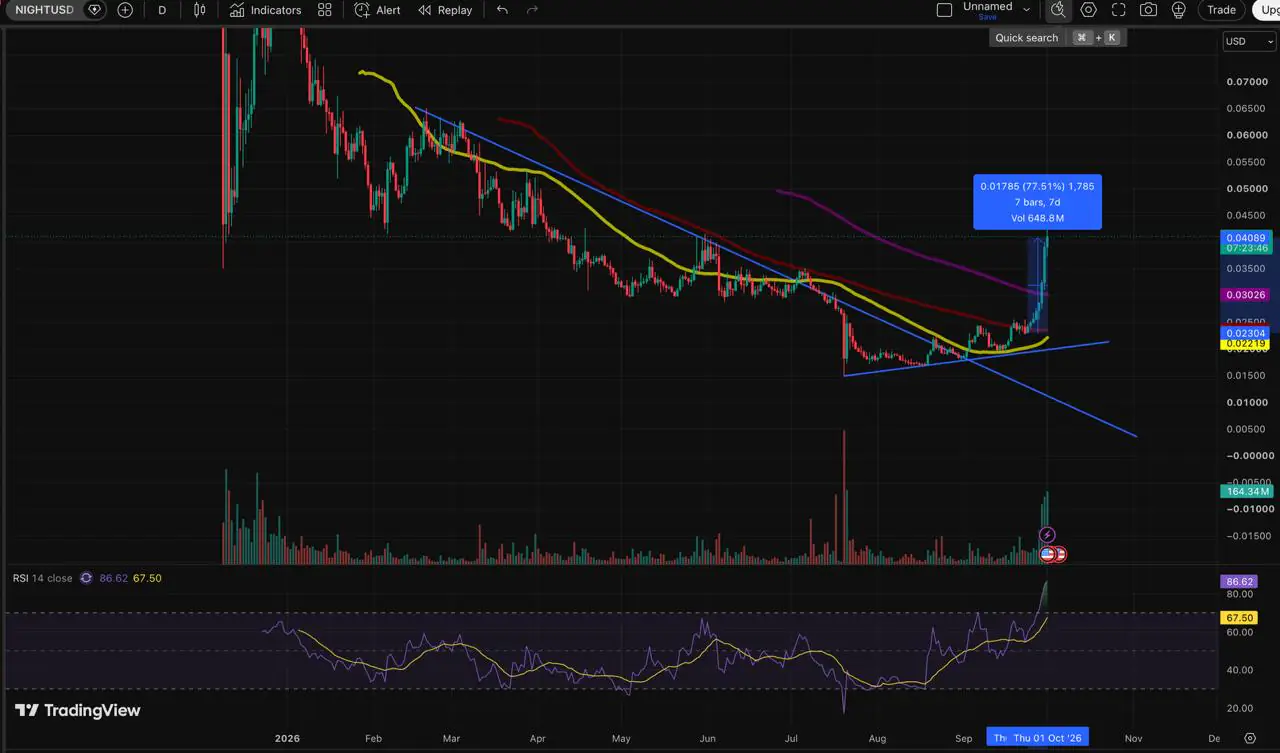
NIGHT pulled back to near $0.0409 on October 1, yet the token remains roughly 77.5% above its September 25 price of about $0.0230. Sellers have trimmed a larger gain, but the retreat has so far preserved most of the advance.
The move higher coincided with a broader recovery across altcoins, and NIGHT appeared among the tokens flagged in a review of the broadening altcoin rally. For NIGHT, the latest surge built on a recovery that had begun before it.
How NIGHT broke the pattern of falling highs
For much of the year, NIGHT printed lower highs as sellers halted each rebound below the previous one. A long descending trendline traces that pattern, and the token's climb above it ahead of the late-September rally offered the first sign that buyers were starting to overcome the pressure that had kept prices falling.
September's pullbacks then held above the July and August lows, while the most recent advance cleared the earlier September highs. Those higher lows and the new higher high strengthened the reversal case: buyers were defending declines sooner and carrying rebounds further.
The speed of the latest rally has nonetheless stretched momentum. The 14-period relative strength index (RSI) stood near 86.6, well above the conventional overbought threshold of 70. Such a reading reflects strong recent gains but cannot tell traders when the rally will end; in strongly trending markets, momentum indicators can hold overbought territory for extended stretches while prices keep climbing.
A pullback can therefore occur while the uptrend survives. What would weaken that case is a series of failed rebounds followed by lower lows. The response at support will help show whether buyers are pausing after the surge or losing control of the recovery.
Where buyers could defend the rally
The nearest moving average below NIGHT is the 200-day simple moving average (200 SMA), near $0.0303, a widely followed gauge of the longer-term trend. It sits within the $0.030–$0.031 area where price traded repeatedly earlier in the year, making that zone worth watching if the pullback deepens.
Reaching the 200 SMA from $0.0409 would mean a decline of roughly 26%. Even if buyers defended it and kept the broader recovery intact, that would be a substantial loss for someone entering after the surge. The deeper references sit around the rally's starting point and the rising trendline.
If NIGHT tests $0.030–$0.031, closes above the zone and sustains a rebound, buyers would have evidence that the area is attracting demand. A close below it, followed by a failed reclaim, would shift attention toward the 100 SMA at $0.023–$0.024. Falling through that second zone would erase most of the gain recorded since September 25. The 50 SMA and the rising trendline sit below it, and losing the trendline followed by a break of the preceding swing low would undermine the higher-low structure that supports the recovery.
Because the October 1 candle was still open when the chart was captured, a completed daily close and the next rebound would carry more weight than a brief move through support.
What Midnight lets an application keep private
The rally has also brought attention to the technology behind NIGHT. Midnight lets applications verify information without publishing all of the underlying data. It uses zero-knowledge proofs to check a claim while keeping the sensitive details behind it private — a contrast with the default on many public blockchains, where recorded transaction data is generally visible to anyone.
An application could, for example, verify that someone is over 21 without revealing their full date of birth. The person provides suitable identity evidence, and the application checks the age requirement. This limits unnecessary disclosure, although the proof still needs reliable identity evidence to establish a meaningful result.
Financial applications could use the same approach to check eligibility while protecting customer information. For NIGHT holders, the commercial relevance depends on whether those services generate demand for the resources needed to run transactions.
How application use connects to NIGHT
Midnight charges transaction fees in DUST, a resource generated over time by registered NIGHT holdings. Transactions consume DUST while the NIGHT remains held. Because DUST is non-transferable and is used to pay network fees, generating it should not be confused with earning cash interest.
Application providers can sponsor those fees, allowing users to access a service without buying NIGHT themselves. A September 29 Midnight Messenger developer update described this approach for identity registration on the Preprod testing network, with mobile apps in team beta. The provider arranges transaction capacity on the users' behalf.
Growth in users could consequently increase demand for that capacity without creating a NIGHT purchase for every new account. How providers obtain and manage DUST will help determine how application activity translates into demand for the token.
That demand also needs to be considered alongside scheduled token releases. Midnight's distribution guide sets out four 25% instalments, with staggered starts and subsequent 90-day intervals. These releases make allocated tokens available to holders on a recurring schedule, although selling depends on what recipients choose to do.
Usage data showing recurring demand for DUST would give investors a firmer basis for judging adoption. The Messenger beta shows how fee sponsorship can work; regular application activity would help establish that design is creating lasting demand beyond the interest generated by NIGHT's rally.
This article is for informational purposes only and does not constitute investment advice. Technical levels are approximate and do not guarantee future price movements.

